

December 29, 2024.
The sun is high, the beer cans are out, Melbourne is washed in summer and joie de vivre.
Jasprit Bumrah, in crisp whites with blue details, is bowling to Mitchell Marsh. The ball pitches just short of good length—what the Aussies call the “hard length”—and rears up, towards Marsh’s torso. Marsh, surprised by the bounce, can only offer the ball his glove.
Two deliveries later, Bumrah pitches a couple of inches fuller, inviting Alex Carey to drive. The ball doesn’t bounce as much this time, but skids, almost gaining pace on its path. Carey drives, but by the time his bat reaches the bottom of its arc, the ball has already snaked past him, into the timber.
On commentary, Harsha Bhogle is exuberant. “Stop it, Jasprit Bumrah! We’re running out of words to describe you, and Australia are running out of batters to play you.” The famous Melbourne Cricket Ground, where the first ever Test match was played 147 years ago, reverberates with the sound of plastic vuvuzelas and dhol.
Australia are 91-6 in their second innings, leading by 196. It’s something, but not enough. The winner of this match—the fourth of the series—will go up 2-1, with only the last match left to come.
***
March 18, 2001.
The shadows lengthen across the M.A. Chidambaram Stadium, or Chepauk, as the shorthand goes. The sea breeze flowing inwards from the Bay of Bengal bounces off its circular concrete structure. Matthew Hayden, batting on a three-digit score, presses his left hand on his navy green helmet, and a stream of sweat flows out from the brim. In that moment, it feels oddly fitting that the Australian kits are sponsored by Kelvinator—a home appliances company best known for manufacturing fridges.
Forgotten from the national setup after a brief debut run in 1993, Hayden has come back as a force of nature. He prepared for this tour by batting for hours on dug up pitches at home. Hayden was always a good player of fast bowling, but that prep gave him tools to use his six-foot-three frame and a surfer’s crouch to devastating use against spin.
Cue: a century in Mumbai, two sparkling fifties in Kolkata, and another century here in Chennai. Over a thousand minutes of batting, and counting, not once has he looked uncomfortable.
Worryingly, he also seems to have slept off the Kolkata shock. He meets Harbhajan with ferocity, pre-empting and then neutralising his drift and turn. The other bowlers are smacked with disdain. Even as the heat mounts, he looks at ease, wiping off sweat and setting up for the next delivery like an ultra marathoner midway through his race.
India have played into Australia’s hands by picking a lopsided bowling attack with only one seamer—Zaheer Khan. While there is merit in going spin-heavy, the lack of seam-bowling options on a fresh pitch is an exposed wound.
Finally, thankfully, the sun dips westward and the umpire calls for end of play. Australia are 326-3. Hayden 147 not out; Steve Waugh 43 not out. The afterglow from Kolkata has been brutally smothered.
***
Many years back, on the same patch of land, a man with broad shoulders and muscular arms stood behind the practice batting strips. He wore a floppy hat and running shorts. Every few minutes, he would grab a red ball, wrap his fingers along the seam, and bring his right arm up and down in a bowler’s motion. And he stood there until twilight, even as his neck went red from the sun and dirt.
A dozen or so teenagers, oversized white shirts hanging off their wiry bodies, stood nearby in a semi-circle, their eyes and ears tuned to him as if they were medical students listening to a surgeon.
After all, he was there to fix a blind spot.
In the late 1980s, Indian cricket had a lot going for them. The surreal World Cup triumph in 1983 was supplemented by the Benson & Hedges tournament win in Australia and a Test series win in England. Around these marquee events, they also bagged an Asia Cup and Rothmans Cup title each. They co-hosted the 1987 World Cup—the first time the tournament had travelled outside England—and reached the semi-finals.
Despite all this glitter, they lacked the one key component of every great team: fast bowlers. India did not know how to produce one. Their fastest bowler wouldn’t qualify as fast outside the subcontinent. All their success, through history, was pegged squarely on gifted and gutsy batters, and an armada of spinners.
So, Ravi Mammen, the managing director of the Madras Rubber Factory (MRF), planted the foundation stone to create a fertile ground. The first call to design the programme for the MRF Pace Foundation went to Australia. If someone was going to instil pace as a function of physicality, fitness, nutrition, and philosophy, it had to be Dennis Keith Lillee—the greatest fast bowler from a country that supplied fast bowlers on a conveyor belt.
A decade or so later, a young Zaheer Khan would board a train from Baroda to Chennai. He was tall and athletic, but weighed in the sixties. He left the foundation more than ten kilos heavier, all in muscle, ready to become India’s first 90 miles an hour bowler. It would take longer still for India to have a bench full of them.
***
March 19, 2001. Day Two.
The sun is visible above the roof of the stadium. Australia are cruising at 340-3, sights set on 500 and beyond.
Steve Waugh tries to sweep Harbhajan and misses the ball. The bowler and surrounding fielders go up in appeal; the umpire isn’t much interested. Meanwhile, away from everyone’s attention, the ball has bounced up from Waugh’s pad, landed nearby, and backspun towards the stumps. Instead of tapping it away with his bat, Waugh has used his right palm. The game pauses for a couple of seconds until everyone realises that the Australian captain has found the rarest and most needless way of getting out.
Ricky Ponting lasts one ball against Harbhajan’s drift. Gilchrist tries another aggressive sweep, and fails. His scores since that century in Mumbai—0, 0, 1.
The ominous shapes of 340-3 have turned into 344-6 in the space of ten minutes and six Harbhajan deliveries.
Hayden is now stepping up gears. One slog sweep climbs into the air and lands in the back rows of the upper deck. A breath or so later, he shimmies down the track and lifts Nilesh Kulkarni into the open space behind the sight screen. The Chepauk crowd is anxious for his wicket, but applauding him anyway.
Harbhajan gets Warne, Gillespie, and Colin Miller caught at three different spots. There is one battle he’s waging against Hayden’s force, another he’s winning blind against the rest of the lineup.
Hayden gets to his double century, and the Chepauk crowd rises as one to salute him. They’re in awe. It’s hard to remember a non-subcontinental batter conquering these conditions so thoroughly. He’s out a few minutes later, the last one to go, beaten in flight by a loopy Harbhajan off-spinner.
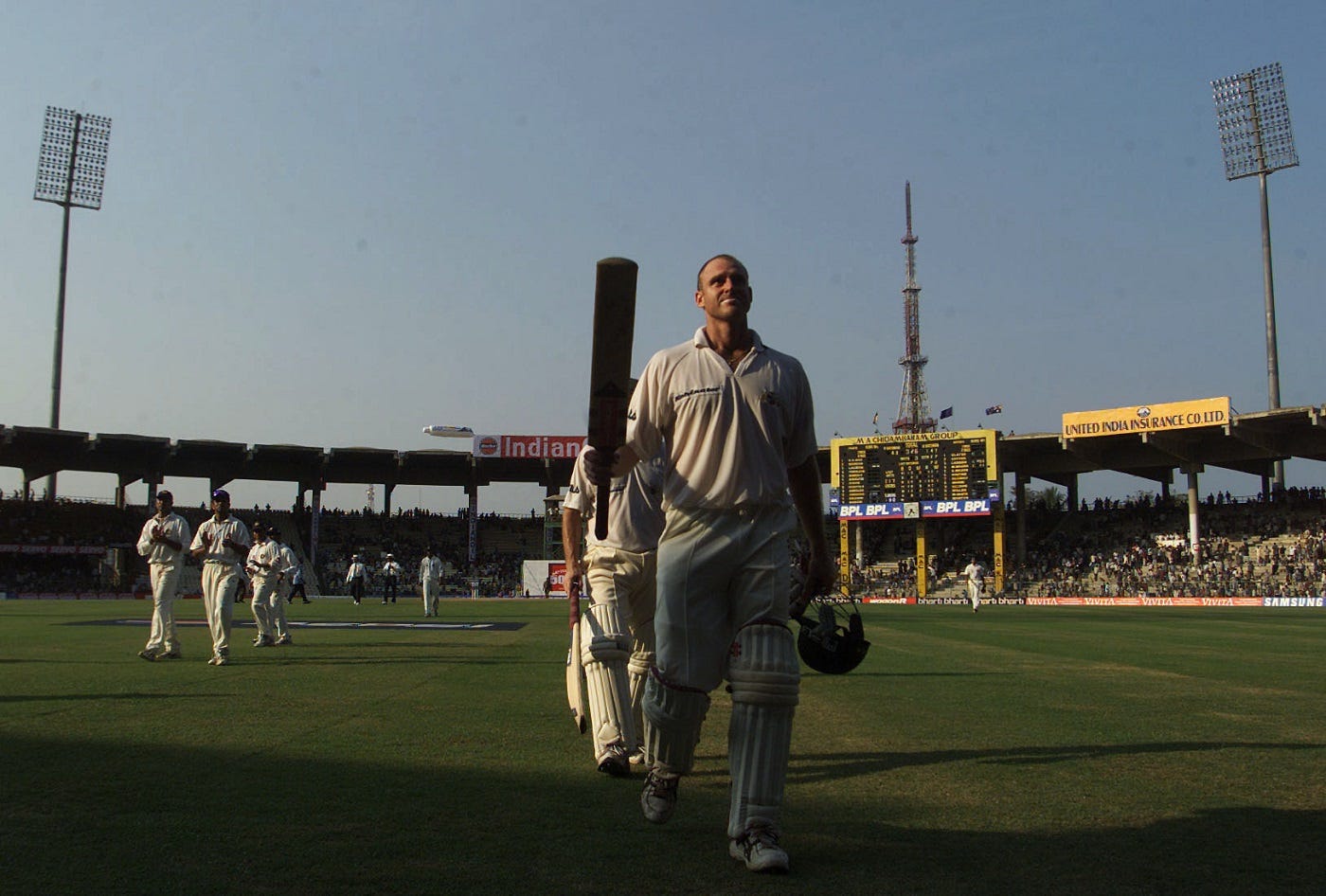
The crowd rises once more, to send him off with a standing ovation. The applause soars louder as Harbhajan follows behind him, finishing with seven wickets in the innings, maintaining the cadence from his thirteen wickets in Kolkata. Anil Kumble, his arm in a sling, watches on with brotherly admiration as his future partner falls into the embrace of an adoring crowd.
Australia, 391 all out.
***
There was a leitmotif to Indian batting in the 1990s. First, a pulsing anticipation; then the intoxicating thrill of watching Sachin Tendulkar tear apart the best bowling attacks in the world, his bat drawing neat and satisfying shapes in the air; and then the hush from his dismissal, as India’s hopes left with him.
The team wasn’t short of batting talent. You couldn’t call a lineup of Navjot Sidhu, Mohammed Azharuddin, Sanjay Manjrekar, Ajay Jadeja, Vinod Kambli, then a young Sourav Ganguly and Rahul Dravid, deficient. But when the stakes rose high, when pressure pressed into muscle, everyone looked at Tendulkar.
India’s two biggest matches from that decade illustrate their Tendependence™.
At the 1996 World Cup semi-final in Calcutta, Sri Lanka set India a target of 252. In those days, 252 was formidable, tough even, but nothing herculean. Tendulkar, already the tournament’s highest run scorer, lit up the evening with the sound of his sparkling, clean bat. While the rest seemed to freeze under the weight of the game, Tendulkar flourished, scything through Sri Lanka’s best bowlers at will. When he got out for 65—an unlucky deflection landing into the wicketkeeper’s path—India had only reached 90. From there, India plummeted to 120-8, as Calcutta’s disappointment boiled over into rage and manifested with bottles and burnt paper.
Three years later, India were 254-6, chasing 271 against Pakistan in Chennai. It was the first Test between the two nations in nearly a decade. Tendulkar was playing one of the all-time great Test innings. Then, he got out—partly to back spasms and partly to Saqlain Mushtaq’s trap—and India fell over in a heap, losing three wickets for four runs.
Pakistan took a victory lap as Chepauk gave them a dazy, heartbroken standing ovation. Tendulkar was inconsolable in the dressing room, and didn’t come out to receive his Player of The Match award.
The theme was consistent in debris and wealth. In 1998, India won five triangular ODI tournaments; Tendulkar scored centuries in four of those five finals.
As he climbed from boy wonder to someone Sir Don Bradman saw his reflection in, all an Indian ever wanted was for an ensemble cast that could form a cushion around his genius, give it space to breathe and fail.
***
March 21, 2001. Day Four.
India finish their first innings at 501.
Shiv Sunder Das has scored 84; Ramesh, 61; Laxman has airbrushed 65 of the most gorgeous runs you’d hope to see; and Dravid, refreshed and renewed from Kolkata, builds on his rhythm with 81. Hell, even Sairaj Bahutule has chipped in with 21.
Around them, Tendulkar’s 126 is a masterclass in control and precision. This is Tendulkar the accumulator, far less thrilling than his 90s version, but perhaps more efficient. For long periods, he looks serene and impregnable, as if nothing Australia have, not even McGrath and Warne, is good enough to get him. This is the first series in a decade where his batting contribution is noticed as a matter of fact and not the highlight.
Shane Warne finishes with figures of 42-7-140-2. He’s rarely looked less threatening than these last few weeks.
India’s lead of 110 should prove decisive, but there’s ample time left. Over to Harbhajan, once more.
***
Before Harbhajan can get to Australia, Hayden and Slater get to India. They hack down 80 runs off their deficit within an hour. Coach John Wright is sitting on a cane chair outside the home dressing room, exasperated and desperate. India cannot endure another hour of this.
Captain Ganguly is desperate too. He’s cycling through his companion spinners to find some breathing space for Harbhajan. Hayden plays another slog sweep. By now, he’s playing this shot on instinct, inevitably to great success. This one is only slightly mistimed, a little airy, and that’s all Zaheer Khan needs in the deep.
The wicket isn’t Harbhajan’s, but it sends a shot of energy through him. He twinkles out Slater and Gilchrist from the other end.
Australia overtake the deficit. Justin Langer and Mark Waugh balance resistance with silk. Mark Waugh, the high priest of languid batting, is now 36 years of age, but his feet are moving like he’s twenty-five. He’s soon joined by Steve—his twin brother, elder by four minutes, and the captain of the team. With every passing run, there is a preemptive anxiety setting in amongst the Indians too. A tall target is not easily chased in this part of the world.
The old SG ball, fraying on the sides, is turning but not biting yet. Or maybe the Australians have finally figured out how to muffle it. And then, one ball spits at Mark Waugh. Of course it’s Harbhajan. Ponting comes and goes, as has been his rhythm all spring. Warne doesn’t last long either. Harbhajan, by now, has taken over the Chennai air, the turf, and every functioning mind inside the Australian dressing room.
***
March 22, 2001.
Steve Waugh leans in to defend against Harbhajan, only to find that he’s nowhere near the ball. Jason Gillespie and Colin Miller fend and prod, and become a tangled mesh of limbs. Harbhajan’s length is a thing of rare beauty.
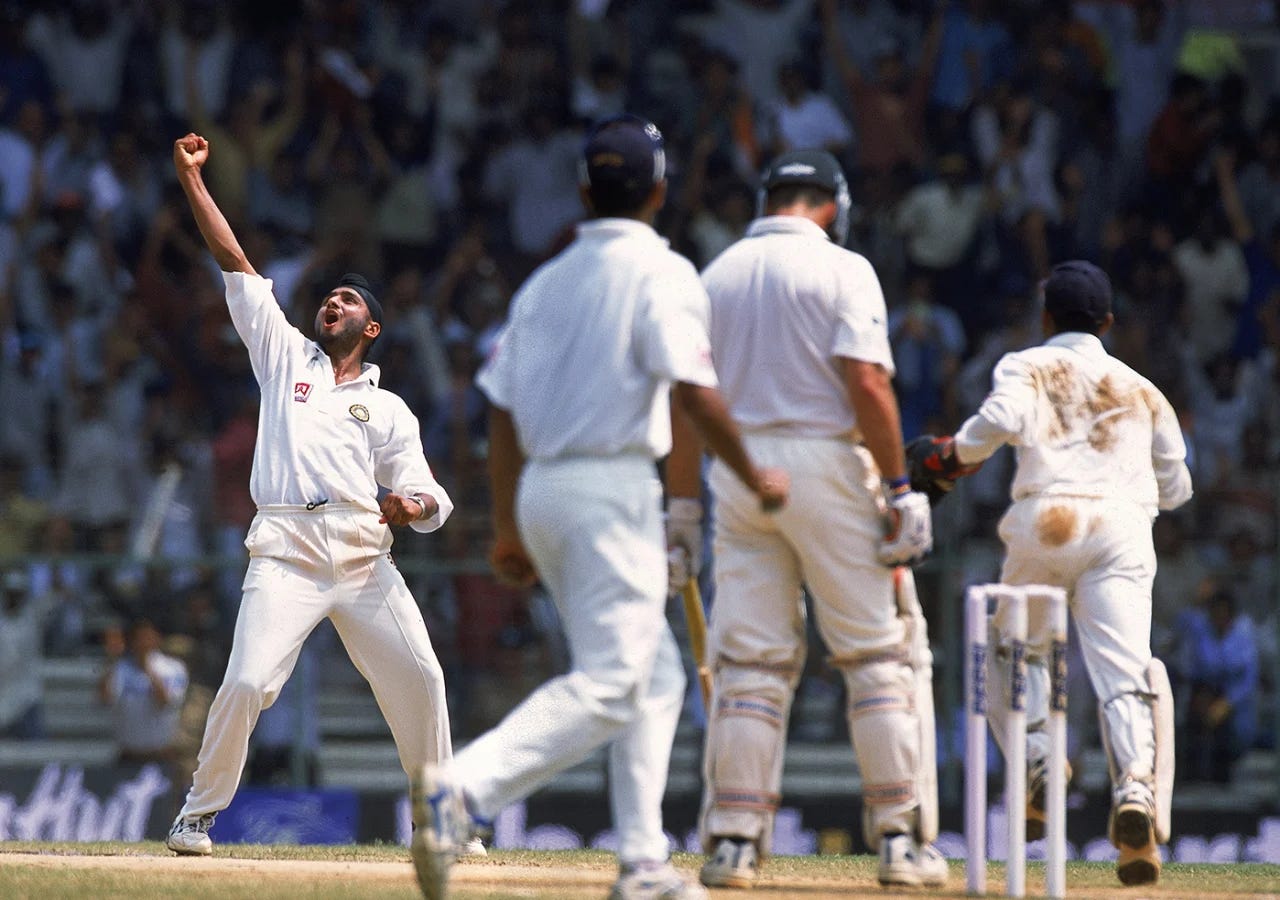
Australia are all out for 264. The scorecard is odd. On the left side are the batters, a line of greats and would-be greats. On the right, in the dismissals section, is a repeating beat of one name. Har-bha-jan Singh, the bha and jan pronounced quickly, like sixteenth notes.
Just one year back, after the death of his father, Harbhajan had considered leaving cricket entirely and moving abroad. “I don’t come from a family with a lot of money,” he told Scott Oliver here. “When my father passed away, I could continue with cricket - but I was going through a lot of dramas out there, problems with the cricket board… Or I could take the easy option and go abroad to work. As what? Could be anything: truck driver, labourer, filling petrol, whatever.”
And now, he has 8 wickets in the innings and 15 in the match, taking his series tally to 32. For perspective, India had picked 50 Australian wickets in that series. The next best after Harbhajan’s 32 were Tendulkar and Zaheer Khan with 3.
India will have to chase 155. It will have to be the highest ever chase at Chepauk, and the highest against Steve Waugh’s Australia. No biggie.
Glenn McGrath snares SS Das early, which brings VVS Laxman to the crease. Laxman starts creaming boundaries from the get-go. Every Indian, inside and outside the dressing room, has a spiked heart-rate and sweat bubbling from every pore, and here is this man, relaxed as if he’s at a beach, tapping and flicking perfectly decent deliveries to the boundary.
A good length ball from McGrath disappears to the midwicket fence before he can finish his follow-through. Warne and Gillespie are dispatched to both sides of the wicket. Sadagoppan Ramesh, local lad and an intricate strokemaker himself, watches from the non-striker’s end with a smirk. He’s got shots, but none like this.
Then Ramesh plays loosely to cover, sets off for a run, gets halfway and starts wondering if he left his geyser on, which is too complex a thought when the ball is in Ricky Ponting’s hand. Actually, Laxman had started to run too, until he saw Ponting pick up the ball and decided to trundle back to his mark, leaving Ramesh hanging midway, looking like he was thinking about geysers.
Sachin Tendulkar announces himself with three crisp boundaries. India cross 100; they’re flying. The finish line is rising on the horizon.
Gillespie comes around the wicket and bowls into Sachin’s chest. Out. A few minutes later, Gillespie teases Ganguly outside the off stump and finds the outside edge. Out. Rahul Dravid plays possibly the ugliest shot of his international career thus far. Out.
The crowd is on edge and the commentators are speaking in high tones. John Wright steps inside for a smoke. He can’t handle this.
Laxman reaches 66 off a mere 82 balls. In this Test alone, he has scored 131 runs, 92 of them in boundaries, each more elegant than the previous. He smacks Colin Miller on the leg side, expecting a boundary, and then sees the Australians celebrating. Mark Waugh—36, remember—has caught a ball he had no business reaching.
135-7 now. John Wright is typing away at his laptop. “That may be the Test match. Fuck, fuck, fuck.”
20 left to win.
The Chepauk crowd has fallen into a pin-drop silence. There’s no shock, just dread, that throat-parching sensation from knowing how this ends. Many are remembering the famous afternoon of January 31, 1999.
***
They are remembering Sachin Tendulkar, struggling but playing with mastery and authority like only he could. Pakistan’s bowling lineup of Wasim Akram, Waqar Younis, and Saqlain Mushtaq powerless in front of his bat. India were 50 away from victory.
The stadium looked the same then—a brutalist open-lid concrete can that absorbed every kilojoule of heat available.
Akram came back with the old ball. You could be one run away from victory with five wickets in hand, and Wasim Akram with the old ball held the potential to wreck your dreams. Nayan Mongia, who, for so long, had been a picture of discipline next to Tendulkar’s rapier blade, tried to heave Akram into the Marina Beach. The ball ballooned up and landed softly into Waqar Younis’ hands.
Tendulkar, then, played a couple drives worthy of art galleries. The greatest left arm seamer to have ever graced cricket could only stand mid-pitch and look. Saqlain was pulled and driven or fours. Tendulkar was gasping between deliveries, completely taken over by back spasms.
Only 17 left to win. The Chennai 2001 crowd can see, in their mind’s eye, Saqlain set the trap. They’re pleading, “Don’t, Sachin. Don’t.”
They can see Sachin step out on the next ball, a loopy doosra from Saqlain. They can see the ball go up, up in the air, Sachin folding over, and the ball falling vertically into Wasim Akram’s hands.
They can see Wasim Akram jamming the ball into Anil Kumble’s front pad; they can see Sunil Joshi meekly placing the ball into Saqlain’s hands; and they can see Javagal Srinath defending an innocuous delivery with the softest of hands, and the ball backspinning onto the stumps.
They can hear the piercing silence of defeat.
***
March 22, 2001.
Sameer Dighe is at the crease. Until thirty minutes before the match, he was a reserve wicket-keeper. He’s now having to steer the final act of a mythological epic—on Test debut, mind you. He takes 10 runs off a Colin Miller over.
Four to win.
Steve Waugh passes the ball to Glenn McGrath. Of course, he does. It’s almost evil. Seven Australian fielders stand near the pitch in a close, suffocating circle. Zaheer edges a typical McGrath teaser to the slips.
Australia need two wickets. India need four runs. Along with the dread from ‘99, it’s impossible to not think of the 1986 tied Test match.
Harbhajan Singh comes in to bat. It will be his long gangly limbs vs McGrath’s probing lines. He survives the first examination. So fitting that the last lines of this epic have him in the centre.
McGrath doesn’t relent. He’s back for another over. India need two runs. Steve Waugh brings the field in even closer. He’s confident that, in a 1v1 battle, McGrath’s ball will beat Harbhajan’s bat.
McGrath bowls a yorker, which Harbhajan squirts away between gully and point. Harbhajan doesn’t even look at Dighe, just runs. Dighe doesn’t need to look at Harbhajan either. They run one, they come back for another. Dighe’s arms are raised. Ganguly is out of his chair, Wright is out of his chair, Chepauk is screaming.
Harbhajan and Dighe confirm with the umpires that this is real.
It is.
India 2-1 Australia.
***
It is often thought that Chennai 2001 is forgotten behind Kolkata’s surrealist magic. I disagree. I think Chennai 2001 gives Kolkata 2001 a brighter lustre. A blowout result would’ve been a damp climax to a series that deserved to end in heat and tension. Similarly, without this match ending in triumph, Kolkata 2001 would’ve been beautiful but orphaned.
Chennai 2001 gives it context and meaning.
India became a substantially better Test team. Until this series, India had a win-loss ratio of 0.562 in Test cricket—effectively, losing twice the games they won. Since, the rate has climbed to 1.605. The transformation was driven by a talented, youthful team with a forward-looking management, sure, but the tailwind from one dreamy fortnight of March 2001 can barely be ignored.
This series also bathed India vs Australia in new light, turning it from one of many big contests to the marquee event in the calendar. For starters, the rivalry became tighter. From the start of the Mumbai Test, the head-to-head reads 22-20 to India. They’ve played thirteen series in this century, seven of which were decided by a margin of one.
The first World Cup final of the 21st century was played between India and Australia. As was the most recent ODI World Cup final, played in front of 90,000 blue shirts under the sweltering heat of Ahmedabad. The Test match that generated the highest live crowd ever in Australia’s cricket history was the Boxing Day Test in 2024, when Jasprit Bumrah almost bowled India to a win.
In Bumrah, India now have the most fearsome fast bowler in the world, scouting and catapulted into the mainstream by John Wright himself. In the last decade, they’ve travelled to Australia and won, twice, thanks to a pace battery of their own, many of whom have walked through the MRF Pace Foundation in Chennai. The role of mentoring aspiring Indian fast bowlers has now been passed over to Glenn McGrath.
The admiration for Australian excellence runs deep within Indian cricket. No country exports more talent to the IPL than Australia. The top three highest paid foreign players in the tournament’s history are all Australians. The first winning captain of the tournament, the only foreign captain in the inaugural season, was Shane Warne.
Harbhajan went on to become one of India’s greatest spinners, finishing his Test career with 417 wickets. The next in line, an even more successful off-spinner, grew up just a few miles away from the camps where Dennis Lillee taught India how to bowl fast.
India vs Australia 2001, when it started, was expected to be the final conquered frontier for the most ruthless Test team the game had known. On the third afternoon in Kolkata, midway through the series, the result was a foregone conclusion. And then the series turned into something that hadn’t been seen before and hasn’t been seen since.
The Border-Gavaskar Trophy is named after two men who symbolised the tenacity that great Test cricket demands. In the spring of 2001, across one steamy month, the trophy earned its name.
Beautifully written set of articles, Sarthak. Looking at it from across the border, we were expecting the Aussie juggernaut to keep on rolling mercilessly. But then something murmured in Kolkata. Laxman delivered well beyond any promise we'd seen in him in '99. The wiry Harbhajan got the ball spitting up and biting at the hard-nosed Aussies. And the crescendo built, all the way to that last ball at Chepauk, and beyond to the final at Lord's.
I'm happy I witnessed all this, the slumbering giant finally waking up and claiming its destiny. Part of me though is disgusted by how that confidence and self-assuredness has morphed into arrogance, so that a neighbour who would willingly root you on against the empire finds it hard now to tell them apart. Khair, we'll always have these memories.
PS: don't think Dennis Lillee has "passed away"
Oh man, I knew how it ended, and yet I was on tenterhooks. Written like a thriller....