

“When the low, heavy sky weighs like a lid,
On the groaning spirit, victim of long ennui,
And from the all-encircling horizon,
Spreads over us a day more gloomy than the night.”
- Charles Baudelaire (The Flowers of Evil)
Misery is a good place to start. Consider the state of things. India had been beaten inside three days in Mumbai, dismissed twice in a blur, their bowlers swept to smithereens by Adam Gilchrist and Matthew Hayden. Then, days before the Kolkata Test, Javagal Srinath broke down, joining Anil Kumble in the physio’s room. Rahul Dravid, already grasping for rhythm at the crease, was laid low by a fever and couldn’t train. VVS Laxman’s lower back took him to the physiotherapist. And then, as if the play had been written for maximum despair, Steve Waugh called correctly at the toss and Australia racked up 445 runs.
As the sun set on Day Two of the Kolkata Test, India were 128-8, 317 behind Australia, staring at another three-day defeat and a series loss in record time. In the Australian dressing room, cigars and whiskey bottles were laid out, in anticipation for the coming evenings when The Final Frontier would’ve been conquered.
In room number 214 of the Taj Bengal hotel, John Wright, India’s head coach, sat with four cans of Heineken and five cigarettes. He’d call it one of the loneliest, most desolate nights of his life. “The Aussies were an exceptional team,” he wrote in his autobiography, “but we were playing as if we didn’t think we belonged on the same park.”
At a dark hour of the night, Wright got a message from the front desk. Three fans—Vinay, Mahmud, and Sanchayita—had left him a note, hoping it would reach the team: “You guys can still win this. We believe in you.”
The Indian cricket fan’s devotion has never had much to do with logic. It is closer to madness. Your score could be in binary, the team could lose by an innings before lunch on the third day, producing a performance so abject that the highlights package doesn’t know what to show—and still they would come, with painted faces and handmade banners and throats ready to burn from shouting. That note to Wright and team was the purest distillation of that faith.
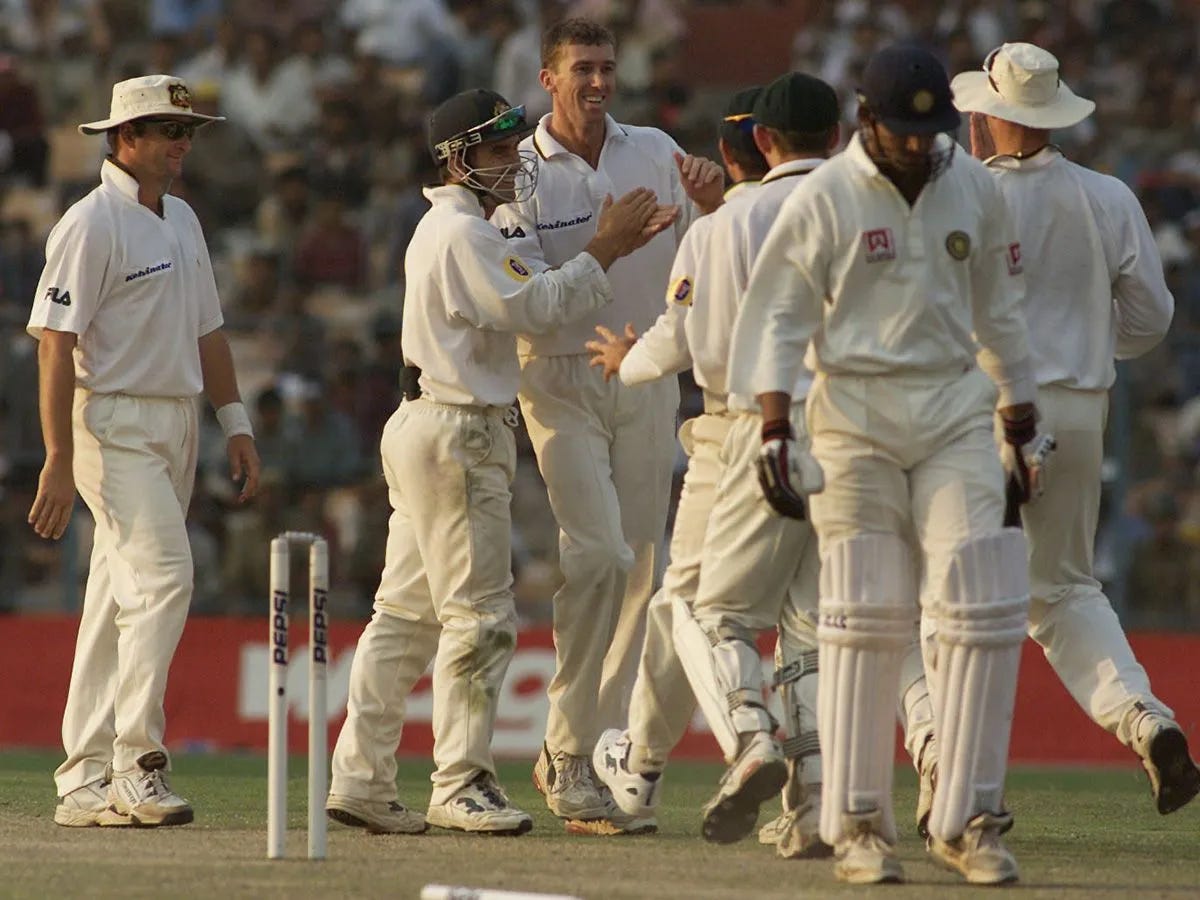
Cricket is a game of weird laws with weirder names. Amongst them is “Follow on”—asking a team to bat again after falling short of their opposition by 200 runs or more. The leading team has the option to enforce it or pile on the misery and bat again themselves. Historically, to follow on in a Test match was to stand one step away from defeat. If you batted extraordinarily well, you could claw your way to a draw. Winning was essentially unheard of—in 124 years and over 1,500 Tests, it had happened just twice.
Early on the third morning, India were bundled out for 171 in their first innings, giving Australia a lead of 274. Steve Waugh sniffed another crumble and asked India to follow on.
India had not crossed 200 in any of the three completed innings of the series. So when their openers, Sadagoppan Ramesh and Shiv Sundar Das, stuck around for an hour or so without catastrophe, there was that a brief unclenching of the gut within the dressing room. This wasn’t going to be another surrender. Heavy loss, maybe, but they were going to keep the Aussies out in the sun for a bit and salvage a shard of dignity.
At the fall of the first wicket, VVS Laxman walked in to bat, much to the bemusement of the outgoing batter and fifty thousand fans at the Eden Gardens. Rahul Dravid was the vice captain of the team, and number three was his spot. But, Laxman had scored a flawless 59 in the first innings, as if he was batting on a different pitch, against different bowlers, to everyone else. He was the last one out in the first innings, and as he walked back towards the pavilion, John Wright had intercepted him with, “Don’t take off your pads, Lax. You’re going in at number 3.”
Laxman felt right at home. He had batted at three for Hyderabad for nearly five years. He’d later write, “If I had the option, I’d always bat at number 3.” He cherished the challenge, perhaps buoyed by his knock in the first innings, but he also needed to repay the faith.
At the time, Laxman wasn’t a fixture in the Indian setup. He’d dip in and out of the team, score a cute 40 and then struggle for two whole matches. A bad series here meant he’d be out again.
Between the two Tests, Laxman had travelled to the holy land of Shirdi. On the journey, his mind had been cluttered with questions: “I had done everything in my control, so why this test by fire? Why were the runs not coming? Why was I in and out of the team? What more could I do?”
Then, days before this Test, Laxman felt a twinge in his back and went over to Andrew Leipus, India’s physio. As it turned out, it was more than a twinge. His upper body was leaning to the left, like a building with cracked pillars. A disc had slipped in his spine. Amidst that time-crunch, Leipus managed to just about reorient Laxman to get him onto the field.
And so, here he was. In the cauldron of Eden Gardens, the ground he had fallen in love with as a teenager, facing the team against whom he had played his two most substantial innings in India colours, at a delicate point of his career, now carrying the weight of having to spark a miracle. Obviously, he pulled Glenn McGrath for four.
Laxman was tall, almost willowy, but deceptively sharp. His feet glided up and down the pitch as if he were an ice-skater. When the ball came fast, he’d shuffle forward and back; when it was slow and loopy, he would shimmy down the track and meet it full. And sometimes, he wouldn’t move at all. He’d just stand on his toes, let the ball come to him and pat it away wherever he wanted. He could do all this because he had those wrists. Man, what wrists. Supple, elastic, sculpted when the almighty was in a generous mood and had a lot of time, they could drop the same ball dead or send it fizzing across the turf. In a lineup and age of batting capitalists, Laxman was an aesthete, incapable of scoring a dirty run.
McGrath went short again; Laxman pulled him even more crisply for four. At the other end, Australia were landing body blows. SS Das got out. Sachin Tendulkar’s arrival caused the Eden Gardens crowd to erupt, and his swift departure unplugged them entirely. But, within seconds, they realised the batter walking in was hometown royalty, Maharaj, Sourav Ganguly. And they went up again. To have watched Ganguly and Tendulkar at Eden is to have experienced a feral wall of sound that does not so much hit your ears as pass through your body like a shot of electricity.
Ganguly laced Gillespie and Kasprowicz for boundaries through the covers, the ball barely lifting from the surface. With every boundary, Australia packed the off-side field with more fielders, and he’d still pierce them. The crowd, delirious, were eating out of his hands. When the fast bowlers bowled short—his old, nagging weakness—he’d play with soft hands or take it on the body. Ganguly was probably never a great Test batter, but that day, with the game and the series hanging by a thread the width of a hair, he brought the street dog to the fight.
Laxman and Ganguly’s duet completely belied the state of the game. While Ganguly dealt with the seamers, Laxman set his eyes on the emperor, Shane Warne.
Laxman peppered the cover and mid-wicket boundary with boundaries, literally toying with Warne’s lines, forcing the great bowler to switch angles every other minute. And when Warne went short, Laxman pulled him with force to the mid-wicket boundary. Steve Waugh set attacking fields, leaving gaps as bait, and Laxman pierced all of them.
The highlight of the contest was Warne going around the wicket, bowling into the rough, and Laxman hopping forward like a ballet dancer and driving him with the spin—a ridiculously tough shot against a leg spinner—for four. It happened so many times you’d be forgiven for thinking they were repeated clips.
“A lot of players came down the track and hit me inside-out once or twice, but not as consistently as VVS did for two days - or however many days, three days, I can't remember!” - Shane Warne, speaking to The Cricket Monthly in 2016
Laxman’s wagonwheel just from facing Warne that innings could sell for millions at an art exhibition. Warne had struggled against India before, but rarely been dismantled like this.
And just when it was time for the Laxman-Ganguly partnership to crescendo, Ganguly fell. McGrath found the outside edge, Gilchrist accepted the gift, and Eden Gardens fell into a long hush. No one left, because the Eden crowd doesn’t do that, but the overwhelming feeling was that a nail had been driven into India’s coffin.
Rahul Dravid walked into the sapping Kolkata afternoon, still carrying a burning fever. Steve Waugh, ever verbally sharp, reminded him of his demotion in the batting order. “Three in the last innings, to six now. Six to out of the side!”
Eden Gardens rose as one when Laxman tucked Warne off his pads for a single to reach his century. One hundred and sixty-six balls, seventeen fours, batting turned into expressionist art. This was only his second Test century, and just as pristine as his previous one. He took his helmet off, raised his hands, and beamed to the crowd.
At the end of day three, as a tired and cramping Laxman walked back to the dressing room, Steve Waugh asked him to lead the way across the boundary ropes, the entire Australian team applauding from behind.
India were 20 runs in deficit—still breathing, but barely. In the away dressing room, Michael Slater waved a cigar under his nose. “The result is so close, I can smell it.”
That evening, Prem Panicker wrote in his report: “It is possible for India to wipe out that deficit, then put another 250 on the board, and really push the Aussies against the wall, in the fourth innings. It is also possible for me to walk on water, and then convert a jugful of that same water into sparkling champagne.”
***
Day Four. 14th March, 2001. Wednesday. Temperature in Kolkata touching the mid thirties, humidity above 80 percent. Eden Gardens was packed with fifty, sixty, seventy-five thousand, who knows? It was hot and it was loud. Hope was still many miles away, but they got the fight they’d so desperately wished for.
Glenn McGrath and Jason Gillespie returned with the new ball and chests full of fire. They were always going to. Australia’s pride could not be dented by a single day’s batting, however extraordinary. McGrath, in particular, was a force of nature. With a six foot four frame, he’d land the ball on a handkerchief for hours on end, spell after spell, in the morning and afternoon, then once more as you’re counting the seconds until sunset. How long will you survive? Gillespie was different, less skilled but the consummate workhorse who never let up.
That morning, Gillespie repeatedly beat Dravid and Laxman’s bats, sometimes even kissing the inside edge only for the ball to slip past the ‘keeper. McGrath, back to his metronomic best, kept teasing the outside edge. Somehow, Laxman and Dravid saw off the first hour and drew India level.
There is an old story, older than cricket and sport and many holy texts. A sacred bird gets consumed by fire and burns down, and from its pyre, rises again. The Greeks called it the Phoenix. It is a story we tell when reason has been exhausted, when you stand at the precipice of defeat, when India’s most respected cricket writer is joking about turning water into wine. On the night of March 13th, the only thought within the Indian dressing room was about survival and delaying the inevitable. No sacred birds were invoked.
But the thing about the Phoenix is that it burns until it suddenly, impossibly doesn’t.
Gillespie went full and met Laxman’s straight bat. Four. A couple of deliveries later, he went short; Laxman rose on his back toe and guided the ball past the slip cordon. Four. Next ball, Gillespie went full again, and Laxman drove him past the covers. Four. Gillespie returned for another over, Laxman drove him for four again.
Have you ever been to Kolkata for Durga Pujo? Or a Bengali neighbourhood in another metropolitan city during that week? You should. Enter the pandal around 6:30pm, just as the priest is weaving a dhunuchi—clay pot filled with burning camphor, coconut husks, and resin—around the giant Maa Durga idol. Next to him, four percussionists, cowskin drums (dhaak) hanging on their torso, play a triplet-heavy beat with thin sticks. Someone blows into a conch, and its resonant sound rolls through the pandal. And slowly, as the beat accelerates, visitors gather around the idol. The fragrance from the dhunuchi and the insistent, breathless percussion enter your body through different channels and meet somewhere near your chest, the beat building and building, the state of trance both inexplicable and inevitable.
If you ever want to know what such an evening feels like, I’d send you to Eden Gardens on the morning of 14th March, 2001.
Rahul Dravid, so far, had stuck around, barely visible behind the Laxman sound and light show. Without form or health to fall back on, he slowly built up confidence the way he knew best—by surviving, by making the bowlers come to him again and again. Then Michael Kasprowicz reverse swung the ball inwards, and Dravid leaned on his left toe to flick him for four.
One boundary in a thirteen thousand-run career might seem insignificant, in a way that one match amongst a hundred and sixty four does. But, until then, Dravid was the immaculate, obdurate technician who could bat for hours, often without adequate tempo. In fact, his inability to push the run-scoring forward had forced Ganguly and Wright to think in other directions, eventually promoting Laxman to number three.
“For too long, has Dravid been a captive to the demons of his own mind,” wrote Prem Panicker. “For too long, have those who know his ability wondered about his penchant for setting up some opposing bowler as a bogeyman, and tying himself down.”
That shot against Kasprowicz was the morning bell from where Dravid turned from a man batting in chains to one who could balance stillness and sizzle. 19 turned to 40, then to 50. Dravid hit everyone, nearly matching Laxman for tempo even if he couldn’t match the artistry. He smoked Warne for three boundaries in one over. What’s more, he even sledged that day! When he reached his century, Dravid jabbed his bat at the press box. He clearly had things to say.
As India’s lead soared and Eden grew louder, Laxman and Dravid entered a trance themselves. They broke the day down into phases of ten overs and did not once look at the scoreboard. In that first session, they added 122 runs at an Australian pace of 4 runs an over.
They batted, and batted, and kept batting. They hit every bowler Steve Waugh threw at them until he relegated himself to the boundary, leaving whoever pleased to bowl their pies. The hot March sun was beginning to have its effect on the toughest cricket team in the world. Matthew Hayden bowled, Ricky Ponting bowled, even Justin Langer bowled. The crowd at Eden Gardens, impervious to the heat, swelled and screamed with every boundary. The game, now, was on.
Laxman reached his double century. India’s lead had crossed 200. Steve Waugh cycled through his strike bowlers one more time, hoping to get something before the shadows lengthened and the India dressing room could break into a long bout of joy. Nothing. Laxman and Dravid remained undefeated through the day.
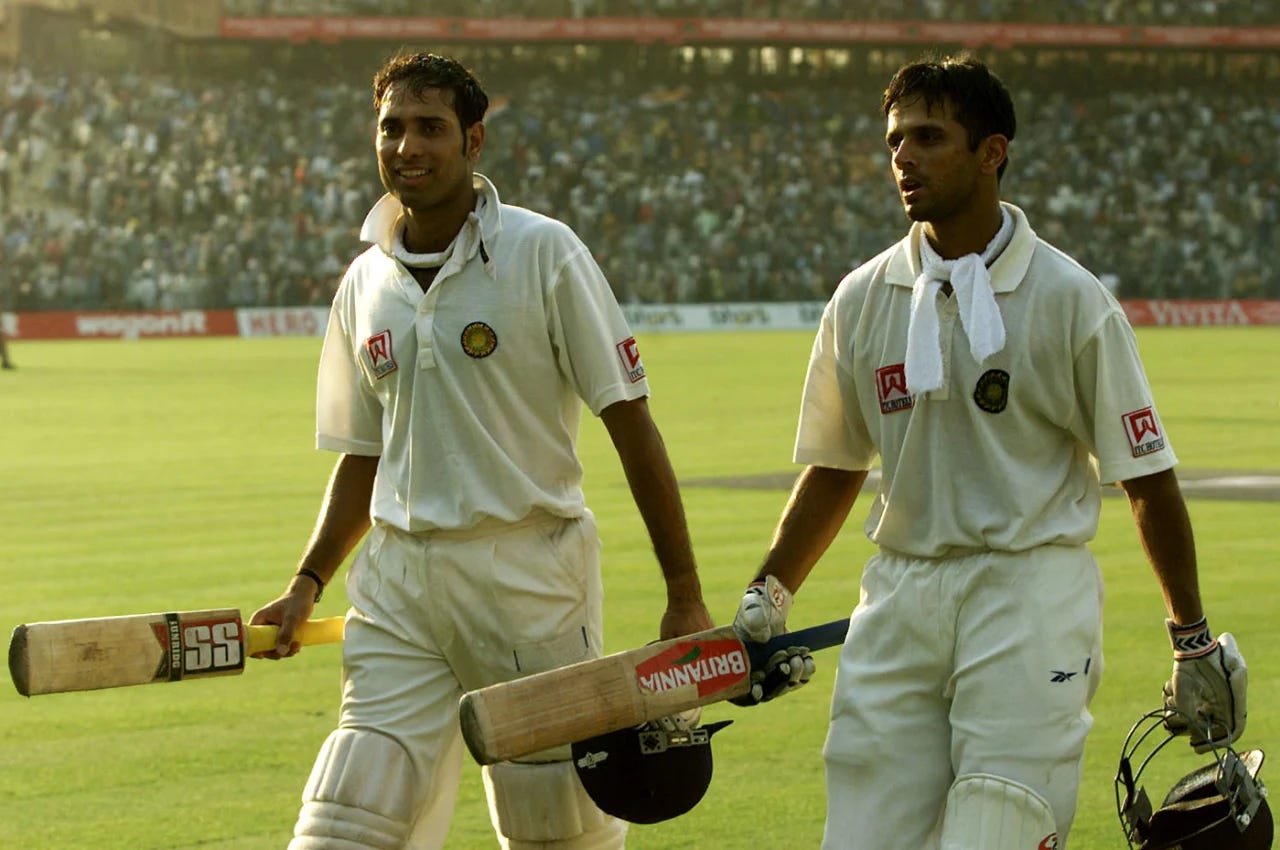
At stumps: Laxman 275 not out, Dravid 155 not out, India 315 ahead. Laxman lay on the physio’s table; Dravid on another, nearby, plugged to an intravenous drip. The question of declaration hung in the air as the team gathered at Sourav Ganguly’s palatial bungalow in Behala for dinner.
Around the dinner table at Ganguly’s, John Wright posited that while Steve Waugh’s Australians had become a winning machine, they didn’t know how to play for survival. So, leave just enough time and runs to tantalise them into a chase. And then, unleash Harbhajan Singh.
***
On Day Five, Eden Gardens was packed an hour before the start of play. The streets leading to the stadium were filled with fans who couldn’t snare a ticket but wanted to wave at the team bus. It was a weekday morning, and Kolkata couldn’t care less about pushing paper at a desk.
Laxman finished with 281—the highest score at the time for an India batter. He had batted a combined eleven hours in the Test. Dravid chalked up 180. He says he has batted better elsewhere, because it’s a quintessentially Dravid thing to measure a knock by its difficulty, but this was his most significant batting effort.
India left Australia 384 to chase in 75 overs.
Now: Harbhajan Singh. Twenty-year-old boy from Jalandhar, picked despite his action and demeanour. Many months before this game, Sourav Ganguly had dragged coach John Wright to watch him. Fiery, fiesty, and immensely skillful, he was the perfect Ganguly bowler.
Everything about Harbhajan Singh said spin. And no, it wasn’t the turban and the lineage of Bedi, Maninder, and Sarandeep. It was his long, lean limbs and a torso that lacked muscle, as if tuned for rotation and whip. His bowling action was a thing of beauty. He started with a couple of hops, then spread his arms wide like an eagle, brought them back above his head, ran his right arm over his left, his torso twisting with the stride, and released the ball fizzing all the way onto the pitch. Loop this, set it to a dhol beat, and you have a bhangra routine.
On a flat pitch, Harbhajan was a handful; on anything spicier, he was a menace. The rapid revs on the ball made it spit and bite, like wicketkeeper Nayan Mongia found out early in the day, when a ball pinged off the pitch and broke his nose.
At tea, with two hours of play left, Australia needed 223 runs and India needed 7 wickets. If one were to place a serious bet, you’d think India would struggle to dismiss seven. Australia were likelier to reach their target, however outlandish their effort would have to be. The window for Harbhajan and co. was shrinking.
You’d think that at most grounds, not Eden Gardens. Not with a hundred thousand voices, flares dotted across the circular stands from burning newspapers, a hot mid-March sun, and Harbhajan making the ball hop and dance.
The Australians felt the heat but refused to buckle. Matthew Hayden reached another fifty—his third in four innings. Across from him stood Steve Waugh, the toughest cricketer you’d hope to watch, the kind of batter you’d want to call captain in this situation.
Harbhajan sent another fizzer whose revs you’d hear if you stood close enough, and Steve Waugh could only place the ball into the hands of a close-in fielder. This was the typical Harbhajan wicket, first beating a batter in the air, then off the pitch, leaving him fending and prodding. Six to go.
In came Ricky Ponting, a walking wicket, picking Harbhajan as well as a hammerhead shark would pick Viswanathan Anand’s opening gambit. Out. Five to go.
As the clock ticked down, Ganguly needed someone to support Harbhajan from the other end. Raju was tidy but not threatening enough. So he turned to a weapon he didn’t nearly use enough: the right arm of Sachin Tendulkar. One thinks of Tendulkar and thinks straight bat, straight drive, runs in bulk. Fair enough. Nobody before or since has been so good for so long. But if you had seen him bowl, you knew he was borderline prodigious. He could bowl leg-spin, off spin, seam-up, or dibbly-dobblies. He had rescued semi-finals, taken five-wicket hauls, sent Brian Lara’s stumps cartwheeling.
Ganguly gave him one over. Tendulkar bowled a ripping leg-break and trapped Adam Gilchrist in front. Four to go. Next over, he sent a similar ball to Matthew Hayden, who played the same shot as Gilchrist. Out. Three to go.
Up next, Shane Warne. The best bowler in the world, the greatest spinner to have ever lived, a gift to cricket theatre. With the bat, he was more than capable. Tendulkar vs Warne was the marquee contest within every India vs Australia series at the time. Hissing leg spin vs twinkling feet. The roles had been reversed for this short passage.
You know how, when you have a really talented friend, and you end up in a situation where you have to do the thing he’s good at, you kind of push yourself a little? It’s that weird sense of competition, borne out of not wanting to look silly in front of your friend, but also a little bit of ego that you aren’t inferior. Tendulkar and Warne were great friends, and on that afternoon, Tendulkar bowled a vicious googly that Warne would’ve been proud of in his pomp. Out. Two to go.
Eden Gardens’ sound had become a screech. “Crowds at Eden Gardens have never been truly estimable, its capacity overwhelming logistics, so it might have hosted larger attendances,” wrote Gideon Haigh. “What seems sure is it never felt as full as on 15 March 2001, stands heaving with motion, without a speck of empty terrace to be seen.”
Kasprowicz and Jason Gillespie held on. Every minute felt like an hour. After coming this far, were we going to realise we had been short by a whisker?
Gillespie flicked Harbhajan into a fielder. One to go.
Harbhajan Singh to Glenn McGrath. Seven fielders and a wicketkeeper around the bat. An edge, a mishit, a badly judged leave, anything would do. Harbhajan hopped in, spread his arms, twisted his body, and released a quick, full turner. McGrath misjudged the line and played with his pad. A hundred thousand and eleven Indians went up in a roar, and before the appeal could reach its highest note, umpire S. Bansal’s index finger had gone up.
Australia, all out 212. India win by 171 runs.
***
What is there to say about Kolkata 2001 that the match itself has not already said?
Steve Waugh, who lost very little on a cricket field, called it the greatest Test he had ever been a part of. Even in defeat, he wanted it known that he had been there, that he had stood in the middle of it, that he had felt everything that passed through Eden Gardens on those five days.
Many will tell you that everything that came after—the wins abroad, the World Cups, the belief that India could compete with anyone, anywhere—flows from this single Test in this unique city. Perhaps. History is generous with its turning points. But Kolkata did not feel like a mere turning point at the time. It felt like something greater and less explicable, almost spiritual. There had been no precedent for a story like this, no idea that an epic like this could even be imagined. But here we are, twenty-five years to the day after Harbhajan Singh trapped Glenn McGrath, still wondering if those five days were real.
If you watched it, you know. You’ll carry Kolkata 2001 for the rest of your life.
What does it say about your writing that it felt more intimate than watching the game itself?
Laxman’s coming of age was that test. I always thought he handled a cricket bat like a badminton racquet. Steering it at just the last moment.
So, so good Sarthak. Gets even better on repeat reading.
Took me back to 2001, me following the game on All India Radio, while travelling between my paternal and maternal grandparents' villages. Had no radio access post lunch that day only to get the shock of my life next morning to see Dravid and Laxman still batting. Once in a lifetime feeling and your writing took me back to that day.