

On the day of publication of this essay, sixty thousand people will file into Eden Gardens in Kolkata to watch India play West Indies in a World Cup knockout match. Eden Gardens, at full capacity, is the sensory peak of Indian cricket. Not too long back, it used to hold more than a hundred thousand fans. It was also one of India’s default venues for the big games—tournament knockouts, series finals, Test matches against Pakistan, England, Australia, and South Africa. Its collective sound was worth travelling across states for. Eden Gardens has since lost a lot of capacity and that place within Indian cricket’s administrative heart, but this evening, when the drone camera flashes a panoramic shot of the stadium, the sight will be a reminder of why this Victorian sport developed a thick Indian accent.
Tonight, if you ask a fan at the stadium for his prediction, you’ll hear what conviction sounds like. He’ll tell you that India will win and qualify for the semi-final; the West Indies will lose and leave to a rousing reception. Probe him further, and he’ll serve a similar-toned prediction for the semi-final. Will, not should.
If you happened to be around Indian cricket’s orbit in the early spring of 2001, hearing things like this must make you feel dizzy. No Indian team, ever, has been this utterly dominant at cricket.
Since its first Test in 1932, India has been the sport’s most colourful underperformer. Every generation, Indian cricket’s conveyor belt would throw up a genius, and that genius would shine bright and brilliant, but inevitably find himself amongst the also-rans at the end of a major series. In the sixty-nine years between their first Test and February 2001, India played 336 Tests. They won a mere 63 and lost 112, placing them sixth on the ten-team table for win-loss ratio.
The crowds filled up stadiums regardless, with outsized passion and expectation. Their unique, quixotic relationship with cricket was never more evident than the two riots at Eden Gardens in 1996 and 1999. Their rage at years of structural incompetence boiled over into flames, and they returned the next day carrying placards and posters.
It’s hard to imagine now, but India’s place in cricket’s imagination and cricket’s place in India’s imagination had undergone seismic transformation. The 1983 World Cup triumph triggered the first explosion. At the time of that win, Indian cricket didn’t have enough money to award the returning players. Within four years, they were co-hosting the next World Cup. Within a decade more, satellite television had arrived in Indian living rooms and cricket had swallowed every other sport’s share of the national attention. Cricket’s popularity was rivalled only by Bollywood, and on some days, not even that.
Internationally, India had emerged as the obvious candidate to lead the sport into the new millennium. The 1996 World Cup, even considering the semi-final riots, had been a success. Jagmohan Dalmiya had served as president of the International Cricket Council. Elsewhere, they ran nuclear tests and hosted the American president for a week. In the late 90s, one associated India—the nation state and the men’s cricket team—with coiled energy.
And then, between February 27th and March 22nd, 2001, India played a Test series that changed the posture of its cricket team, its voice, and the sense of what was possible. At the time, not many would have predicted so. Test cricket was the holy grail and the Indian Test team was in shambles.
I. Prelude
Sydney, 2000. The Indian team had brought in the new millennium watching fireworks over the harbour. From home came a sliver of unrelated good news: a flight carrying the hijacked passengers from IC814 had touched down safely in New Delhi. It was temporary respite. The wounds from a 0-2 deficit in the three-match Test against Australia were still fresh when the third Test came knocking around.
India batted first and were bowled over for 250. Against a hapless bowling attack, possessing neither edge nor precision, the Australian batters filled their boots until they got bored, finally declaring their innings at 552/5. India came back out to bat, expected to crumble again. And they played that part to near perfection barring one batter from Hyderabad who was anyway on the verge of getting dropped from the team.
Vangipurappu Venkata Sai Laxman scored 167, but to say he scored those runs would be wrong. He painted. In fine strokes when the ball was pitched up, in bold flourishes when it was short, his lean arms wielding the bat with a feathery lightness. For every breath of his 255-minute innings, he turned batting into a purely artistic endeavour. The harder the Australians came at him, the more elegantly he replied. If batting could ever be set to a Stradivarius concerto, it would be VVS Laxman at Sydney.
India lost, as India often did back then when they travelled, but Laxman boarded the flight back to Mumbai having cast an impression on everyone watching, not least the Australian team. It wouldn’t be the last time they ran up against Laxman’s brush.
Anyway, 3-0 to Australia. After the Test humiliation, India played an ODI tri-series against Australia and Pakistan, where, out of eight matches—four against each—they lost seven.
They came back home, tail tucked firmly between their legs, to face South Africa in a two-match Test series. They lost both the matches, but the series is remembered for finally uncorking the depth of match-fixing’s rot within and outside Indian cricket. The proliferation of dishonest money had been an open secret for years. Now, we got a tableau of just how many people had filled their bathtubs with cash.
Hansie Cronje and Mohammed Azharuddin, two statesmen of the sport, never played another Test. Cronje was weeping in a court that summer. He was dead within two years.
With Azharuddin’s implication, a part of Indian cricket died immediately. Azharuddin was the shy, lanky boy from Hyderabad who had made it to the top. He was India’s first long-term captain after the peerless Kapil Dev. As India and Indian cricket got more ambitious, Azhar was seen as its moral anchor, the soft-spoken but firm Muslim figurehead in a country that was Nehruvian on paper, but couldn’t control its climate. He was proof that talent and performance could marry grace, and carry you from the bylanes of an old city to leading the Indian contingent at World Cups. That even he could be corrupted served as the final full stop in the romantic’s relationship with the sport.
It is one thing to lose matches, completely another to lose the trust of a nation that rearranged its daily life to watch you play. Indian cricket had known a period when it couldn’t win a race of one, but it had never known a low like this.
Sachin Tendulkar, always the reluctant captain, gave up his captaincy. Kapil Dev was sacked as the coach, his position untenable after the double-sided attack of CBI investigations and a terrible Test record. Into the turbulence strode Sourav Ganguly, firebrand from Calcutta privilege, nicknamed Maharaj, and John Wright, a 46-year-old soft-spoken Kiwi with zero national team coaching experience. They inherited a dressing room that was broken in every way a dressing room can be broken—in confidence, in trust, in identity—but which contained, if you looked carefully, the spine for rebirth in Tendulkar, Dravid, Kumble, Laxman, and Srinath.
Ganguly and Wright took a young India team to the final of the ICC Knockout in 2000. Ganguly scored belligerent centuries against Australia and South Africa, and asked his team to raise the tempo even further. It started with Tendulkar, otherwise the anchor of India’s batting, tearing into Glenn McGrath, evoking memories from ten years prior when he would butcher bowlers with a cherubic face and toothy grin. Then, Yuvraj Singh, a tall, athletic 18-year-old from Chandigarh, cut and pulled his way to 84 in his debut innings. 21-year-old Zaheer Khan, who had moved from Baroda to Mumbai, and pitstopped at Chennai to refine his bowling under the shadow of Dennis Lillee, bowled dipping 90mph yorkers into Steve Waugh’s stumps. In the middle of all this, even Venkatesh Prasad, whose batting skills would rival mine, hit a 75-metre six. The change in ideology, now looking back, almost feels overnight.
All said, Test cricket was a substantially tougher ballgame, where India had no recent evidence of strength. Then, a few days before the series, they lost Anil Kumble—their one true match-winning bowler. They reached Mumbai short of confidence and skill.
Australia reached Mumbai on a winning run of fifteen consecutive Tests. Steve Waugh, their captain and talisman, had called this tour The Final Frontier. Over the decades, Australia had beaten everyone everywhere except India in India. Waugh recognised the unique challenges that an India series brings, but he also had a team so stacked with gold-standard talent, so deep, they were equipped to handle everything. Crossing the frontier seemed like an inevitability.
II. Swept Aside
On the morning of the first day, the two teams stood across from each other, heads bowed, holding a minute of silence for the passing of Sir Don Bradman. There are many ways to describe Bradman, but the simplest maybe that he was the greatest ever, the rightmost tip on the spectrum of excellence. In no other sport has one man ever been so far ahead of a hundred and fifty years of others.
India batted first, and within the first hour, lost four wickets. Home town hero Tendulkar stroked a flurry of boundaries, often giving the impression that he was batting on a different pitch to everyone else, but eventually fell to Glenn McGrath’s relentless probing lines. India were all out for 176.
Australia lost their first five wickets for 99, and for a brief, heady passage, India were on top of the best team in the world. The architect of Australia’s troubles was twenty-year-old Harbhajan Singh, the turbaned off-spinner from Jalandhar who had once ruffled up Ricky Ponting in Sharjah and earned a suspension. Now, on a dusty Wankhede pitch offering generous turn, no Australian batter was truly picking him in the air or off the pitch. One more wicket and India would be beyond the specialist batters, into the tail.
From that delicate position, Adam Gilchrist unleashed a soaring arpeggio of sweeps and slog-sweeps and practically batted India out of the game. His treated the Indian spinners with such ferocity that you were left wondering if the scorecard before had been a mirage. To this day, his 122 stands as one of the greatest knocks ever played by a visiting batter on Indian soil.
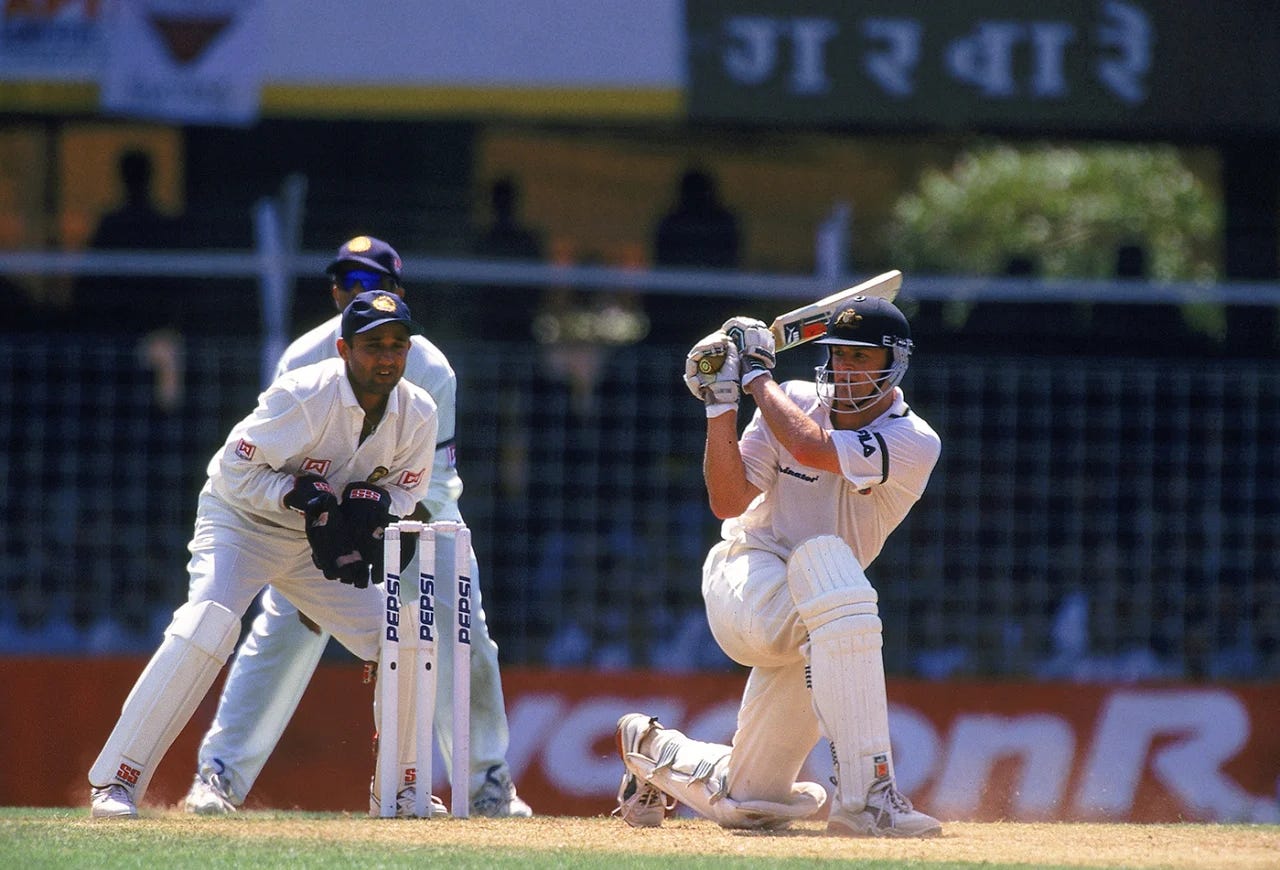
Matthew Hayden scored a century too, signposting his gluttonous appetite for runs. Built like a monolith from Mount Olympus, Hayden made full use of his frame to take the pitch entirely out of the picture, sweeping balls from good length, walking down at will. Australia took a lead of 173.
India reached 154-2 in their second innings. Sachin Tendulkar was looking majestic once again, still leading that enduring but kind of one-sided battle with Shane Warne. All hopes for a resurgence sat on his shoulders. Then, Tendulkar fell to Mark Waugh; Ganguly ran himself out; Laxman nicked behind; Dravid was castled by Warne. Four wickets in twenty minutes, four different ways of failing, each leaving to a deepening silence across Wankhede’s circular cauldron. The rest of the lineup, hardly any match for the Australian bowling attack, gave the scorers little trouble.
Australia’s openers wrapped up the 47-run chase without sweat. Three days, it had taken them. What was that thing about frontiers?
On this day, twenty-five years back, the Indian team was dealt a rude lesson in the chasm between them and the Australians. They were barely playing the same sport. For so long, India’s Test team were known as lambs abroad, but lions at home. That halo, already fragile, now had been punctured.
That evening, Aaj Tak, a new twenty-four-hour news channel—India’s first ever—filled its slots with cricket. Ex-cricketers sat under studio lights and dissected the fragility of India’s batting lineup and the structural differences between Indian and Australian cricket. By the end of the night, the overwhelming consensus amongst the panelists and fans alike was that it wouldn’t take Australia all five days in the second Test at Kolkata either.
This is a teaser 😁
Thank you for this article, and I look forward to the next two.
I would point out that in 2000 the visiting South African team also played six one-day matches, and that was what the police latched on to at first -- the efforts to fix those matches.