

I don’t usually wake up at 6:30 am on Saturdays. Weekends are for sleeping in, especially once a chill has settled over the city. This past week, a persistent late-autumnal rain, bleeding through nights into mornings, has turned Bangalore into a hill station, calling for a blanket and hot chocolate. And maybe, once the eyes have opened enough, an old comfort read.
Not today, though. Today, India-A are playing New Zealand-A in a warm-up match to prepare for the upcoming Test series. They have lined up with the entire first-team top order: Yashasvi Jaiswal, KL Rahul, Devdutt Padikkal. By the time I have washed my face, India-A are almost bowled out, and they haven’t even reached 100 yet. These batters will be lining up for the first team in a couple of weeks, and that familiar sight of a seaming ball sneaking through their defence should be troubling. It barely registers. I have woken up to watch Aaquib Nabi bowl.
The drone shot looks like a painting. They’re playing at Lincoln’s Bert Sutcliffe Ground, with its Lattice-balcony pavilions and white tents, and surrounding walls of pine trees. The sky is covered in a sheet of grey. Lincoln, I learn, is a town of 12,000 on the Canterbury Plains, half an hour from Christchurch. In the distance lie low, grassy hills. Some of that grass has evidently been used on the pitch, making it nearly blend with the field.
India-A finish on 113. Then the bowlers come out, and the new ball is predictably kept away from Nabi. Anyone who has watched him bowl for Jammu & Kashmir over the past three years will rate him as India’s best new-ball bowler after Jasprit Bumrah and Mohammed Siraj, neither of whom is playing this game. In overcast conditions, he’s better still. And yet, he must wait.
Nabi gets one over, the 11th of the innings, by which time the sun has begun to break out through the clouds. The ball moves, but harmlessly.
**
Aaquib Nabi has been a popular name around Indian cricket for some months now. His 60 wickets at an absurd average of 12 carried Jammu & Kashmir to last season’s Ranji Trophy—their first domestic title of any kind. In the final, Karnataka’s batting lineup read: KL Rahul, Mayank Agarwal, Devdutt Padikkal, Karun Nair, Ravichandran Smaran. Three current Test players, one recent Test player, and one winsome prospect who should soon be inside the Test setup. Nabi ran through them. The delivery to KL Rahul landed on a good length and deviated just enough, kissing the outside edge on the way out, turning Rahul’s body into bent thermocol. If there had been any doubt about whether Nabi was ready for the next leap, this season and this ball should’ve put that conversation to bed.

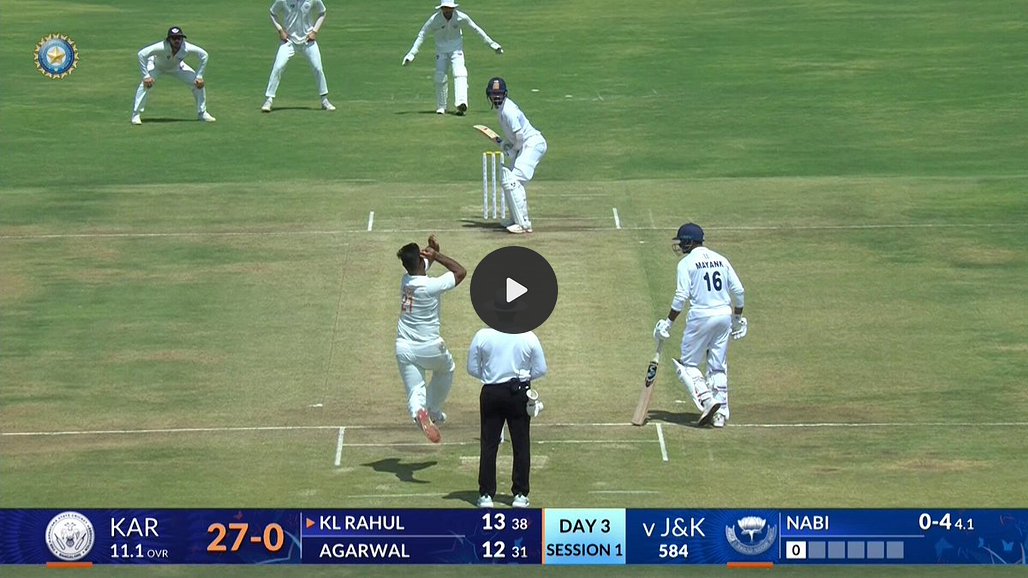
This season itself was a glorious follow-through. In the 2024-25 season, Nabi had picked 44 wickets, pushing Jammu & Kashmir to the quarter-finals—at the time, a first for the team. This run, then, was two years, 104 wickets at a silly, low-tens average, and many runs scored. His reward was an IPL contract at Delhi Capitals, where he played two matches on pitches where batters plundered runs and bowlers were reduced to background props in a grotesque show somehow packaged as the summit of cricket.
India’s next Test assignment was in Sri Lanka, in late July, at the full sulk of the south-west monsoon. Clouds and damp air, guaranteed. Nabi made the squad, but, even in the absence of Jasprit Bumrah, didn’t make the starting lineup in either of the two Tests.
**
Squad selection in India is a funny thing. The committee is drawn from all corners of the country to project an illusion of democracy, whereas the final team is picked on anything but objective, agreeable metrics. The important meetings happen behind the sealed doors of conference rooms in five-star hotels. Nobody ever knows what gets discussed inside. These meeting often push beyond the deadline. At the end, somebody reads out a list of names in a conclusive cadence and leaves.
In matters of national team selection, there is a truth about India’s population, just as there’s a myth. Pick a man from a billion, the line runs, and he has to be good. Many have said this, most recently Justin Langer, then-Australia coach, after India won a Test series with effectively their third-choice team. That term—“a billion”—has a ring, and it feeds into a myth that has now become self-fulfilling.
Sure, India does have a billion people, which means more aspirants, more competition, and more obstacles between talent and opportunity than any other cricket nation. The obstacles multiply exponentially for those born on the wrong side of the privilege fence. Anyone who clears them all deserves to be assumed very good.
But, equally, the further up one goes in the course, the thinner the competition gets. Near the top, the pool of prospects is easily trackable and manageable. The Indian Premier League has helped: more routes to recognition, and a design where young talents spend two months a year in high-pressure environments, shadowing international stars and coaches.
The IPL can be directly credited for supplying India with a conveyor belt of international-ready white-ball cricketers. These days, it’s more interesting to see who the selectors have omitted in the ODI or T20 sides, than who they’ve selected. There is, very genuinely, a problem of plenty. Yashasvi Jaiswal can’t get a ODI or T20 gig, while Vaibhav Sooryavanshi, fifteen years old but precociously talented and now carrying a substantial body of work, has to warm benches. Sometimes, these selections boggle the mind, but they can be explained through cricketing reasons. For example, Sooryavanshi should be in the lineup, yes, but dropping an in-form, world-class, World Cup-winning opener creates a terrible precedent of the “shiny new toy” syndrome. Similarly, even at the height of his powers, Mohammed Shami couldn’t always get into the ODI side, lost to tactical balance. Besides, a team that entered each of the previous four or five majors as favourites, will naturally have a reserve pool that can walk into other starting lineups.
But, often, the density of competition should not be a filter, if the density is even real, that is. This is where red-ball cricket, inarguably the tougher format, throws up its examples. Sarfaraz Khan made his debut in the spring of 2024, after about three years of averaging nearly 100 in Ranji Trophy cricket. That metaphorical door had not merely been knocked open but blown to smithereens. Within his debut series it became clear that Sarfaraz possessed skills, especially at playing spin, rarely found in the rest of the country. He was nimble footed despite his weight, and used his loose wrists and low centre of gravity to open up angles. He got eight months of Test cricket before getting dropped, and then jettisoned from the team altogether. He watched from home as India got smoked in a home Test series by South Africa, falling repeatedly to their good-but-not-elite spin bowlers. The noise suggests he’s not coming back to the team anytime soon either. India is still searching for a middle-order batter who can play high-quality spin.
Then there is Jalaj Saxena. Since his debut in 2005, no one has taken more Ranji Trophy wickets. He was the first to the incredible double of 6000 Ranji runs and 400 wickets. The India call was not straightforward, though. Most of Saxena’s career overlapped with Ravichandran Ashwin and Ravindra Jadeja, two gold-standard all-rounders who became the first names on the team sheet at home, often even away. For a third spin option, India found the singular Kuldeep Yadav in 2017. Saxena should’ve been the next cab in the rank. Except, India looked everywhere but his way. In this time, Axar Patel and Washington Sundar, good cricketers no doubt, got their debuts. Manav Suthar is the latest entrant to that club. He’s really good too. Saxena, meanwhile, continues to slog it out in the arid heat of domestic cricket, playing to two-digit crowds and a handful of reporters. During a match last October, an ex-cricketer-turned-commentator said “it was very surprising,” that Saxena never played for India. The co-commentator reminded him that both of them had been selectors and passed on Saxena.
This list is long. Wasim Jaffer played some Test cricket, but, he could argue, not enough given his returns. Amol Mazumdar never got a chance and Subramaniam Badrinath got one series, despite their mountains of runs. Rajinder Goel, a hallowed name in Indian domestic cricket history, had to suffer from the timing of his bloom. Then, Pankaj Dharmani, Abhimanyu Easwaran, Padmakar Shivalkar, and Priyank Panchal. Cricketing arguments exist for some of their omissions, but they often hold up poorly against those allowed to break the line on a whim.
**
At Lincoln, we’re back for the final session of the day. India-A desperately need breakthroughs. Mukesh Chaudhary supplies the first blow, but the gut punches come, on consecutive deliveries, from Nabi. One ball ducks venomously from good length; the other is fuller, its movement subtle. He almost picks another in the next over, from a delivery that held its line until the last breath and then moved away.
The wickets won’t count. He could pick five the next morning, and they still won’t count, like the 104 Ranji wickets didn’t. Nabi has not been picked in the sixteen-member squad for the Test series. In two weeks, when the Test team arrives in Wellington for the first match, he will have flown back home. Barring an unforeseen injury to the group of four fast bowlers picked, he will stay home.
India are playing the New Zealand Tests at the start of the southern hemisphere summer, when the air is damp and the pitches green. Nabi is built for these conditions. He isn’t quick, but he doesn’t need to be. He places the ball instead of hurling it. That ball, when red like a flea market toy, mostly lands where he intends it to. It lands with its seam upright and proud, sometimes curving in, sometimes away. The last time India toured New Zealand at this time of the season, a bowler of a similar profile repeatedly tore through the batting lineup of Sehwag, Dravid, Tendulkar, Ganguly, and Laxman.
The tragedy of the snub goes beyond this tour alone. As Jasprit Bumrah’s body gets into bloodier fights with his will, and India’s pace stocks stand severely depleted beyond him and Siraj, Nabi had to be the easiest slot-in. He can bowl long spells, he can bowl tough overs, he can bowl in pressing heat and nippy winters. He has trained all his life, our common friend and journalist Mohsin Kamal says, to play Test cricket. And yet.
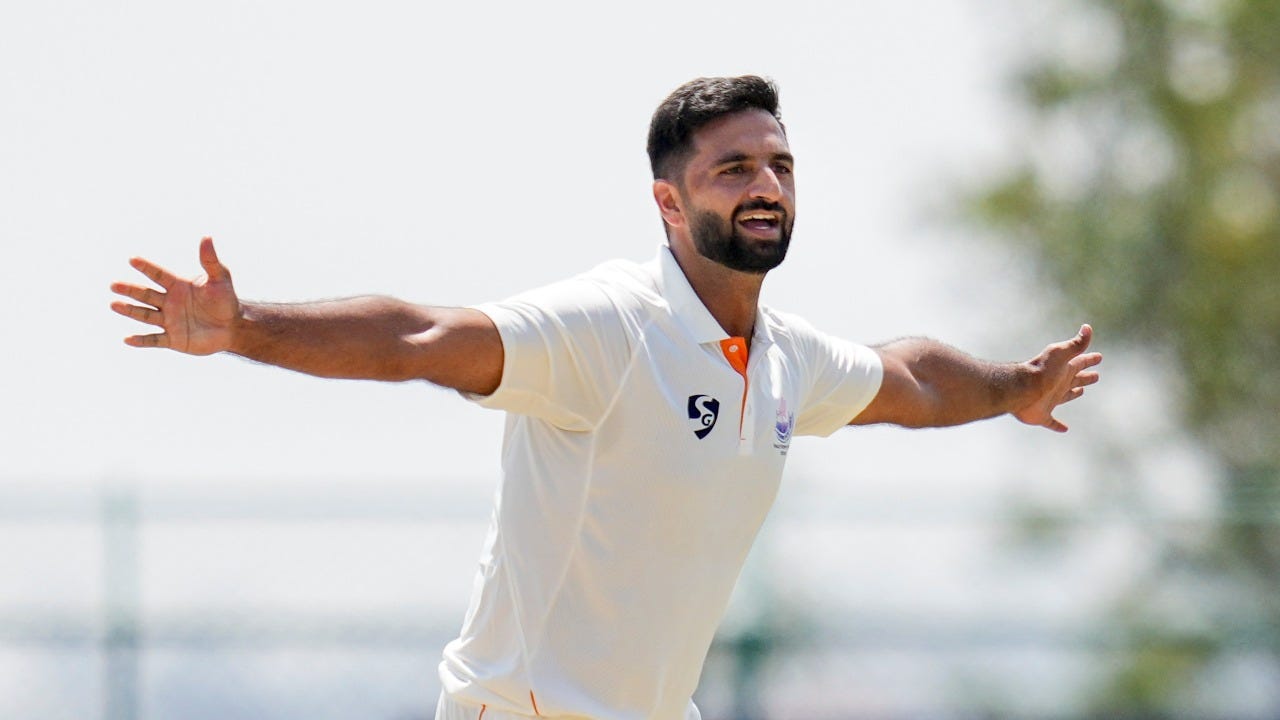
In the month before this New Zealand tour, Srinagar hosted the Irani Trophy, its biggest match in more than forty years. The Irani Trophy is a supercup of sorts, contested between the Ranji Trophy champions and the Duleep Trophy champions. Imagine the seismic significance of Jammu & Kashmir playing this flagship game in front of a doting, loud home crowd. Many, including Nabi, couldn’t have dared to dream of this.
The rest of Jammu & Kashmir’s team played the game. Nabi, instead, was picked as a reserve seamer for India’s inconsequential ODI series against the West Indies. There he got one match on a day when West Indies scored 400 and India chased it down without dropping sweat. Nabi is not an ODI bowler, certainly not on roads as flat as my writing desk, and yet, that’s the examination he has to endure. “He should’ve been at the Irani Trophy match,” Mohsin says. “Five-wickets easy.”
Some months back, in the afterglow of the Ranji season, rumour went around that Nabi had been asked by then chief selector, Ajit Agarkar, to prepare himself for the New Zealand tour. It was understandable to think of him beyond the tour to Sri Lanka, where India were likely to play only two seamers. Agarkar brought panache to the selector’s role: one, he was never shy to take the tough or unconventional call; and two, more importantly, he always held press conferences to explain his selections and take questions. Agarkar had been a brave bowler, and he picked his teams—whatever of them he could—with a similar progressive vision.
Agarkar left his office this September. Lately, some of his more radical decisions had been undermined and overruled by those higher up on the Board of Control for Cricket in India (BCCI) ladder. Sometimes, it’s worth remembering that the BCCI is the only cricket board in the world with “control” in its name. That control manifests in all sorts of ways, not least in keeping their most marketable faces close to the team. So, unable to mould this young team to a coherent vision, Agarkar left as his contract ended. Another ex-player, evidently closer to the BCCI, has taken up the position.
There was no press conference after the squad announcement for New Zealand. There’s unlikely to be one in the foreseeable future.
–
Aaquib Nabi turns thirty next week. India won’t tour New Zealand in another four years, England in the next three, Australia and South Africa in the next two. These are the conditions where he could both warrant a place and truly shine. He will soon be of the age when selectors begin discarding fast bowlers. Even in the short term, their gaze has moved sideways to Gurnoor Brar, Prasidh Krishna, Akash Deep, and Anshul Kamboj—talented, all of them, but that’s hardly the point.
Like Prem Panicker tells me, you could write a parallel history of Indian cricket through the players rejected for reasons other than cricketing merit.
That story starts with Palwankar Baloo, who Ramachandra Guha once called, “India’s first great cricketer.” On one tour of England, in 1911, Baloo picked up 114 wickets, becoming the subject of many affectionate nicknames and headlines in local newspapers. In India, he was often seen through his social status: born in Dharwad to a chamar family, amongst the lowest rungs in the Indian caste hierarchy. His Dalit birth was tagged on him everywhere he went. Even in Bombay, a modern and progressive city on many fronts, life found a way to remind him of where he came from. Despite his outsized skills relative to his team-mates, Baloo was denied the captaincy of the Hindus in the annual Bombay Quadrangular tournament.
The newest chapter is Aaquib Nabi: born in Baramulla, genial and soft spoken to a fault. In form, foundationally strong, he has done everything that can be asked of a prospect and then some. And, in all likelihood, his time has gone before it ever came, before he could have the chance to grasp it.
Tum cricket fanatics kitna achcha likhte ho! I say this with much awe and affection 💜