

Shreyas Iyer has the gait of a Bollywood hero in action. He walks with his head thrown back, shoulders loose, a languid authority in every stride. He’s chill, but he’s in control. He wore that nonchalance to the Feroz Shah Kotla Stadium on April 25th, and kept it on while depositing balls fifteen metres into the stands.
The last of his sixes took his team, Punjab Kings, to within two runs of victory with nine deliveries left. They got there with a single and a wide. In the dugout, players and staff exchanged high fives and hugs. On the pitch, Shreyas tapped fists with his partner, Shashank Singh, pulled off his helmet, blew out some air, and that was that.
Nothing in the pictures told you that Punjab Kings had just completed the highest ever chase in T20 cricket. They didn’t tell you the significance of getting there with eight deliveries to spare. It’s one thing to execute a record chase, completely another to stroll and hop your way there.
On the receiving end of this, the Delhi Capitals, their faces drained and empty. At the halfway mark, with 264 on the board, they must’ve believed the match was half won. No batting lineup, however deep, chases that down. Not after fielding for two hours in Delhi’s brutal afternoon heat.
Evidently, it was not enough even for a tight finish.
Between them, the two sides faced 234 balls and hit 82 to the boundary—a four or a six every three minutes, for close to four hours. It was extraordinary viewing, equivalent in sensation to eating an entire bar of Toblerone after every meal for a week.
A record chase should leave you on your feet, adrenaline coursing through your body. This one left numbness. Shreyas played several gorgeous strokes that evening; KL Rahul’s innings was an exhibition of neat lines drawn into the Delhi air. I cannot recall a single shot from either knock. Compare this to, say, the near-photographic clarity with which I remember Sachin Tendulkar’s six off Andrew Caddick at the 2003 World Cup—a match I haven’t watched in years. I could draw the line of Caddick’s delivery, point to where it pitched, trace how Sachin swivelled onto his back foot, the arc of his downswing, the exact roof of the Kingsmead Cricket Ground the ball sailed over. This isn’t nostalgia talking, because I remember, just as vividly, Harmanpreet Kaur’s six over covers in last year’s semi-final against Australia.
These shots left a mark because the game around them had texture, richness, many different skillsets colliding. The sixes came as release. For most of this IPL season, teams have compulsively operated with the volume knob turned hard right, leaving no time for breath, nevermind release.
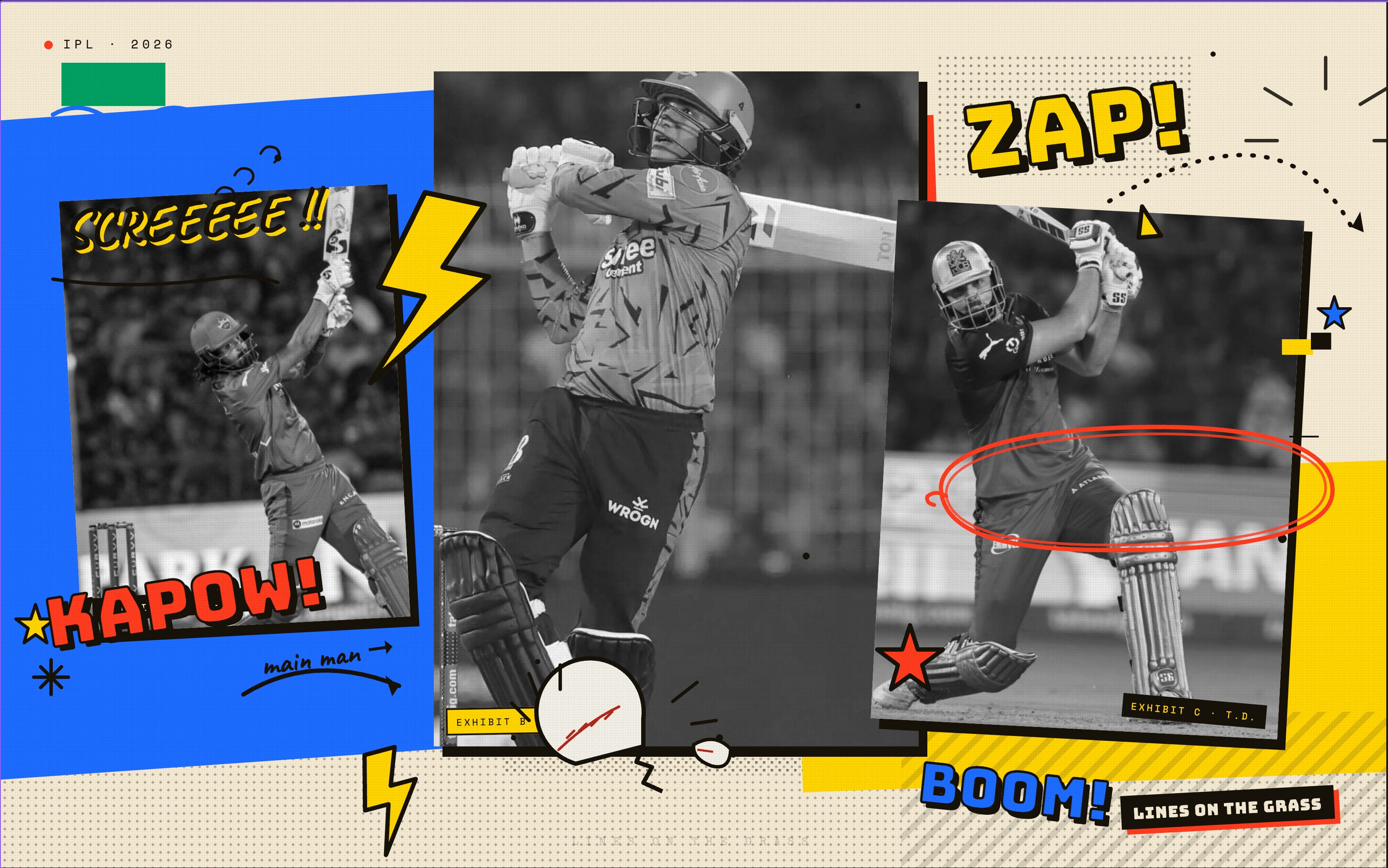
Recently, Muttiah Muralitharan—coach these days at Sunrisers Hyderabad, but holder of 1347 international wickets in his youth—was asked about this incessant flood of boundaries, the soaring team totals in the IPL, and how to not make bowlers feel like props at a batters’ play.
He said, “If we give fair wickets, the spectators will say it’s become boring because the T20 followers want entertainment, so they want to see the fours and sixes. That’s why the tournament is built like that. It is a big business at the moment, sponsors and everything, so you will lose the sponsors and interest of the people if you change it.”
Most others would’ve phrased that answer differently. They would’ve perhaps leaned into the technical and physical skill required to hit so many boundaries, how good their own batters are, or how power-hitting is the nucleus of T20 cricket in the 2020s. Murali, to his great credit, did not muffle the bowler underneath the IPL employee. He smiled through his answer—he always smiles—but read those words again, and you’ll notice a tone of resignation.
**
The Indian Premier League was born with a mishit.
It was the evening of April 18th, 2008. The M. Chinnaswamy Stadium in Central Bangalore, resplendent under floodlights and fireworks, was decked up for a carnival night. At the inaugural match of cricket’s new, glittering show, out walked two new teams. The Kolkata Knight Riders, owned by Shah Rukh Khan, wore a jet black jersey with gold details and gold helmets—Shah Rukh wanted his team to look like medieval knights. Opposite them, the Royal Challengers Bangalore. Owned by a liquor baron, named after a whisky brand, a lineup of 35-year-old Test cricket specialists dipping into a discotheque.
T20 cricket, just four and a bit years old at the time, was still a child. A tournament like the IPL was a solo trip to Disneyland. Nobody knew what to expect.
And so, the first evening. Sourav Ganguly and Brendon McCullum, two firebrands at opposite ends of their careers, pushing and prodding but unsure what tempo to assert. McCullum was on 8 runs off 8 balls—slow by every measure. He needed to hit or go, so he hit. A couple of thrashed fours loosened his limbs and perhaps the mind. But something, you could tell, was still simmering. He swung again. The next ball kissed the outer edge of his bat and flew over the boundary behind him.
Mishit it might’ve been, but it landed with a crack. A Bollywood dance number blared through the speakers, the crowd were up on their feet, even the VVIPs rose up. We were away.
This shot set off a chain reaction whose impact neither McCullum, nor Shah Rukh, nor the league’s creator Lalit Modi could’ve anticipated. Before the match, the International Cricket Council (ICC) President, Ray Mali, had said to Modi, “Congratulations, you have taken cricket to the next level.” They turned out to be prophetic words.
McCullum went into a trance, flaying every bowler coming his way, most into the low-hanging second tier of the Chinnaswamy Stadium. The home crowd, yet to form true loyalty to a franchise team, danced with him anyway. McCullum finished that evening with 158 unbeaten runs off 75 deliveries. Kolkata Knight Riders racked up 222 in their 20 overs. And the collective breath of those present, presenting, in the dugout or watching from home, was taken away.
The next afternoon, Chennai Super Kings put up 240 in their 20 against Kings XI Punjab, who responded with 207.
And just like that, a new order of cricket was written. This old sport hadn’t known a cocktail of drama, glitz, and fireworks as potent as this. From here, it was going to be sixes in bulk. Bats would get fatter and boundary ropes would be pulled in. Teams would get to hoard the world’s best talent. The scariest hitter in the world would bat alongside a technical genius and the most prolific batter in the world. The hitter will score 175 in one afternoon; the prolific guy, soon becoming the face of the sport, will touch nearly one thousand runs over one sweltering summer. Some years later, teams would be allowed a substitute, changing the game’s tenor and rhythm, empowering batters with even more freedom. And all these logs of lean muscle would make hitting boundaries their entire personality.
The audience, long thirsty for something fresh and punchy, would lap this up. They’d be fed so much they’d stop tasting what they’re eating, but they’ll come back for more every evening. At the ground, there will be a DJ dedicated to raising the decibel level and your blood pressure. He’d scream into the mic every thirty or so seconds. On commentary, ex-cricketers will shuffle between selling you cars and asking you to stop what you’re doing and watch a man obliterate bowlers.
**
T20 was invented to fix a few problems. One, most other cricket—Tests and ODIs—happened during work hours. And two, Test and ODI cricket took up hours, often without adequate bang for buck. It was niche and inaccessible for those on the outside looking in. Much market-research later, the answer was a shortened format, played under dark skies and floodlights.
But you’ve got to be careful while compressing a complex, moving entity. Traditional cricket, for all its visible sluggishness, holds tremendous nuance. Bowling requires putting your ankles through many times your body weight—six times an over, over after over. Batting requires facing projectiles at highway speeds, hurled from twenty-two yards, often moving sideways off the surface or through the air. Both skills are extremely difficult—they’re supposed to be, that’s the point.
Cricket at its best places a batter in conversation against a bowler. A seamer finds the right length on a moist pitch and the ball holds its line till the last moment before darting away. The batter plays and misses, plays and misses. The slip cordon walks in three yards. The bowler, ravenous, goes fuller and quicker. Every ball is a question. The batter, if he’s any good, listens. He shoulders arms to one, defends another with soft hands, then punches the next through cover, rebalancing the tone of the argument. This is where cricket breathes. The sport accumulates meaning through pressure, and it is in resistance to pressure that character is revealed.
Take Virat Kohli. Amongst a garland of great innings, some of his finest T20 outings came when the bat was made to work hard. His unbeaten 82 against Pakistan, on Diwali 2022, came against three Pakistani seamers making the ball bounce and swerve on a spicy Melbourne track. The game had almost slipped out of India’s hands. There’s another 82 not out, against Australia in Mohali—Kohli the batter, beginning to enter stratosphere; and India, still playing an archaic version of T20 cricket, on the precipice of getting knocked out of a home World Cup before the knockout rounds. You have many others—the 72 in the 2014 semi-final against South Africa, the 89 in the 2016 semi-final against West Indies. Fine knocks all. But slightly obscured by their volume, you’ll find his 49 and 55 against unyielding Pakistan bowling attacks on abrasive pitches. Played between a few weeks of each other, those two innings turned Kohli from good to great. Pressure knocks make a batter, and it’s doubly true in Test and ODI cricket. None of his nine IPL centuries would’ve given him remotely comparable satisfaction.
Ask Sachin Tendulkar about his favourites, and he will not default to Sharjah ‘98, but Chennai ‘99; Lara will speak of Barbados, not Antigua. Good batting, like good boxing, is an act of resistance and dominance both.
**
I was at the Wankhede Stadium, on March 5th, watching India play England in the semi-final of the T20 World Cup. I will remember that night for how special inhabiting Wankhede felt: the chants rolling across the stands, every other minute; the boy in the next seat venting to me, a complete stranger, about Varun’s bowling; the uncle to his right, a man weary from India losses, sitting with crossed fingers till the final ball; bhel distributed in the row below us; boxes of aamchi in the row above; the yelps, the groans, and the roar from Bumrah’s yorkers at the end.
Writing this two months after that evening, my remaining memory of the cricket is fairly broad-stroked. India batted first and scored 253 in 20 overs. 253 should be an insurmountable total, the kind which deflates the opposition. England nearly chased it down, falling seven runs short, the match on a wire until the penultimate over.
But, even at its final turn, when thirty thousand of us sat with clenched bums, the contest hinged on one question: could the English batters clear the boundary a couple of more times? Not what the bowlers might do, the ways they could own the night, perhaps the pitch playing tricks. Nothing, just the distance the batters were capable of covering.
In the final at Ahmedabad, three days later, India batted first and scored 255. Given the wide boundaries of Ahmedabad’s fishbowl, New Zealand stood no chance. It turned out to be a boring, colourless World Cup final that, looking back, was decided within the first half an hour.
Eight days later, on the first day of this season’s IPL, Sunrisers Hyderabad scored 201, which the Royal Challengers Bengaluru chased down with five full overs to spare, as if to confirm that T20 cricket, in all forms, was a loop, the same melody moving between instruments without change in register or tempo.
In school, during computer lab periods, while the teacher made her rounds checking if we’d finished our C++ assignments, we played a browser game called Stick Cricket. It was cricket reduced to its barest bones—a stick figure at the crease, a thinner stick-figure bowler delivering the ball, and two or three shots to choose from. You picked a direction, pressed your arrow key, and the ball flew. It was incredible fun: I once scored some 400 in 10 overs playing with Bradman and Sobers. You could finish an entire match in the time it took the teacher to walk from one end of the lab to another. It was too ludicrous a caricature to venture beyond browsers and mobile phones.
By making cricket a mirror image of this, by pushing the conditions so far in favour of the batters that bowlers become secondary citizens, you deny the sport its central tension. And without tension, without a strong pull to a push, there is no story. You lay the road for fewer matches that test every skillset of the sport. You arrive, eventually, at scores above 250 in World Cup semi-finals and finals, and 264 getting chased in two hours flat, without sweat. You arrive at a version of the sport where the highlights reel and the full match feel roughly the same, and every frame has the same species in the centre. No amount of shrieking hyperbole from the commentary box can conceal the foundational hollowness of such a thing.
T20 cricket, this format so full of possibility, has been reduced to an inert television programme. It’s weak sport. And everyone is worse off, even the batters.
This is such a beautiful articulation of what some of us are feeling. I wonder if it feels particularly dry this time around because it has come so soon after a high-octane WC, in the same venues, with the same players, the same din, the same cliches by the commentators, and (almost) the same fans.
There have been some classic hits, like Bhuvi, Virat, Rabada, Narine. But somehow it all feels a bit blurry, like one song hasn’t quite faded out before the bass drops on the next.
I watched the 4th innings highlights of the Aus-Eng 1981 Headingley classic on YouTube recently. Some standout aspects:
1. No aggressive exultation from the fielding side after taking a wicket. No gesticulating to cameras. In fact, after taking his 3rd or 4th wicket, Bob Willis turns back so quickly, after appealing, to walk towards his mark that I thought the batsman was not out. He didn't even venture to meet the exulting fielders. Only when I saw the batsman walk, did I realize that he was, in fact, out. Listening to Bob Willis in his later years, one could see that he was quirky and different. Maybe, he was still fuming at the ignominy of not getting the new ball. It is said that Mike Brearley did this deliberately to get him worked up so that he would bowl with hostility, but I digress.
2. No aggressive commentary. No speaking in breathless tones continuously as if a war is going on out there. Lots of pauses. And almost unbelievably, no clichés. Just observations.
3. No aggressive camera angles following the departing batsman closely, all the way to the boundary, whereby the batsman feels duty-bound to show so much remorse for his dismissal that it makes you squeamish.
4. No aggression from the spectators, aided and abetted by the aforementioned camera angles.
Just a smattering of claps/appreciation/oohs and ahs for anything happening on the field of play.
What I then realized is that, it is that sport that I grew up watching, reading about and loving to bits. It has no connection to the sport that is playing out now, irrespective of the format.