

It is 6:30 in the morning in Bangalore. It’s dawn, technically, though the sky is covered in a heavy grey blanket. Outside, a westerly breeze pushes the crown of the rain tree hard to the right. Bangalore has been torched, like most of the subcontinent, by summers hotter than ever, and yet, at this hour, in this weather, you understand why the city was once called a hill station. A koel is chirping in single-note whistles, alone. Her mates, evidently, have the sense to still be asleep.
I shouldn’t be awake either. I had gone to bed four hours ago, right after watching France be France against Senegal. This is the first World Cup in my living memory that I am keeping at an arm’s length. I have been questioning if I love Brazil enough to wake up at 3:30 am to watch them struggle to stitch four passes against Morocco. But, it is still a World Cup. For all its garish clothing, abrasive behaviour, and water breaks arriving like planned power cuts, there remain things worth the alarm. One of them is called Lionel Messi.
Argentina are a good team, and like any good tournament team, they’re built for endurance more than thrill. When Lionel Scaloni was handed over the coaching duties in 2018, he was given one diktat: win us the World Cup. Messi, thirty-one years old then, ran a very real risk of finishing his career without one. So Scaloni built a team around Messi, with one tweak: the maximalist robe Messi had worn for Argentina, almost by compulsion, was folded away. This Argentina needed Messi the minimalist, the touch player, the magician who could vanish and reappear. Sometimes, like in the second goal of the 2022 World Cup final, all the team needed was a turn and a touch. Sometimes, a piercing pass, threaded through a gap of inches. For the rest, Messi would know when to wear his cape, from two decades of muscle memory. Scaloni spread the creative responsibilities across his attack, and built a wall of midfield and defence that wouldn’t yield an inch. So, waking up for Argentina’s Messi was a gamble worth taking, but a gamble nonetheless.
The Arrowhead Stadium, in Kansas City, is tall, wide, and roofless, like a wok without a lid. I notice Messi as he leads his team out. The sun is dipping behind the giant rugby ball-shaped electronic screen perched on the far side, and he’s taking the sight in. There was an intensity to Messi’s face in 2018 and 2022, a tightness in his jaw and eyes, perhaps from the tension of not knowing if he was on his last chance for a World Cup. That burden has been lifted. This is a World Cup and multiple Copa America-winner Messi. His shoulders are loose; his face, carrying the puff of age, is a lot more soft around the edges. I didn’t think Messi would play this World Cup. Last September, when the Buenos Aires crowd serenaded him, carrying posters of “Gracias por todo,” I took that for an ending. With his life’s objective fulfilled, I thought he would unlace his shoes. I am glad he didn’t.
Here, then, is a full World Cup of Messi ahead of us. There’s a quirk about watching a genius: for 85-87 minutes of a 90-minute game, you don’t watch them at all. Professional footballers, a widely-accepted theory goes, are in possession of the ball for two minutes a game, at best. The rest of the time is spent covering ground, shadowing runners, waiting to sprint, sprinting without a pass, pressing, jostling—you get the drift.
Messi may be football’s greatest ever walker. He wafts in and out of spaces, like air, a faint outline behind the hyperactive movement of others. He isn’t lazy—he works diligently in defence when his team needs it. Most of his walking happens as his team patiently builds up its moves. Messi waits, several beats ahead. And then, as the ball moves into his quarter, you feel the wind change direction. Your back straightens. Something snaps into motion within him. Your eyes leave the ball and start searching for him. Often, the move won’t complete and the possession would be recycled, but there is a thrill to the anticipation, a sensation that magic might be a five-yard pass away.
The first such moment of this game comes around the fifth minute, as Argentina move the play high on their left wing. Messi, almost stationary, suddenly springs to life and sprints into the penalty box. The pass to him never materialises, but the attempt brings the crowd to their feet. They have their first “ooooh” of the night.
The ball eventually finds him around minute seven. Argentina move forward in a wave. Messi receives the ball, pirouettes on his left leg, turns to see Algerian defenders standing in a double-layered wall, and passes the ball behind. He understands tempo, this guy. Maybe, in a previous life, he was a musician or a poet. So he just moves the play along, lowers the heartbeat. Not now. With every little touch and turn, the heart pumps a little faster, but he’s asking you to settle in. Ninety minutes is a long time.
This passage, still, highlights a couple of truths about the play we’re a captive audience to: one, Messi is 39. There was a version of him, not too many years gone, that would’ve seen two blocks of defenders and taken them on. It used to be his thing. He would slip past defenders, a ribbon snake on a swamp, the ball glued to his shoe. The mind inevitably wanders to all the goals he’s scored like this: his first great goal, against Getafe; the semi-final goal against Real Madrid; then, the one against Athletic Bilbao, so incredible in dexterity, so fluid in motion, it was sent to a lab to analyse. Those days are long past us. Even Messi, it turns out, has to reconcile with time.
The second truth is that Messi understands this. Which is incredible. Athletes who touch sustained greatness get there by believing nothing is beyond their reach. Sachin Tendulkar did not retire because he ran out of belief; his body just caught up with his spirit. Rafael Nadal deeply understands fear and insecurity, as the documentary Rafa shows us vividly, but he never thought that a tennis match could not be won. Most who reach the very top of a sport carry a version of this sickness. For Messi to be Messi and still be alive to the erosion within him is a gift almost as rare as his football skills.
Around the tenth minute, Lautaro Martínez dinks the ball towards Messi, setting him one-on-one with the Algerian goalkeeper, Luca Zidane, son of Zinedine. Messi takes two deft touches towards the goal, and, in the same motion, dummies a shot, swinging his foot in a hitting arc and breaking—the arc, not his stride—at the last moment. The goalkeeper, already crouching low, has lost balance, his legs buckling under him. My throat has belted out “Messi!” or some such. With his next touch, Messi scoops the ball over the goalkeeper, into the net. The American commentator screams like he would for a home run. The linesman raises his flag to signal offside. Messi nods, knowingly. It’ll come.
In the seventeenth minute, the ball is played to Messi again, who’s standing halfway between the centre circle and Algeria’s penalty box. The pass is quick and vertical, cutting past a line of defence, signalling aggression. Messi turns while receiving the ball, cushioning it on his inside leg as he sets off towards the goal. The heart pumps again. There are two passes available to him on either side, or a longer dribble if he chooses so. I’m up from my chair. The defenders, two-thirds his age, are backing off. It’s logically a wise decision; to apply pressure on Messi is to douse fire with your hands. But it’s also a perilous decision. He takes one step, two steps, and then thwack! About twenty-five yards away from the goal, Messi has let rip. The ball curls between two defenders, over and sideways from the goalkeeper, touches his outstretched fingers, and sploshes into the white mesh of the goal.
It’s a superb shot, but only by the standards applicable to everyone else. If you have watched enough of Messi, this is a goal you’ve seen a hundred times over. I doubt Messi thought much about the shot himself—it was too close to the ‘keeper, too many inches away from the top corner for his liking. The moment, regardless, was incredible. He stretched his hands wide, like the wings of a bird, and went on a long celebratory run before letting himself be wrapped in Argentine hands and bodies. Messi is playing his sixth World Cup, and perhaps, for the first time, with true freedom.
Twenty years back, a few weeks after Messi’s thrilling World Cup debut against Serbia and Montenegro, David Foster-Wallace published an essay on Roger Federer. Titled ‘Roger Federer as a Religious Experience’, the essay has become something like a Messi highlight—timeless, a reference for its craft, and quoted at every opportunity, not least by this writer. It starts thus: “Almost anyone who loves tennis and follows the men’s tour on television has, over the last few years, had what might be termed Federer Moments. These are times, as you watch the young Swiss play, when the jaw drops and eyes protrude and sounds are made that bring spouses in from other rooms to see if you’re O.K. The Moments are more intense if you’ve played enough tennis to understand the impossibility of what you just saw him do. We’ve all got our examples.”
Replace Federer with Messi, Swiss with Argentine, and the paragraph sits just as neatly for The Messi Experience™ in the last couple of decades. I have given up, over the years, trying to be civil while watching him. The sounds, whatever they are, are involuntary; it’s my body reacting to him. I’m sure a sound was made when the ball turned right, mid air, and hit the Algerian net. Other sounds were made too, in spurts, throughout the first half, even if there weren’t any other goals. There was a body feint here, a little dribble there, the anticipation of sorcery enough to set off a spark.
The faces of the Algerian defenders tell a story. They know they are at one man’s mercy. They start the second half better. Argentina respond, with their gang of muscular tyros moving into attacking zones and taking their shots. Messi is fairly peripheral. He’s around, floating in the vicinity of the action, but outside the frame. Then, in the sixtieth minute, another midfielder takes his shot from long range. The ball flies low into the goalkeeper’s hand, and pops right back out. Oh. Messi has taken off for the rebound. Behind him, the Algerian defender takes one step drops. Easy, 2-0.
Rewind the footage to the moment the goalkeeper spills the ball, and you’ll notice Messi uncoiled, already sprinting. A lot of football, sport even, happens between events. You’ll hear top-level pros talking about visualisation and anticipation. This, is what they mean. Messi, like all good forwards, has reacted to the possibility, not the play.
Just a few moments later, another ball from the midfield is sent towards Messi—fully switched on now, playing near the last defensive line. His first touch takes him beyond the nearest defender, as if his body is moving in union with the ball. Oh yes. Second touch, further. Only the keeper and eighteen yards between him and the goal. Oh yes! The left foot uncoils, loads, and snaps. The shot’s good, the goalkeeper equal to it. Messi slows down, smiling. Oooh, it’s coming.
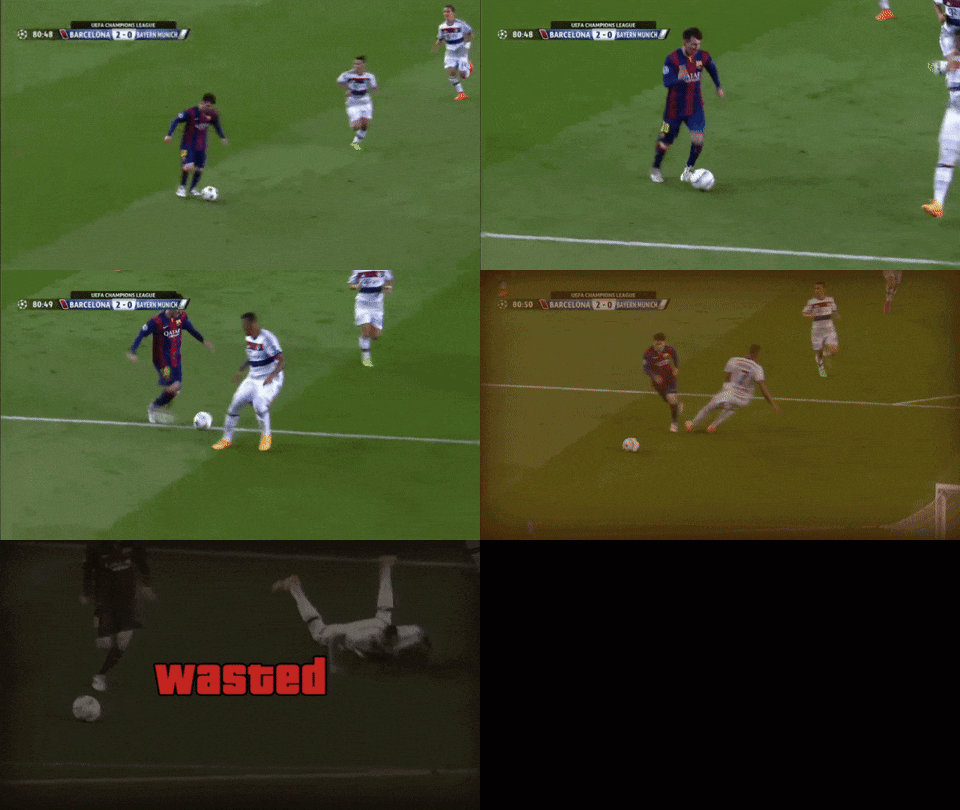
There is an air of inevitability to Messi in this mode. You cannot always reason logically that the next one is coming; you just know it is, like how you know it will rain from looking at the sky and smelling the air. Algeria’s defenders seem to know it too. They are a half-yard deeper than they were five minutes ago. I wonder if, all those years ago, Jerome Boateng, one of the best defenders in the world, playing for one of the best teams in the world, saw it coming too.
Argentina are in fifth gear now. Passes fly forward with real speed, slicing through defensive lines. Algeria, already fragile, are getting opened up. The ball is moved to the left flank, and passed back across the penalty box, just outside, on the edge of the ‘D’. There stands Messi. One touch, another touch, both sideways, and that left foot drawn back again.
An archer’s range of motion, in sequence, can be described as: nock, draw, anchor, aim, release, follow through. Messi doesn’t need to anchor, neither does he need time to aim. He lets his muscle memory take over. The destination is certain from the moment the ball leaves his foot. It moves low, hovering over the ground, swerving outside then inside, sneaking in near the post, almost kissing it. It’s impossible to stop for a goalkeeper who had been standing, reasonably, near the centre of the goal. My flatmate must be a deep sleeper because I have no clue how my shriek hasn’t woken him up. 3-0, hat-trick. Messi is on his follow-through, smiling, waiting for his friends to join him.
I am a frequent borrower of words, and the words I’m thinking of in this moment belong to an Uruguayan man, born on the other side of River Plate from Messi.
“One fine day the goddess of the wind kisses the foot of man, that mistreated, scorned foot, and from that kiss the soccer idol is born. He is born in a straw crib in a tin-roofed shack and he enters the world clinging to a ball. The ball seeks him out, knows him, needs him. She rests and rocks on the top of his foot. He caresses her and makes her speak, and in that tête-à-tête millions of mutes converse.”
We have been watching Messi for twenty years now—he first wore the Argentina shirt at a World Cup as an eighteen-year-old substitute, gangly, sharp and slippery, while his current coach played right of defence. His longevity is a marvel in itself. Football is a young athlete’s sport. It’s ruthless, ready to discard you the moment your hamstrings start moaning. Besides, playing centre-forward is serious work. And yet here he is, thirty-nine in three days, still the most decisive man on a pitch occupied by players at least a decade younger and quicker.
There was a little bit of poetry in the placement of this hat-trick too. In the six hours preceding this game, Kylian Mbappé and Erling Haaland, 27 and 26, from France and Norway, had scored two goals each. They are the present and future, exhibits of elite talent meeting unimaginable confidence and superhuman, almost lab-created, physicality. They don’t beat so much as pummell opponents into submission. For illustration, check out Mbappé’s second goal from the night, a thirty-five yard rocket that left the Senegal goalkeeper tapping at thin air. Messi is playing his sixth World Cup and sits with sixteen World Cup goals. Mbappé has fourteen and he has only begun his third.
Messi is nothing like them, never was. For him, the goal happens when it has to. The journey there, the passes, the dribbles, the magic that sometimes pays off, sometimes doesn’t—that has always been his raison d’etre. The play isn’t a means to an end, but the end itself.
While everything around him evolves, gathering pace and muscle, accumulating bricks for football as a more frantic, more dramatic spectacle than ever before, Messi wafts in and out of space, like air, waiting for the moment when he can play with the ball. Even in his minimalist avatar, there’s a boyish joy to what he does. Maybe that’s why we love him with a tender, heartfelt warmth. Maybe that’s why he transcends the petty discourse of team fandom. And maybe that’s what makes Messi eternal, worth waking up red-eyed for, even if he’s 39 and puffy-faced.
Uff! That last para was poetic!
And this sentence says so much - “Messi is playing his sixth World Cup, and perhaps, for the first time, with true freedom.”
Fantastic piece. Someone must have slipped us the same hymn sheet…