

Around half past ten on February 18th, the exit turnstiles at the Delhi Gate metro station had stopped working as exits. Trains kept delivering passengers, but the platform had no room left to receive them. Bodies pushed into each other, the whole thing now a mass growing denser and louder and less patient by the minute. Outside, Delhi was rainy and misty, the final passages of winter before it gives way to spring.
One would assume many of these were office workers already late on a Wednesday morning. Some were, definitely. But, once the mass finally loosened, a thick stream gushed out towards the Ferozeshah Kotla Stadium, where South Africa were playing UAE in an inconsequential game. By mid-afternoon, eighteen thousand had packed into the Kotla. Screaming, heaving, adding more life to the vibrant soundtrack of this World Cup.
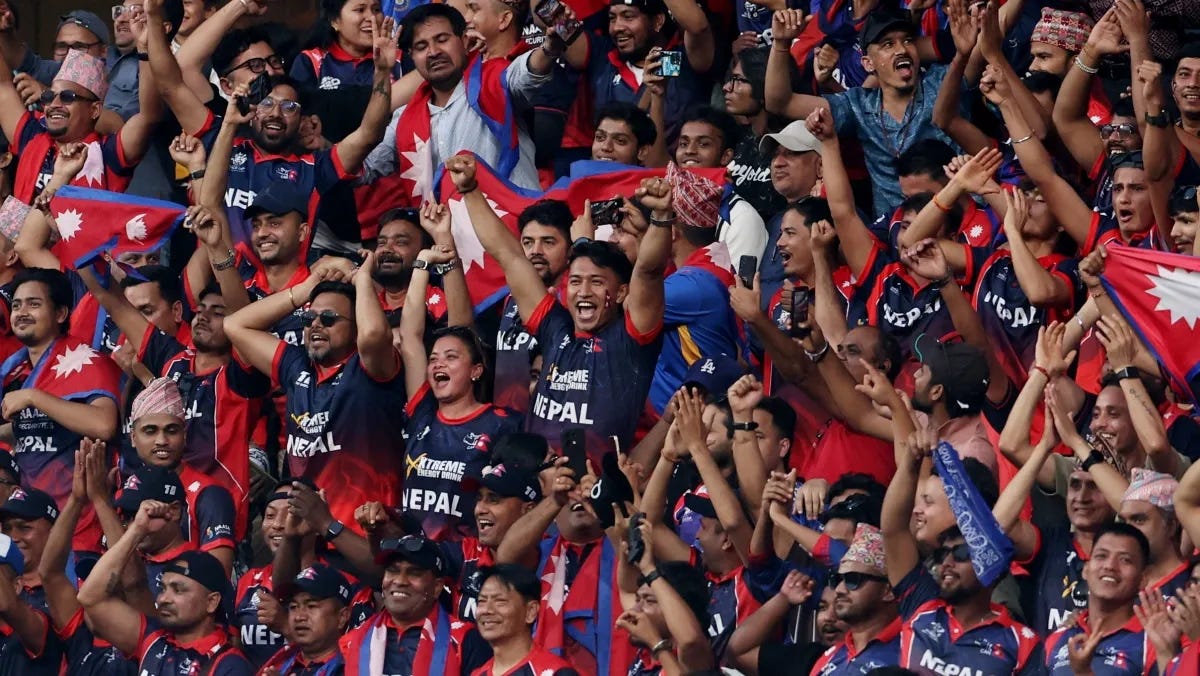
The previous evening, twenty thousand fans had serenaded Nepal’s cricket team at the Wankhede Stadium in Mumbai. For two weeks, one of Indian cricket’s spiritual homes had turned brick red. The stands and walkways were flush with Nepal shirts and Nepal flags, their collective sound carrying celebration and a distinct hilly dialect.
Scotland fast bowler Brad Currie felt he was, “playing in front of a nightclub.”
Niraj, an agricultural engineering graduate from Tribhuvan University, travelled all the way from Itahari, a city on the eastern tip of Nepal. “Watching Nepal play at a World Cup in an iconic venue like Wankhede felt like some sort of dream,” he told me. “The moment our national anthem was played, everyone stood up and sang, keeping their hands on the chest carrying their flags high. It felt pretty emotional. Even though we lost that game, being there was like witnessing a history beyond just a match.”
In Chennai, the local train station at Chepauk was crammed on matchdays with cricket travellers in knockoff jerseys. Along Victoria Hostel Road, the street lining the MA Chidambaram Stadium, fans were hunched over next to jersey vendors, going through the racks to find the name they’d come searching for. One vendor kept a small batch of Smriti 18s and Harmanpreet 23s, should anyone be interested in that other series happening across the pond. They sold out.
Gomesh from The New Indian Express found an engineering student carrying banners that referenced America’s Dutch history to the USA vs Netherlands game.
In Colombo, the Sinhalese Sports Club ground threw its gates open for multiple games, including the curtain raiser between Pakistan and Netherlands. For the matches it didn’t, or couldn’t, its grass banks were opened for free. There is precedent to this: the R Premadasa Stadium, a 15-minute tuk-tuk ride away from the SSC ground, had offered multiple free-entry games during the Women’s ODI World Cup last October.
The Sri Lanka leg of the tournament built steadily, game by game, until it peaked in Kandy, where Sri Lanka met Australia at Pallekele with qualification on the line for both sides. The stands were full, the grass banks were packed, and the game was a bonafide classic. One might have seen the result coming, but the electricity was off the charts. The papare band, with their brass quartet and mini drums, laid a carnivalesque background score to a night that will live long in Lankan lore.
Every tournament needs an early hook, a propulsive force that takes it from ambient noise to a live tour engulfing a people as it crisscrosses between cities. Football doesn’t sweat about this, so vast is its popularity, so many stories simultaneously playing out. And, besides, a football World Cup tours once every four years. Cricket neither breathes nor has the breadth of football. The last World Cup ended eighteen months ago; the next one starts eighteen months from now. And the sport is still struggling with expansion beyond the handful that keep it alive.
In the subcontinent, where support is often partisan and fickle, it’s hard to drum up an immediate interest outside of local-team bubbles. During the 2023 Men’s ODI World Cup, the India games were packed, stands resembling rising walls of blue, while the others had relatively sparse attendance. The chance of variation was worsened gravely by the appalling schedule and ticketing process.
This time, it didn’t matter who was playing. The audience came anyway. And the teams they came to watch, the “minnows” who are generally expected to be grateful for the pass and just make up a crowd, all turned up ready to fight. Netherlands almost beat Pakistan; USA had India gasping in Mumbai; Nepal ran England close; Zimbabwe won a group that had Sri Lanka and Australia; and Italy have not looked anything like World Cup debutants.
Which makes it a crying shame that the best match of the tournament, an all-time World Cup classic, was played in front of a hundred thousand empty seats. Afghanistan needed 19 to win off 9 balls against South Africa, when Noor Ahmed, with a career batting average in single digits, hit a six that Dhoni would’ve been proud of. A few minutes later, with 11 needed off 5, Noor hit another. A run out on the last ball tied the game and took it to a super over—effectively, a one-over shootout.
Afghanistan scored 17 runs in their super over. South Africa responded with a hit and two, but left too much in the bag with 7 needed off their last. Then, Tristan Stubbs, in keeping with the game’s pulse, hit a six. Like my friend MV observed, there was an inevitability about that six, as if the match couldn’t end just yet.
It was nearly 3 pm in Ahmedabad, the sun roasting twenty-two drained players as they stretched for a second shoot-out. The tremendous hollowness of the backdrop was hitting even harder now. Those vast sheets of orange and blue plastic were piercing the eye, the echo from bat and ball lifeless, missing its human amplifier. But, by then, the digital crowd had turned up, drawn to the insanity once word had spread through Twitter and WhatsApp groups.
The South African batters, taking first hit in this second Super Over, smashed three sixes to mount an immense, unachievable 23. Unachievable for whom, you ask? Good question. The short, lean, and muscular Rahmanullah Gurbaz responded with three sixes of his own to set up another final-ball decider. This time, the target was too far.
A game that had moved one way and another for four and a half hours finally had a winner. There was dejection, maybe a tear or two for Gurbaz, and some very tired high-fives amongst the men in gold and green.
We’ve now reached half-time at this World Cup. The group stages are past us and the tightrope walk between triumph and elimination begins now. Many of the teams who have given this tournament its wind have boarded their flights back home. They will be next remembered in 18-24 months time.
Niraj tells me, “I wish there could be a way where full members of the ICC find a window whenever they’re touring Asia to stop over at Nepal for a short series. If it happens, the Tribhuvan University ground in Kathmandu will be filled to the rafters.”
The sensation from this fortnight will linger on for a long while—past the knockouts, past the incoming wave of franchise tournaments. What the cricket did, and what the noise around it did, was pull the sport back from the place its custodians had been dragging it towards in the lead-up.
It was nasty. We should have spent the weeks before the tournament mapping out group-stage permutations and debating middle-order holes. Instead, three governments turned cricket into a lever for foreign policy, and our entire bandwidth was swallowed.
As Andrew Fidel Fernando—whose work I shadow with a stalker’s spirit— writes here, the point was not about one missing team or a potentially cancelled game. It was the tonality of the conversations, the untold stakes on the table. Cricket’s global governing body, which exists in theory as a neutral steward, has learned over the years to tilt when tilted upon.
“The ICC (International Cricket Council) has begun to favour one set of geopolitical ambitions over others, India never so much as copping a censure for its refusal to play in Pakistan. To take the ICC at face value would also require believing that ICC Chair Jay Shah is conducting his business in complete separation from Amit Shah[his father], who is India’s home minister.”
After much theatre, India and Pakistan did walk out together at the R Premadasa Stadium. Everyone watched. The official broadcaster claimed a digital reach of 163 million—the highest ever for a T20 World Cup game, more than the previous World Cup final. The match itself was predictably lopsided, the gulf between the two sides wider than ever before.
Before the game and after it, the choreographed no-handshake sequence continued. Once the profits have been secured from cricket’s most lucrative fixture, grace is clearly a surplus commodity, something to be written off. It’s at such moments when you think of the friendships that have never been permitted to form, or the tissue of fraternity between two cultures that now lies torn.
Then you think of those who played India-Pakistan cricket through actual wars, and showed a far greater grace than anyone today is managing. Last week, fourteen former captains signed a petition urging Pakistan’s government to provide medical care to the incarcerated ex-Prime Minister and cricket captain Imran Khan. One of the signatories was Sunil Gavaskar.
Isn’t that what sport is all about—a stage for humanity to push beyond its physical and mental boundaries; for the winner and loser to stand shoulder to shoulder; for recognising that adversaries for mere hours are fellow travellers on the same trek?
It should be. But we’re at a point where sport’s narrative and its voice have both been placed at the auction table, available to the highest bidder. While one group wants to own who sport is meant to serve, the other wants to own how sport is supposed to sound.
And how incredible that while all this was happening, the teams and players who exist only at the fringes of cricket, its paying guests, have lit up its biggest competition in front of hundreds of millions.
Days before the start of the World Cup, Sharda Ugra had written, “This is cricket’s last pre-LA Olympics T20 World Cup. Played in the format in which the sport will return to the Games in 2028 after 129 years. (The 2028 T20 World Cup will be held in Australia-NZ after the Olympics). With that in mind, there couldn’t have been a better advertisement of the scale, vibrancy and passion of the game and for the game for the non-cricket world than this World Cup.”
That passage was immediately followed by, “But look where we are now.”
Like she wrote, the tournament most definitely stands diminished. We could’ve done without the racket and its reverb tail of one-upmanship. But, I ask her, has the rest of it lived up?
She responds with, “Hell yes. The cricket always rescues you. Once the match starts, everything else dusts away.”
The official theme song of the World Cup, ‘Feel The Thrill’, is composed for nightclubs. The hook comes in early, with a bhangra beat on top of processed drums, and a Tumbi riff as ear candy. The lyrics, a mish-mash of words leading into a chorus of “This is our year,” barely register. The beat carries the song. It has the quality of being a dance-trigger at parties and pubs, the kind of track where nobody remembers the lyrics but everybody moves.
This World Cup, too, has played out like that. The posturing around it was ugly. But once the cricket started, it moved, and it moved in voices we don’t hear often enough, and for two weeks we found out that sport sounds best when it sings in a chorus.
Love how visual the opening is, and the pivot in the middle is so smooth.
10 mins reading this is almost the same amount of time I've spent watching (yet another? Already?) World Cup.
Exactly my point. Love the coined term Modium. Please tell me why is Abhishek Varma still being continued with? Don't we have a strong bench?