

Two minutes into the half-time interval of the World Cup final, Ronaldo, Ronaldinho, and Madonna rode a dune buggy named Maestro onto the pitch. Dancers hung from its metal rails as Madonna sang her song, “Music.” The two Rs, who once turned football into music and dance, who left defenders grasping at the space where they’d been, sat tranquilised in bright, single-coloured tracksuits. It was hard to tell whether this was real or a South Park sketch mocking the Teletubbies.
Madonna was the first act of the half-time show, sponsored by Topps, a collectible-manufacturing company. Each act was given a minute of stage time. Gustavo Dudamel conducted “Seven Nation Army” with the New York Philharmonic and the Muppets; BTS sang the chorus of “Dynamite”; Jason Sudeikis and Brendan Hunt walked out as Ted Lasso and Coach Beard and substituted Justin Bieber onto the pitch, and Bieber sang a verse about heartbreak or something; Chris Martin, who had curated all of it, played a new song with Kermit and Miss Piggy and a chorus of schoolchildren from Staten Island; Shakira came on barefoot with Burna Boy and sang “Dai Dai,” the tournament’s official song.
The interval took twenty-seven minutes, breaking the fifteen-minute norm standardised fifty years ago. The half-time show itself was the second musical act of the evening. Ninety minutes before kickoff, iShowSpeed—a streamer with 59 million subscribers on YouTube, famous for jumping over cars and fastening an electric dog collar on his neck—became the first performer of the final, singing a self-composed song called “Champions.” A bit later, Tom Cruise stood in the centre circle and told a crowd that had paid upwards of $10000 a ticket that football belongs to the world, in the voice he uses to explain the grand heist in a Mission: Impossible film.
The final itself—the football, that is—was but one part of the evening’s programme, and the evening was the headline show of the 39-day event that has earned FIFA close to 15 billion dollars.
**
FIFA has not released the viewership numbers yet, but its video platforms recorded close to 29 billion views. Given the last World Cup drew an audience greater than 5 billion across linear TV and streaming platforms, this edition is expected to touch nearly 6 billion combined.
The numbers, whatever they are, will exceed expectations. Much of the World Cup was played under smoke. Tickets were overpriced, visas were rejected, referees from countries Trump doesn’t like were sent back, and fans from the Global South were altogether absent. All of that stayed true from the opening ceremony to Madonna’s music. To more football-adjacent matters, the enlarged, 48-team World Cup drew its own scepticism: Were there too many small countries? Will there be too many dead rubbers? Won’t the minnows get bashed silly by the big teams? The answer was a resounding, repeated “No.” Every one of these “small” nations pulled their weight and some more.
The football was stupendous. The group stage ran from Cape Verde’s blanking of Spain to France dismantling everyone in their way. The knockout stages produced one thriller after another. By the quarter-finals we were asking ourselves if, football-wise, this was the most exciting World Cup in recent history.
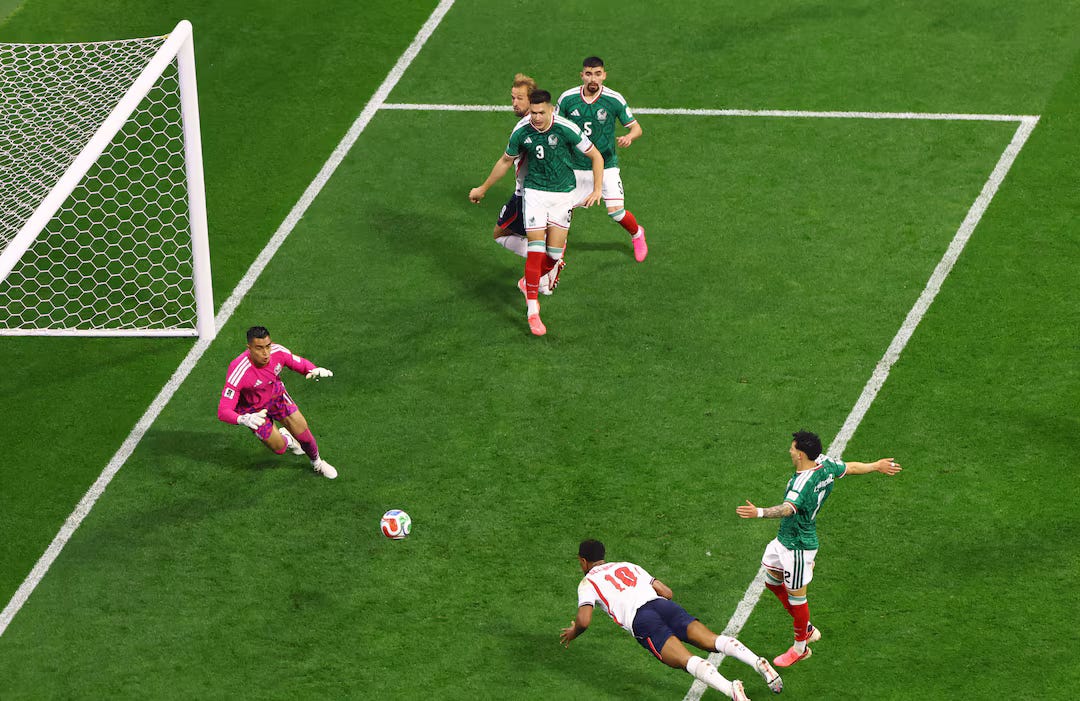
But that’s not how Gianni Infantino, FIFA’s president, measures success. Last year, he had told a room of American and football dignitaries that the World Cup will produce “104 Super Bowls.” The day before the final, while garlanding Trump with his words, Infantino claimed that he had overseen the greatest cultural event in human history. This was his Woodstock, his Tomorrowland.
So, on the day of the final, after 48 teams had played 103 matches over 38 days, Infantino did not think football was enough; the day could hold more content.
**
Content began as a modest word. It came from the Latin word continēre—to hold together, to contain—and described the material inside a container. Over time, the word became an entity unto itself. A newspaper report, a television programme, the text and pictures on a website gradually coalesced under the umbrella of “content.” Today, content is also a photograph of someone’s breakfast, a twelve-second video of a dog chasing its tail, or a podcast in which two men discuss rich men.
The word makes no distinction between information and entertainment; it is simply a mass of substance to be uploaded, distributed, monetised, and profited off.
Consider the opportunities that a football match can offer: pre-match, mid-match and post-match shows; tunnel footage; warm-ups; player arrivals; fifteen, or now, thirty minutes of half-time; commentary feeds; fan cams; streamed reactions; dressing room footage; behind-the-scenes footage; pitch-side footage; VIP footage. As we came to realise this World Cup, football’s rhythm itself can be broken to include a three-minute ad-break. The match remains the central event for the broader definition of football, but it is, in fact, a generator of content.
It explains, to a large extent, the two moves from Infantino and FIFA over the last few weeks. Once the success of this World Cup was indisputable, Infantino announced a plan to expand the next one to 64 teams. Then, on July 28, he revealed his real endgame: to sell off parts of FIFA, a not-for-profit organisation that governs global football, to private investors. The first investor lined up is Thrive Eternal—the venture capital firm founded by Joshua Kushner, the brother of Donald Trump’s son-in-law Jared Kushner.
The thing about greed is that there’s no finish line, only milestones beyond which there’s the prospect of more.
To FIFA’s member associations, Infantino attached a sweetener: each country signing their approval would be eligible for an immediate payment of up to $20 million, followed by another $20 million in development funding between 2027 and 2030. Refuse and that payment stays at $8 million per the existing plan. Deciding between matcha and sangria for a Friday evening starter can be called a choice; a decision on a $32 million windfall, not quite.
And yet, within three days, confederations representing well over half of FIFA’s 211 members had rejected the proposal loudly and angrily. Some of the outrage stemmed from Infantino blindsiding everyone, including his own senior advisors within FIFA, while drafting this plan and taking it public. The rest of the anger was territorial battle dressed as principled stance: UEFA, European football’s governing body, administers an expanded Champions League designed to produce more games between Europe’s richest clubs, and was now appalled to discover FIFA applying a similar logic.
The proposal will probably die a swift death, but its significance does not depend on whether FIFA eventually sells the subsidiary. The idea itself is worth unpacking, as is the enlarged Champions League, the 64-team World Cup, and even the sponsored halftime show. They all germinate from the same thought, that a sporting competition is an asset whose value rises with every additional match, market, sponsor, screen and minute it can occupy.
Matt Hughes, writing in The Guardian, points to JP Morgan’s pitch with the new FIFA subsidiary—a growing portfolio of tournaments, third-party capital and debt financing, partnerships and events selected for yield. One line proposes raising the number of global tournaments each year from 200 to 450.
Infantino has been laying the groundwork for years. In 2021, he proposed a biennial World Cup cycle, down from four year gaps; last year, FIFA turned the Club World Cup from a random one-week affair in the middle of the season to a full-fledged 32-team event in the summer, eating further into the precious little time players get in the off-season.
Every proposal and plan, you’ll notice, is discussed through the extra revenue it will bring FIFA, not the sport, not the players, and most definitely not the fans.
**
It’s not just a football problem; every rich sport is trying to scale for revenue.
Between June 2021 and March 2026, there were four Men’s T20 World Cups, three World Test Championship (WTC) finals, one Men’s ODI World Cup, and one Champions Trophy. Between now and the end of 2031, there will be two Men’s ODI World Cups, two Men’s T20 World Cups, three WTC finals, and another Champions Trophy. Seventeen world championships in a decade—and this is only the men.
In tennis, the four Grand Slams have 128-player draws—for men and women—played as straight knockouts. Scaling vertically is not simple: the next possible field is 256, requiring an extra round and 128 additional first-round matches. So the sport has expanded from the sides. The Australian Open now sells an “Opening Week” of qualifying, practice sessions, exhibition matches, live music and family entertainment before the main draw. Seven of the nine Masters 1000 tournaments now run in an expanded twelve-day format.
Formula One has stretched its 2026 championship to include 24 races. The Summer Olympics and Commonwealth Games can only resist for so long. LA28’s five additions—cricket, flag football, baseball/softball, lacrosse, squash—blend US domestic ratings and massive global markets.
Niccolo Campriani, former Olympic champion and the director of the LA2028 Organising Committee, straight up cited Instagram followers as a measure: “We all recognise the critical importance of a strong digital presence in order to keep the games relevant for the youth. And cricket is offering a unique platform to do so. Take my friend here Virat. He's the third-most followed athlete in the world on social media with 314 million followers.”
The anomaly within all this has been the Men’s ODI World Cup, historically cricket’s most lucrative global property. It expanded from 12 teams in 1999 to 14 in 2003 and 16 in 2007, before retreating to 14 in 2011 and 2015 and only ten in 2019 and 2023. The contraction came after the 2007 edition exposed a terrifying commercial possibility: India could get knocked out early and take the sport’s largest television audience with it. The advertising risk was in hundreds of millions.
Ten-team World Cups removed that financial jeopardy. Everyone played everyone once, guaranteeing India nine matches before the knockouts—nine broadcasts lasting eight or nine hours, many placed on weekends, each carrying hundreds of advertising slots. In 2023, broadcasters reportedly sought as much as INR 30 lakh for ten seconds during India matches and the knockouts. The format announced most recently, for next year’s tournament, moves back to 14 teams but keeps multiple league stages, again, to make more space for big teams.
Every sport with a substantial audience is trying to maximise yield.
Consider, then, what happens to those playing. Players become subjects of a never-ending movie; teams get gegenpressed by streaming platforms to open their locker rooms and training grounds and let a camera crew in. The story of Ryan Reynolds and Rob McElhanney buying Wrexham FC after watching Sunderland Till I Die on Netflix is well known. But, browse through the top streaming platforms, and you’ll find at least twenty major football clubs turned into documentary subjects. Count regional platforms, club-produced films and one-off historical documentaries, and the number comfortably exceeds thirty.
**
There will soon be more matches, more tournaments, more sponsored shows, and more announcements that all of this has been done for the supporters. Some of it might even be good. We’ve been on this ride for decades, since television networks started paying in millions for the rights to show sport. The deal values have multiplied with broadcast technology, as have the ways to dress up sport.
The suits have just one problem, which their myopia doesn’t let them spot: once the referee blows his whistle, they lose control—not entirely, but enough. They can’t account for a third-minute red card, or the world’s most revered footballer headbutting his opponent in a World Cup final, or a team losing by three goals in the year’s biggest match scores thrice in six minutes. They want to engineer sport into a spectacle, and yet, the version of sport that becomes a true spectacle is chaotic and uncontrollable.
After the World Cup final half-time show, the platforms were swiftly dismantled and carried away, the pop stars disappeared into the tunnel, and the players returned to the field that had been borrowed from them. Then the final resumed in its beautiful, unreel-able form. Spain just held onto the ball, while Argentina chased shadows and sometimes barged into them. It took 120 minutes to decide a winner, and the goal was neither scored by Lionel Messi nor Lamine Yamal, the two superstars on the posters, nor by any of the other faces selected for the broadcast’s lingering hero shots. It was scored by a player often mocked by supporters of his own club team, and who, in the first match of the World Cup, was praying to the almighty to let a contentious goal stand.
The most shared footage after the final whistle was of Donald Trump insisting on standing next to the Spanish players as they lifted the trophy. Infantino’s feeble attempts to pull him aside produced no relent. It was an amazing sight—the two most corrupt, power-hungry men in the stadium clapping sheepishly at the edge of the frame, while the most collaborative, unselfish team in the tournament reached their sporting zenith.
Now, that’s good content.
Fantastic article and as the saying goes, great content 😊
How much money and power is enough? Every sphere - Sport, Business, Careers, Relationships, Life.. are inundated with the thirst for more Money and Power.