

On January 30th, 2026, a skiing World Cup season race began in falling snow at Crans-Montana, Switzerland. The town was in mourning—a fire at a bar on New Year’s Day had killed forty people. At the finishing gate, sponsor banners were replaced with ribbons that read, in French, German, Italian, and English, “Our thoughts are with you.” A minute’s silence was observed before racing.
Visibility on the upper portion of the Mont Lachaux course was poor and deteriorating. Two of the first five starters crashed. Next out of the gate was Lindsey Vonn.
There are athletes you know about even if you don’t follow their sport. Vonn is one of them—eighty-four World Cup race wins, twenty crystal ball titles, and an Olympic gold, a career so brilliant it could be enshrined on a wall at the Olympic Games headquarters.
Now forty-one, recently unretired, racing on a right knee that was partly titanium, she was leading the World Cup downhill standings again. Vonn had recently become the oldest woman to win on the World Cup circuit. For her, this race at Crans-Montana was effectively prep-work for the Winter Olympics in Milano Cortina—at the time just over a week away.
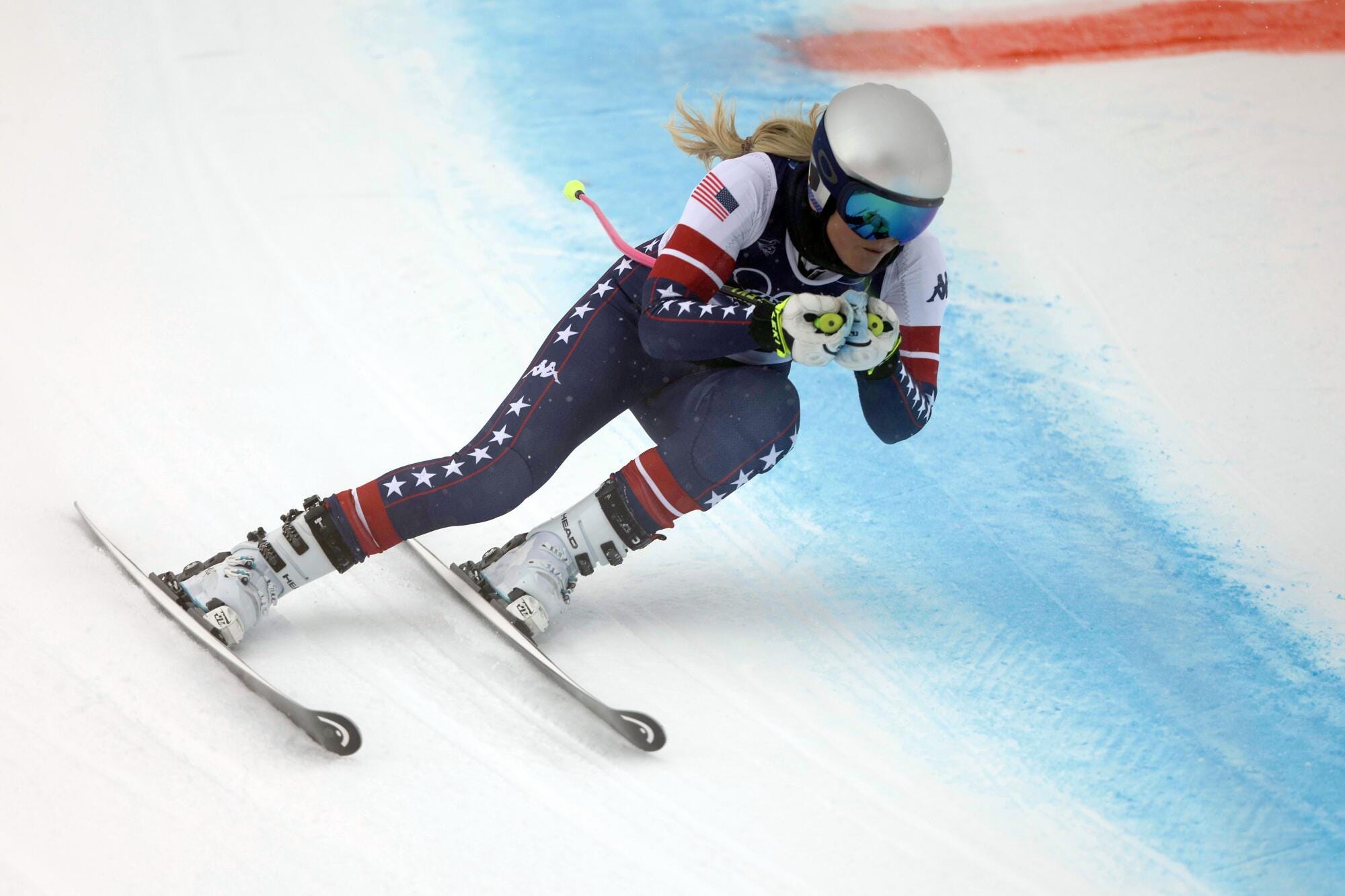
Vonn pushed out of the start gate and was the fastest skier through the opening section. Then she launched off a compression, landed badly, got splashed around by sheer momentum, before sliding at speed into the safety nets. She lay tangled there for five minutes. Then she stood up, skied to the bottom slowly, stopping to clutch her left knee, and was airlifted to a hospital.
Scans revealed a ruptured anterior cruciate ligament (ACL) in her left knee, along with bone bruises and a torn cartilage. The ACL is to a skier what the wrist is to a pianist. It is the foundational ligament they build their careers on, absorbing all the forces from landing at high speeds and odd angles, helping hold the core as the body contorts to turn at eighty miles an hour.
Four days after the crash, Vonn held a press conference at the curling stadium in Cortina d’Ampezzo. The downhill skiing event at the Winter Olympics was a mere hundred hours away. “I’m not letting this slip through my fingers,” she said. “I’m going to do it. End of story.”
When Vonn announced her return in November 2024, racing again after accumulating a litany of injuries, Franz Klammer, the legendary Austrian skier, had offered an explanation that would stand the test of time: “She’s gone completely mad.”
Five days after that press conference, there was Lindsey Vonn, bib number thirteen, core tight, knees braced and bent, at the top of the Olimpia delle Tofane skiing course. A mile and a half of ice below her, dropping in ripples. She had won six World Cup races on this course alone.
And so, she tapped her poles together three times and pushed off.
Thirteen seconds later, her right arm caught the inside of the fourth gate. In downhill skiing, at those speeds, you are a human projectile. The gate hooked her and her body spun sideways, rotating in the air, bent and twisted like a rag in a gale. She landed with a crack. A couple of seconds passed. Then her screams tore through the icy silence of the broadcast.
What do you call this—the desire to jump off a snow cliff nine days after a ligament surgery? To call this madness, though, is to suggest there exists a sane version of the same pursuit, and there does not, there never has. A downhill skier who launches herself off a mountain has not miscalculated the risk; she has absorbed it so completely that it has become the terms on which she lives. Vonn is a vivid expression of the persistent, almost devotional willingness of an athlete to break themselves open. It’s an obsession, an addiction that refuses to leave the body.
How else does one describe Ayrton Senna going at 300 kmph at Imola one day after Roland Ratzenberger had died on that very circuit? Or Niki Lauda returning to the pit a mere forty-two days after his Ferrari turned into a red flare in Nurburgring, after surgeons had to replace his charred facial skin with patches from other parts of his body, after suction tubes were inserted into his lungs to suck out the tar and ash he had inhaled from the accident?
Think, then, of Dean Jones in Chennai. Barely twenty-five years old, Jones batted for 500 minutes in murderous heat to score 210. He was dehydrated, vomiting, and completely out of control of his bodily fluids. He came back to the dressing room seven kilograms lighter than when he’d walked out. Mike Coward, who was there, described dilated pupils, swollen lips, a body weak and racked with pain.
Jones had been batting in a daze for the last third of the innings. One wonders what the daze felt like from within. Whether, past a certain threshold of suffering, the game stops being something you are doing and becomes something that is happening to you instead, the body just a vehicle for the journey to complete itself.
One afternoon in Antigua, as most of India was asleep, Anil Kumble bowled uninterrupted for two hours with a broken jaw, two thick layers of bandage running across his face in a cross, and dismissed Brian Lara. Brett Lee’s ankle absorbed sixteen times his body weight with every delivery, for an entire career, through six surgeries, and he never once slowed down. Sachin Tendulkar batted days after losing his father—you could see the swollen eyes behind the helmet grill—and scored a century against Kenya that nobody who watched it has found the correct vocabulary for since.
I watched Marty Supreme recently and haven’t stopped thinking about one scene. Marty Mauser, the table tennis prodigy at the centre of the film, leaves his pregnant girlfriend standing at the foyer of a building. She’s in her third trimester, it’s late, she doesn’t have anywhere to rest for the night, and he’s going to train. He doesn’t pause at the doorway, doesn’t look back. Mentally, he’s already at the table, preparing to return a serve. It should be the scene that damns him, and the film underscores him as an emotionally-stunted manchild repeatedly, but the finality of Marty in that sequence, the matter of factness, felt so familiar.
All my life, I’ve read about athletes operating outside the edge of what we consider “normal”. Sport doesn’t take over a life so much as it replaces the ordinary rhythms by which a life is lived. What remains is a body that only understands the world as preparation or performance.
Serena Williams won the Australian Open singles title while eight weeks pregnant. I still can’t begin to imagine what it means to carry a life inside you while putting your own through the violence of a Grand Slam fortnight. I’m fairly certain Serena and her ilk don’t see it as a negotiation. What I’m thinking of, and maybe what you are, is perhaps best described by what Rohit Brijnath reached for:
“The lit cauldron at a Games never dies, for it symbolises the insides of athletes. The flare of skill, the burn of bravery and the flickering of audacity like Finland’s slopestyle skier Kuura Koivisto who decides his ski suit is impeding his speed and descends the mountain in a tank top in 2 deg C weather.”
Perhaps professional athletes need to be wired this way. The dot on the horizon you have been chasing since you were a child never truly gets closer, but that the chase itself is the life, the whole life, and to stop, for the flame to extinguish, would be a kind of death more final than anything the body could suffer.
I am confident that Lindsey Vonn, lying in the safety nets at Crans-Montana, was already thinking about climbing up the mountain at Cortina. I’m confident she’s thinking on similar lines as she lies in a hospital bed, with a mashed left leg, somewhere in the Italian Alps. That’s just how they live.
Sarthak 🙇🏽♀️🙇🏽♀️🙇🏽♀️
What writing and so much enlightening.
The dot on the horizon you have been chasing since you were a child never truly gets closer, but that the chase itself is the life, the whole life, and to stop, for the flame to extinguish, would be a kind of death more final than anything the body could suffer.
Salute to these athletes💪🏽
To be human is to give it your all at whatever you do❤️