

Last month, a nine-year-old from Pune breached 1800 ELO points and became the youngest Women’s Candidates Master in the history of chess. In a country that has learned, in recent years, to wear its chess obsession proudly, you might expect Avni Hinge’s name to be everywhere. It isn’t. Her achievement slipped past in the screeching noise of five state elections, the Indian Premier League, and the daily ticker of a war. Many weeks later, a Google search turns up exactly two reported profiles: one each from Indian Express and Dainik Jagran.
Around the time Hinge was reaching rarefied air, I had the chance to speak to Jordan Himelfarb—managing editor at Toronto Star—about his new book, Interregnum. A short review was published in today’s Deccan Herald. Himelfarb and I spoke for nearly an hour, and most of it circled the question of storytelling within chess.
First, a scene.
On the afternoon of 12th December, 2024, the Habitat Comedy Club in Mumbai was buzzing. Three panelists sat behind a table on stage with microphones. To their right stood a giant projector screen, almost stretching between floor and wall. The audience was not the usual comedy crowd. They were young men and women, and some in early middle age, who had gathered on a weekday afternoon to watch a chess match.
A few thousand miles eastwards, in the banquet hall of a luxury resort in Singapore, eighteen-year-old Gukesh Dommaraju sat across from the defending world champion, Ding Liren. At stake, the world championship title. The hours went by, and the crowd at Habitat cheered Gukesh’s moves with full throats, as if they were shots in a football match between Manchester United and Arsenal.
After four hours of push and pull, will-he-won’t-he tension, the match heading towards a draw, Ding moved his white rook to f2.
Interregnum begins with Ding’s world championship triumph in 2023. “Ding is slight and wan,” Himelfarb tells us. “Eye contact is not his forte. Ding likes to watch the rain, read poetry and philosophy. He detests leather shoes because they remind him of businessmen, of people with power over others.”
When Ding reached Singapore to defend his title against Gukesh, he had not won a game in over three hundred days. He had been hospitalised for depression. Magnus Carlsen, never one to hold his words, declared him “permanently broken.” And yet, Ding showed up, crediting coffee for pushing him through the pain.
White rook to f2, in that situation, was a blunder. Ding knew it the instant the piece landed on the board. At Habitat, the panelists—professional chess players, among them Tania Sachdev, who represents India—rose from their chairs, recognising what the move had done to the game. On the projector screen, two faces told the whole story: Ding’s dazed eyes darting across the board, Gukesh’s narrowing on the pieces, confirming to himself that what he was seeing was real. The crowd released a thunderous “YESS!”
Gukesh put his hands over his mouth and got up from the chair. He moved his king to e5. He was going to be World Champion—the youngest ever, four years quicker to the summit than Garry Kasparov.
“Interregnum,” according to the Oxford Dictionary, means “a period of time during which a country, an organization, etc. does not have a leader and is waiting for a new one.” To that end, Himelfarb traces a timeline in sync with the book’s name—from Ding Liren’s World Championship title in 2023 to Gukesh’s in 2024. But the book reveals itself, quickly, as a fix to a different problem.
And chess has a couple. The first is the simplest: it is nearly impossible to enjoy casually. Learning the game properly feels like enrolling in a semester of applied mathematics. Knowing the rules will win you games against your three-year-old nephew, but your empire’s influence effectively stops there. To watch the professionals, to understand what they’re thinking, to feel the tension in a position, demands a wealth of knowledge that most people will never acquire.
At least, that’s the impression the game gives off. And it’s a forbidding one, thick enough to act as a barricade against ever considering chess as a hobby pick-up. If you’re winding down after a hectic day, the last thing you want is to rev your brain back into an overdrive of positional calculations. A quick game of FIFA, an episode of Seinfeld—these ask nothing of you, which is precisely the point.
This feeds into its second problem: the absence of a colour palette to dress its characters in. To play chess professionally, one must live the life of a monk or an addict; nothing else would suffice.
If I were to ask you to describe a chess player, how would you go about it? You’d think of short hair, a tad unkempt. You’d think of crisp shirts and analog watches, maybe a suit and spectacles. They’d have the gaze of a mathematics professor. They’d be the kind of person who enters a party late, eats their dinner quietly in the corner, and leaves at 10pm. The kind you’d have to explain every joke to.
“Chess has long had a communication problem,” Himelfarb told me. “It’s an abstract, technical game. But it’s also a beautiful, dramatic game, full of interesting characters and profound emotions. I wanted to capture all that in a way that resonated for chess fans and newcomers alike.”
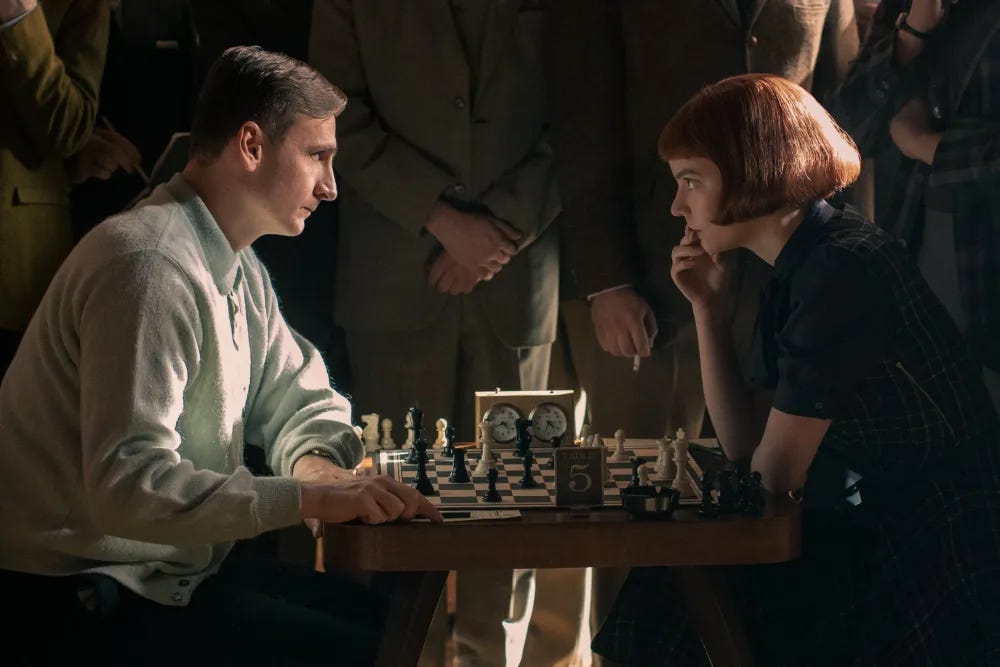
Himelfarb’s own interest in chess spiked with The Queen’s Gambit. The Netflix show appeared in the first year of the Covid pandemic, that suffocating summer when we had too little social interaction and too much time on our hands. Episode by episode, as the lead protagonist Beth Harmon moved through those ornate, tense American rooms, her life a breathless loop of preparation and performance, Himelfarb found himself drawn into her life. Beth, contoured in drab shades, held within her all the obsession, anxieties, and insecurities as one finds in athletes of more glamourous sports.
The truest portrait of a place is found in the lives of the people who live there. Interregnum is their story.
Ian Nepomniachtchi—affectionately called Nepo—was born as the Soviet Union was crumbling. He was raised on Chekhov and Pushkin and the hop of the knight. Of all his brilliant rivals, Magnus Carlsen once said, Nepo might be the only “genius.” But genius in chess is a fleeting tag. In the 2021 World Championship match in Dubai, Carlsen administered such a thumping that Nepo, mid-tournament, “apologised to his chess-obsessed country and cut off his topknot like a disgraced samurai.”
Magnus Carlsen himself is rendered not as just another character but a force of nature. He completed fifty-piece jigsaw puzzles at two; by five, he could name the capital and population of every country on earth. Carlsen knows he’s the best. During the World Cup in Baku, Carlsen asked his social media manager to draft a tweet, to be posted only if he won the tournament. It read: “Chess? Completed.”
Carlsen’s arc presented Himelfarb with a temptation of diving head-first into the technical side of chess. After all, it’s impossible to find a player with a larger vocabulary than Carlsen.
And yet, Himelfarb resists. He sprinkles technical detail the way a good travel writer sprinkles local vocabulary—just enough to ground you in the place without losing you in it. We learn that the Queen’s Gambit Declined was used as a positional weapon, that the Reti Opening places bishops on the flanks to gaze “sentry-like” across the board, that a knight on the rim is dim.
But, every move is narrated as a glimpse into the psyche of the player who played it. For example, Gukesh Dommaraju insists on playing a version of the Queen’s Gambit Declined against the advice of his entire team because he has sensed a fragility in Ding Liren.
Interregnum brings the reader close to the board, but gazing at the players. That’s where, Himelfarb insists, true drama lies.
Netflix’s The Queen’s Gambit was a transformative show for chess. It did for chess for Drive To Survive did for Formula One: bringing a legion of fans who were previously uninterested, and opened their eyes to the stories that hover over the board. The effect was immediate: Chess.com’s membership more than tripled to over 150 million users. Chess sets sold like IHOP pancakes.
Players began streaming, and the game spread, nearly overnight, to corners of the world where it previously had little profile. Consider Hikaru Nakamura, who thinks of himself as a streamer first and a chess grandmaster second. He gets cranky when he has to break his streaming schedule for a tournament. His Twitch channel surpassed one million followers even as his tournament results declined.
But, all these characters, Nakamura and Gukesh and Carlsen and Ding Liren, are men. What about the women?
Chapter five of Interregnum dives into the most jarring loose thread within chess’ fabric: the gender disparity. Thirty years after Judit Polgar breached the world top 10, drawing to a close all doubts about the ceiling for women in the sport, there exists an unmistakable institutional apathy.
“It is social residue from a previous century,” Himelfarb told me. “The most important barrier to parity is a history of sexism in the sport - from derogatory comments to sexual harassment and abuse. In recent years, the chess world has finally begun to reckon with this, which is crucial. To see women at the very top of the sport requires bringing more girls to the game and encouraging them to stick with it. That begins with showing girls that the chess world is welcoming and safe.”
In Interregnum, Himelfarb dedicates generous space to India—the birthplace of chess at shatranj. India is home to more grandmasters than any other country. Today, it gives chess.com its highest share of membership. The office of an organisation I once worked at kept a chess board on a small round table, two plastic chairs on either side, for employees to sit down for a quick game. I don’t remember finding the spot empty too often.
Viswanathan Anand, one of the sport’s all-time greats, has overseen India’s recent chess dominance with the care of a parent. It’s hard to find a chess grandmaster in India who hasn’t trained with Anand, either at an academy or at his Chennai home. Chess is part of Chennai’s cultural fabric. You’ll find schools dedicating extra-curricular classes and coaching centres where hundreds gather to learn the sport as an exercise in cartography. Take a flight to Chennai during a major chess event, and as you descend, you’ll spot a bridge painted in the chess monochrome.

Sometime this year, Gukesh will defend his title against the precocious twenty-year-old Javokhir Sindarov. Vaishali Rameshbabu will play for the women’s championship against defending champion Ju Wenjun.
In the paragraphs leading up to the 2024 championship match, Himelfarb illustrates Gukesh’s anxiety and fears in patient lines. At break on the first day, Gukesh confessed to feeling the championship slip from his grasp. That evening, he went to a beach and spent hours watching people bungee-jump from a bridge.
On the next afternoon, after all was played and done, Gukesh, his hands trembling, eyes watering, arranged the pieces in correct order, as he had done after every game since childhood. One chapter of his life ended there, drenched in tears and gold, and another began.
After Gukesh landed in Chennai, soldiers escorted him through a crush of cameras and screaming schoolchildren. He was showered with flower petals. A shy, 18-year-old boy from Chennai was, briefly, the centre of India’s attention, a position many had only seen cricket heroes take.
We experience sport through stories. Stories make us stay up nights and crowd into clubs, screaming at a screen. Jordan Himelfarb’s Interregnum argues that chess produces them in every genre. One just needs to look.
“We experience sport through stories.” - this is exactly what your posts do for me. Help me experience the sport.