

It’s quarter to eight in Melbourne. The summer light is dimming, the air damp with inbound rain. Above the Rod Laver Arena, the roof begins its slow mechanical glide, sealing fifteen thousand people inside to watch two men climb what remains of their mountains.
Novak Djokovic has just overhit a return from a harmless position. He’s taking deep breaths, walking in short steps back to the service line. Carlos Alcaraz stands across from him, rippling biceps and rippling thighs, shuffling on his toes, racquet twirling in his hands.
The Rolex match clock says two hours and eight minutes. Alcaraz leads two sets to one, and 1-0, 15-40 in the fourth set—two break points to go 2-0 up, with the next being a service game. The shimmering silver Australian Open trophy is almost in his hands. For Djokovic, a break here is a death knell.
Djokovic blows out his cheeks, taps the ball a couple of times on the turf, and serves. Alcaraz returns to Djokovic’s backhand. Djokovic pulls Alcaraz to the left edge of the court, then even further to the left, then quickly to the right corner, then back to the left corner, swinging the play around as if he were guiding a kite. 30-40.
Alcaraz wipes his wrists with a towel; Djokovic wipes his face with another. As Djokovic walks back, his face is clenched, his nostrils flared.
Djokovic serves down the T, which Alcaraz can only reach by fully extending his frame. There is no pace on the return. Djokovic drills a winner down the middle. Deuce.
A box-shaped sweat patch is forming on Djokovic’s shrub green t-shirt. It was faint at the beginning of the third set, but now it’s a thick and dark. There isn’t a bead of sweat on Alcaraz’s arms or his electric green vest.
Djokovic serves wide, pulls Alcaraz to the left, then to the right, but sends his return long. Break point for Alcaraz again. The next serve is wide again, which Alcaraz returns without much venom, then Djokovic pulls him wide, hops to net, volleys, and then crunches a smash down the middle of the court. Deuce again.
In the VVIP box, barely fifteen feet above the court, Rafael Nadal, balding, suited, goes, “Oooof.”
Over the next nine minutes, over five more deuces, aces, volleys, a drop shot that crosses the net and then falls vertically, forehands that skim the sideline, Djokovic saves three more break points and holds his serve. 1-1.
A wide smile breaks out on his face. The sweat patch has spread, the breath is heavier, but Novak Djokovic is alive.
***
Djokovic wasn’t supposed to be here.
Three matter-of-fact wins and an injury walkover brought him to the quarterfinal against Lorenzo Musetti—twenty-three years old, fifth-seed, and deceptively good. Djokovic was coming off four days of rest, and led the career head-to-head 9-1.
All that advantage dissolved within minutes. From the third game of the first set, Musetti was the better player by a mile. Before long, the scoreboard read 6-4, 6-3. Musetti broke Djokovic five times across two sets and drew thirty-two unforced errors from a man who barely makes any.
A low hum set in through the crowd, probably sensing an ending. Djokovic had been talking, in the last year or so, about what comes next—tentative references to retirement, and a body that takes days to recover instead of hours. He had pulled out of last year’s semifinal here with a torn leg muscle.
Now he stood thirty, perhaps forty minutes away from a quarterfinal exit on the court where he had won ten Grand Slams, a court that might as well bear his name. And he was getting thoroughly outplayed and outrun.
How much longer?
Then, at the start of the third set, Musetti started grabbing at his inner right thigh. He had felt a twinge in the second set. He played through it because he was playing brilliantly, and because you don’t stop when you have Novak Djokovic on the mat. But, at 1-3 in the third set, Musetti called for medical treatment.
A few minutes later, Musetti sent a double fault and stopped. He wiped a hand across his face, pulled off his headband, and walked over to the net, where Djokovic was already waiting. They shook hands and embraced. Musetti walked off the court, and Djokovic was through to his thirteenth Australian Open semifinal.
In the post-match on-court interview, Djokovic could barely force a smile. “I don’t know what to say,” he began, “except that I feel really sorry for him. He was the far better player. I was on my way home tonight.” He paused. “He should have been a winner today. No doubt.”
Djokovic walked off the court, head bowed, right hand raised. He now had a prolonged stay in Melbourne and one more day to fight for.
On the other side of the draw, Carlos Alcaraz was cruising through the rounds. It was hard to tell that he had never been past the quarterfinals at the Australian Open. First round, second round, third round, fourth round—all flattened clean without blemish. In the quarter final, Alcaraz came up against sixth seed Australian, Alex de Minaur. Two hours and fifteen minutes is all it took him. Alcaraz sealed the match with an ace that de Minaur couldn’t even move for. The smile on his face, always wide but this time with a tiny sidemouth smirk, seemed to suggest, “Did you have a doubt?”
For nearly five years, Alcaraz had been a trapeze artist, playing a high-risk high-reward style of tennis, and letting his skill and physicality guide him. A tactically smart Alcaraz was near unplayable even on his weakest surface.
***
At the semi-final Friday, Alcaraz and Djokovic faced Alexander Zverev and Jannik Sinner. The binoculars, though, were already trained on Sunday afternoon and another delicious Alcaraz vs Sinner final.
Alcaraz’s match started first. Alexander Zverev is six foot six inches of ball-striking talent but yet to taste true triumph. The first session of a long day meant that the game started late in the afternoon, with the sun blazing down on the court, heat and summer humidity pushing at the two battering rams.
Alcaraz won the first set. The force of the ball from his racquet suggested another straight sets win. Zverev stormed back to lead the second 5-2, from where Alcaraz pulled out his first pack of Alcaraz Things™ and took the set 7-6.
As with any Alcaraz match, there were moments when he’d pull off something so technically and physically outrageous, you’d stand up by magnetic force. The camera panned to the crowd and they were standing too, all of us united in our involuntary response to genius.
Midway through the third set, two and a half hours into the match, Alcaraz began cramping up. He bent down and clutched his right quadricep, stood up, and then squatted back down. The trainer came out with sprays and tapes, but nothing helped. Alcaraz played the rest of the set stationary, like a boxer fighting off the ropes, swinging from where he stood. Zverev, who had been drowning, now sensed air. He almost squandered the advantage, because that is what Zverev does, but not this time.
In the fourth set, Zverev remembered who he was supposed to be. Somewhere inside him there is a vault where he keeps his best tennis locked away, opened only on rare occasions, and now he found the key. The forehands thundered. The serves kissed the lines. For about an hour, Alexander Zverev played like a man who had finally believed in his own ability—and when Zverev is free of doubt, there are perhaps two or three players on the circuit who can compete with him.
Alcaraz fought, of course, because fighting is what he does the way breathing is what lungs do, but his legs weren’t obeying him. Zverev, locked-in, kept pounding.
So Alcaraz adapted. He shifted his strategy to counterpunch as a defensive tactic. He shortened the points and went for the kill earlier. Anything to push Zverev back. And it was working. The fourth set stretched to a tie-break. Zverev, for once playing with the fierce determination his talent warrants, closed the set out.
Four hours, two sets each. Outside the stadium, Melbourne was softening into evening, the sun bleeding out along the horizon, the air turning cool. The evening chill acted like a balm on Alcaraz’s legs. He was coming back to something closer to familiar form.
Forty-five minutes later, he played a point that belongs to the museums where they keep Michelangelo and Dalí masterpieces.
Zverev responded with another relentless wave of artillery fire, most of which landed as he intended it to. He broke Alcaraz’s serve to go 5-3 up, playing the game of his life, now serving for a place in the final.
Carlos Alcaraz won the match from there. Zverev’s best was not enough. We’ve seen this movie so many times now. Sometimes, it feels surreal, the way Alcaraz is able to rescue points that he has no right to return, nevermind win. And then he rescues a Grand Slam final, or a semi-final where he’s functioning on one and a half legs, and you wonder if he’s blessed by the divine.
The match went on for five hours and twenty-seven minutes. For a while, it threatened to finish in three. Then it threatened to finish with Alcaraz hobbling across for a retired handshake. And yet, here we were.
Alcaraz could barely speak after the game. Jim Courier waited and waited with the mic. Alcaraz gathered his breath, thanked the crowd, stretched his right leg a few times, and left the court.
Melbourne was now cloaked in the night’s inky darkness. The crowd, already reeling from a physically-sapping classic, were seated for the face they recognise the best, and the face they’re beginning to love.
In the player gym, as Alcaraz was pedalling away on an exercise bike, washing off the built-up lactic acid, Djokovic walked up for a congratulatory pat on the back.
The Rod Laver Arena welcomed Djokovic with thunderous adulation. The reception for Sinner, generous and warm no doubt, paled in comparison.
Jannik Sinner is the closest match to Djokovic on the circuit, almost a 3D reprint, but one full generation younger. Sinner had won their last five matches, the most recent three by straight sets. “Two hours tops,” I texted my friend, who is a staunch Novak fan but didn’t resist the idea.
It took Sinner 39 minutes to clean up the first set. Djokovic neither had an answer for his physicality nor his skill. Sinner’s serves were harder, his backhand pushed Djokovic deeper from the baseline, and his forehand came with the force of a whiplash from a rappelling iron wire. The late-night weather was helping Djokovic stay in points for longer, but without adequate riposte for what Sinner threw at him.
Then you blinked, and then Djokovic was ahead 4-1 in the second set. Sinner’s radar was malfunctioning, and Djokovic’s was just whirring to life. And suddenly, the match felt different. Djokovic’s serve was landing with force and zip, the angle of the forehands just perfect. And when Sinner got too good, Djokovic was happy to let the point go, conserving his energy for points he could control.
One set all.
Sinner, duly, won the third set. He wasn’t anywhere near his best, but it was enough. Time was catching up with Djokovic. The chest was puffing out, the face was clenched. He was taking extra seconds at the towel rack, a few heavy breaths before every serve.
“Novak Djokovic has a way of winning even when he’s losing,” Brian Phillips had once written. But he wrote that five and a half years back. The world was younger, and so was Djokovic. His opponent back then was a 38-year-old Roger Federer. Now Djokovic was 38, his opponent 24.
Djokovic broke Sinner in the first game of the fourth set. Then he held serve to make it 2-0. Deep in the third hour of a semi-final, well past Melbourne’s midnight, Novak Djokovic was playing like Novak Djokovic. This was the Novak we recognised—the one who knew the court like the back of his hand, the one who could stay in the points longer than you, the one who found the only aching joint in your body and pressed his elbow into it, the one who, even if he looked lost, never lost.
“He can hit shots that make you think your TV is a liar. But it’s that other mode, his dark mode of tactical endurance, that makes him the most fearsome tennis player of the past decade and possibly the most fearsome of all time. He’s a genius at operating within bad runs in such a way as to give himself the best chance of seizing key moments.” — Brian Phillips
6-4. Two sets all. One last set to decide the finalist. The Rod Laver Arena was roaring with a guttural intensity, the kind we’d heard after highlight-reel points, say a sizzling Nadal forehand, or a Carlos Alcaraz out-of-nowhere winner. Djokovic pumped his fists at the crowd. He was enjoying the reception, almost playing to it. For a man whose story is as much about his quest for perfection as about wanting to feel truly loved by a tennis audience, this was nirvana.
But there was a fifth set to conquer. At last year’s US Open, after losing to Alcaraz in straight sets in the semi-final, Djokovic had projected his apprehensions about this very situation. “It will be very difficult for me in the future to overcome the hurdle of Sinner and Alcaraz in best-of-five on the Grand Slams. I think I have a better chance at best of three, but best of five, it’s tough.”
At 1-2, facing a break point, Djokovic hit a forehand winner that left Sinner watching with exasperation. At 3-3, he hit another. The match was more than three and a half hours old, and here was the old man, not merely taking his younger opponent on, but playing better tennis.
The crowd roared even louder. Nothing from their sound could convince you that the clock actually said 12:45 am, and that most of them had been at their seats for nearly ten hours. So good was the tennis below them, so inspiring the endurance, it was only fitting that they give some of it back.
A 200 kmph serve down the T, a smashed winner, and another of those angled forehands later, the chair umpire said, “Match point.” The final point summarised the evening—Djokovic doing just about enough to stay put, Sinner responding with force but eventually obliging with an overhit backhand.
Over ten hours of semi-final tennis, Carlos Alcaraz and Novak Djokovic showed us two contrasting interpretations of time. One wants to compress it and smother opponents, make them feel breathless. The other wants to stretch time, make the point existential, make the opponent bare their own weakness for the world to see. One, with their entire careers in front of them, ready to be taken wherever their imagination wishes. Another, with a glittering career behind them, just fighting for every minute, testing how much light is left in the candle.
Now, the final. Alcaraz chasing the high of becoming the youngest ever to finish a Career Slam. Djokovic chasing the never-touched peak of 25 Grand Slam titles. Both breaking into new territory.
***
Sunday afternoon. The roof was open, the sky wore a bright shade of blue, the angular sun cast long shadows on the court. The stands had been full an hour before the warm ups. Rod Laver and Rafael Nadal sat in the VVIP box.
Novak Djokovic had played this match ten times. He’d won all of them. If he won it an eleventh time, there would be surprise but no tremors. Djokovic is timeless, never more so than on the Australian Open court.
Alcaraz’s story gathers new pages every other month. Five years on the circuit now, and his reputation has settled into a single word: hurricane.
Novak Djokovic says, “he reminds me of Rafa.” Alexander Zverev warns of giving him anything to work with. “If you give him time, if you give him the option to dictate the points, you’re not going to win a single point.” Alex de Minaur was flabbergasted after the quarter-final. “I’m probably hitting the ball bigger than I’ve hit previously in these types of matches,” he said, “but I’m still not able to hit through him.”
With Alcaraz, these testimonies don’t make as much a mosaic, as layer upon layer of the same colour, maybe slightly varied shades. There was only one real chink in his armour—his serve—and he spent the last season correcting that.
Alcaraz’s remodelled serve is a lot more fluid, a lot less violent. Djokovic found it so similar to his own serve that he joked about asking Alcaraz for royalties. So far, the serve had held well. No real alarms or blemishes.
In the big final of the tournament he has never won, against the man who has won it ten times, the serve came unstuck. Djokovic broke him twice and breezed through the first set. 6-2. Alcaraz couldn’t afford to go two sets down—remember the right quadricep?
Slowly, with a few long rallies at first, and then some screaming forehands, Alcaraz found himself. The infectious smile was back, the “¡Vamos!” had a bit more chest.
The second and third sets, he collected with relative ease. Somewhere in the middle, Djokovic pulled Alcaraz left and right, then Alcaraz sent Djokovic deep, then brought him forward, and Djokovic replied with a low shot around the net—and somehow, off-balance, Alcaraz returned it for a winner. The audience erupted in disbelief. Alcaraz raised his hand and pumped his fist. Novak put his hands on his hips and took deep breaths, eyes staring partly at Alcaraz and partly at nothing.
What is it going to take?
Fourth set. Six break points. 1-1. More break points. 4-4. 5-5. The sweat patch now covering most of Djokovic’s back. Alcaraz, at the other end, shuffling like a boxer. He was there.
7-5. Carlos Alcaraz—Australian Open champion. The youngest ever to win on all surfaces. He’s still just 22, and already within one Grand Slam title of Andre Agassi.
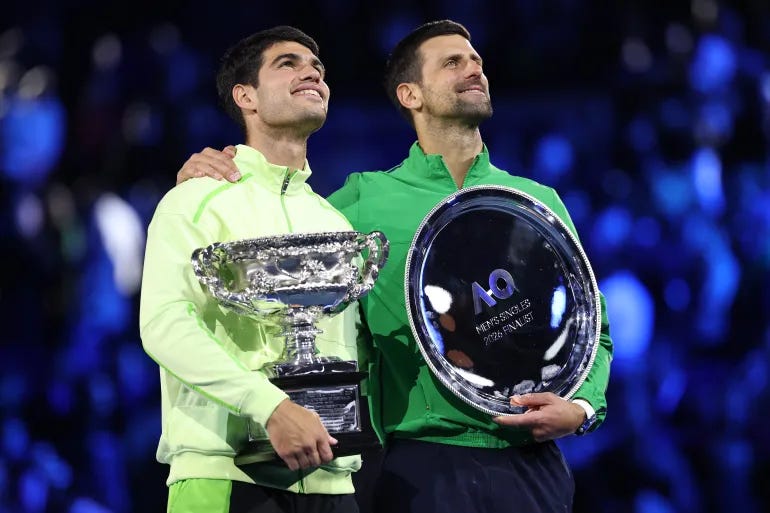
As Alcaraz and Djokovic finished their speeches and retired to the tunnel, Rafael Nadal came over to congratulate his young heir. Alcaraz, still catching his breath but animated like a child, gestured toward the court—something about how hard it was to beat Djokovic. Nadal shrugged and replied with, “Lo sé.” (I know.)
Alcaraz had once limped out of a French Open semi-final against Djokovic. That was nearly three years ago. The following year, Djokovic beat him at the Olympics gold medal match. Alcaraz beat Djokovic twice, in consecutive years, at the Wimbledon final. Underneath the primary plot of Sinner vs Alcaraz, this hidden motif, this cello line playing the countermelody, has given tennis a lot of depth.
It’s the perfect overlap between two generations. Novak Djokovic is still beating champions in five-setters. On the other hand, Carlos Alcaraz’s greatness is no longer in question. Not with these many titles. The conversation has now moved to, “How great can you be?”
The question is now about longevity. And should he ever need inspiration, he only needs to look across the court, at the man who never seems to leave it.
Too good, man. Too good. Some of the lines were as good as those Alcaraz magic tricks.
Thank you. Just loved reading this