

The Indian Premier League is back for its 19th season. It’s our annual carnival of floodlights and noise. Someone sells you an investment plan, someone else an SUV, and gaudily-designed jerseys sell you ten products at once. Even Google has entered the bazaar, advertising its pioneering AI research with insights like, “Jasprit Bumrah has a good yorker.” Many years ago, a wise man likened watching the IPL to encountering a post-modern narrative that seeks to satirise consumerism. I’m yet to find a better description of its aesthetics.
Meanwhile, the cricket keeps running, restless and relentless. Batters hit 90-metre sixes every third delivery while the bowlers wonder if the money is worth the insult.
In this year’s opening round, the Delhi Capitals (DC) are chasing 141 against the Lucknow SuperGiants (LSG) at the Ekana Stadium in Lucknow. And 22-year-old Sameer Rizvi is guiding them to a victory.
Two years ago, Rizvi was plucked out of Uttar Pradesh’s domestic cricket anonymity by the Chennai Super Kings. They paid INR 8.4 crore for him—a figure that sounds crazy but reflects how highly their think-tank rated him. Despite a sparkling start, Rizvi’s run in yellow lasted all of eight games. He was back on the market last year.
Now, wearing different colours, he’s playing the knock CSK knew he was capable of, the kind that makes experts lean forward and nod. He’s doing this on a pitch where bowlers have a say and boundaries have to be earned.
The Delhi Capitals started their chase tumbling, losing four top-order batters for a paltry 26. From there, Rizvi and Tristan Stubbs, young of age but blessed with fortitude, have carried the innings. Rizvi has supplied the pyrotechnics, climbing into LSG’s bowlers every time they’ve missed their length by an inch.
Rizvi crosses his half-century with a deftly-placed boundary. On commentary, ex-cricketers weave a garland of superlatives. Some knock, this, they all say. Every player and staff member in the Delhi Capitals dugout is standing. Amongst them, in the front row, is Prithvi Shaw.
**
Prithvi Shaw applauds with his arms above his head. His teeth flash through his wide grin.
He looks different from the others in the dugout. The cheeks are puffy, the arms a little soft where everyone else’s are lean and muscular. His t-shirt clings a little at the waist. He claps hard, though, and the grin doesn’t waver.
The Delhi Capitals blue-and-red falls well on Shaw. He has only ever worn these colours in the IPL. Shaw came to this franchise many years back, as an 18-year-old, months after leading India to the Under-19 World Cup title. At the time, he was also the brightest talent in domestic red-ball cricket—the litmus test separating the good from the elite. After six years of sparks and patience, the Delhi Capitals jettisoned him in the winter of 2024.
Shaw spent the summer of 2025 without an IPL team. December’s auction, for the 2026 season, was turning out the same way until the Delhi Capitals signed off on a late punt.
They took that punt because they remembered what the 18-year-old could do.
**
Prithvi Shaw’s lore starts from when he was shorter than his bicycle.
Aged 7, he was taken to Raju Pathak, coach at Mumbai’s Rizvi Springfield High School. Pathak put him in the Under-12 nets. Two balls later, he moved Shaw to the Under-16 nets. “He was that good,” Pathak told Open Magazine. “No, the word is natural.”
By eleven, Shaw had signed with a sports management company. There is a picture from the night India won the 2011 World Cup: Shaw at the Wankhede Stadium, sat next to Arjun Tendulkar, both of them 11-years-old, round-faced and bright-eyed. Arjun carried a heavy, incandescent surname. Shaw’s name was already wafting through Mumbai on its own.
Around the same time, a camera crew had travelled across Mumbai for shooting the documentary, Beyond All Boundaries. The film narrated the city’s relationship with cricket through three unique lives: Sudhir Gautam, Akshaya Surve, and Prithvi Shaw.
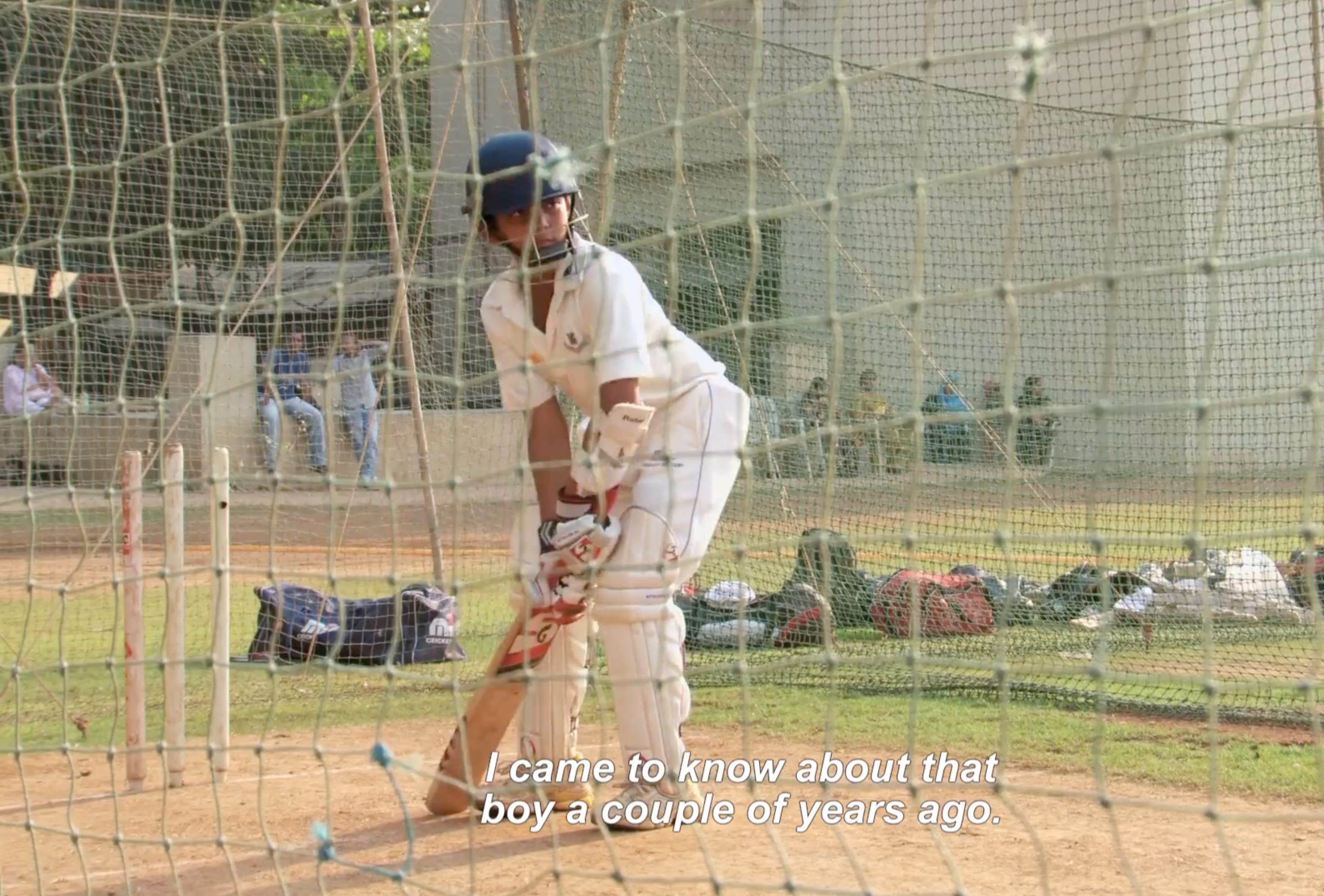
Makarand Waingankar, one of India’s foremost talent-spotters, said of Shaw: “In every match, he’s the youngest, and he’s scoring against the eldest.”
Two years later, exactly a week after Sachin Tendulkar bid a teary goodbye to international cricket, Prithvi Shaw scored 546 runs in one innings for Rizvi Springfield—a world record for junior cricket. The prodigy had become a news item.
The runs and headlines kept stacking up, and senior cricket opened its doors soon. Shaw scored a century on his Ranji Trophy debut. He scored a century on his Duleep Trophy debut. He had four centuries in his first five First Class matches.
The year after, Shaw’s India won the Under-19 World Cup in New Zealand. Guided by coach Rahul Dravid, his team returned with a 100% win record, often looking a galaxy apart from their competition. Meanwhile, the Delhi Daredevils—who’d later rebrand themselves as Delhi Capitals—snapped him up for INR 1.2 crore. Shaw played nine matches in his debut IPL season, and averaged a four or a six every 4 deliveries.
The ball flew off Prithvi Shaw’s bat. It flew with a force and a sound, and thudded into boundary hoardings. He had a flamboyant backlift, his MRF bat reaching above his helmet—a mirror image of Brian Lara, minus the exaggerated crouch. The bat snapped through its downward arc like a whip. He was naturally wristy, comfortable with anything pitched near his feet, but if the bowler made the mistake of bouncing him, the ball often ended near the boundary ropes.
During that first season, the broadcast camera would cut to Delhi Capitals’ coach Ricky Ponting, the expression on his face an amusing mix of bewilderment and excitement.
The India call came soon. The autumn of 2018 brought a home Test series against the West Indies, starting in the arid climes of Rajkot. Still only 18, Shaw had his own navy blue cap.
Ten years ago, his captain had led India to the Under-19 World Cup title and springboarded to international cricket. He was now the greatest cricketer of his generation, en route to becoming an all-time great. Shaw was the next in line.
Shaw started his new life with 134 off 158 deliveries, barely breaking sweat while flaying bowlers with years of international experience. Many a career had been lost to the crevice between domestic and international cricket. That morning, Shaw made the leap look like a hop.
Ravi Shastri, famous for measuring his words, saw “a bit of Tendulkar, a bit of Sehwag, and a bit of Lara,” in the young man. The grandiosity was amusing, but a part of you knew what Shastri was getting at. Shaw, it was evident, wasn’t thought of as a star-in-the-making, but a comet.
There is another picture of Shaw I remember well. It was taken during the off-season camp before IPL 2019. Shaw, wearing Delhi’s blue training kit, possibly coming out of the batting nets, as Ricky Ponting places his left hand softly on the back of Shaw’s head. It is a small, still image, but it contains one of the IPL’s core promises: extraordinary talent, guided by extraordinary mentors.
Shaw played every match of the 2019 IPL season. His tally of 353 runs included an innings of 99 in Delhi that left a lot of jaws agape, including and not limited to the coaching staff in the dugout.
It was the last time Prithvi Shaw was considered celestial.
**
In July 2019, Shaw tested positive for terbutaline—a banned substance found in some over-the-counter cough syrups. He pleaded guilty, but explained that the cough syrup was taken as a remedy for sickness, not as a performance enhancer. The BCCI accepted his words, but slapped an eight-month ban for carelessness.
In the dawn of his international career—the formative years, so to speak—Shaw was deprived of competitive cricket. Indian cricket moved on, as it always does. The Test team found new openers—amongst them, one Rohit Sharma.
By the time Shaw returned, the world was in lockdown. The domestic schedule lay cancelled, and when competitive cricket finally resumed with the IPL, Shaw looked like he had never played this level before. It’s tempting to say he looked like a different batter, but he looked like a different man.
Ricky Ponting and the other coaches kept talking up his talent, at one point clearly speaking to him through their press interviews. Turns out, they were desperate to bring his focus back. During a run-glut, when practice should’ve been of prime importance, Shaw refused to bat in the nets, even upon Ponting’s insistence.
An injury to Rohit Sharma meant Prithvi Shaw made the cut for India’s tour to Australia for a Test series in the winter of 2020.
On the first morning of the series, under an overcast Adelaide sky, Prithvi Shaw lined up against Mitchell Starc. Ricky Ponting was on commentary for Channel 7. He saw Shaw’s stance, the fissures mushrooming within his technique, and predicted his fall to an inswinger. The next ball, Starc bowled that inswinger. Shaw lunged at it, feet moving at a time-lag with the hands, and inside-edged the ball onto his stumps. Two days later, he was undone the same way by a different bowler bowling from a different angle.
Neither delivery should have taken a wicket. Whoever this version of Shaw was, this was not an international batter. This was also not an international athlete. He moved like a 40-year-old, sluggish and late to everything.
India were sickeningly bowled out for 36 on the final morning; Virat Kohli was flying back for India for the birth of his first child; and Mohammed Shami had broken his arm. The team needed every ounce of batting reinforcement, but they knew they weren’t going to get it from Shaw.
Shubman Gill, Shaw’s teammate from the Under-19 World Cup, had built a reputation for a far tighter technique and work ethic. Gill exuded composure with the bat and had the physique of an athlete. He made his Test debut the day after Christmas, and immediately looked the part. A week and a half later, Gill spearheaded India’s impossible chase to win a Test match they had no business fighting for.
At least for the time being, Shaw had no future in India colours. He’d have to light up the IPL to force his way back.
When the IPL 2021 came around, the world still grappling with the virus, Shaw returned heavier than ever. Face round, back a little hunched, small ripples creasing his shirt at the waist. But, he had returned with a bit of the old batting spark. His 82 against the Kolkata Knight Riders included an over of six consecutive boundaries, every one hit harder than the previous. He finished the season with 479 runs at an eye-watering strike-rate of 160—his best season yet.
The national setup called up Shaw for a T20 series, perhaps to see if the tales of transformation were real. He played one game, where he was casual in the field and careless with the bat. And that was the end of India’s patience with him.
Shaw ran out of runs in domestic cricket. Local newspapers carried rumours of a keen friendship with the bottle. His temper spilled over into public brawls. This one time, he was caught faking an injury during a warm-up game before a Test series.
A defiant Shaw cultivated a social-media persona as a perennially-wronged, oft-misunderstood genius. He sought solace in faith and worship, often broadcasting his hope that the almighty keep a ledger of the apparent injustice he was going through.
Back in the Delhi Capitals’ dugout, Ponting’s once wide-eyed expression at his talent had turned into a brooding resignation.
“There were meetings in the night where we would sit and ponder if Prithvi should play or not because he has been failing,” said Delhi Capitals coach and ex-India cricketer, Mohammed Kaif. “So at night we would decide that Prithvi would not be in the playing XI, and then later on the day of the match, we would change our decision - that, no he will because maybe if he goes big, we would win.”
Faith has a limited shelf life. In the winter of 2024, Delhi Capitals finally severed their ties. Ricky Ponting was leaving for another franchise, and it was time for a full reset. Meanwhile, Shaw’s body fat reached an alarming 35% and he was dropped from the Mumbai team. The worst yet predictable indictment came from his captain at both those teams, Shreyas Iyer, who pointed at his work ethic.
At the next IPL mega auction, Shaw went unsold. The competition had extended to ten teams now, and yet, nobody wanted to carry him.
Pravin Amre, ex-India international, Mumbai cricket stalwart, and assistant coach at Delhi Capitals, traced the problem to the whiplash of fame and money. “Maybe he couldn’t handle the glamour and money, the side-effects of the IPL. His example can be a case study in Indian cricket,” he told The Times of India.
One winter morning in 2025 encapsulated the entire Prithvi Shaw story. Axed from Mumbai, Shaw had moved to the Maharashtra team. As such scripts go, Maharashtra faced Mumbai in a warm-up match before the 2025-26 Ranji Trophy season. Shaw opened the batting and blazed to 181 off 138 deliveries. Clips from his innings reached Twitter’s newsstream. As he was walking back after getting out, Musheer Khan, his ex-teammate from Mumbai, muttered, “Thank you.” Incensed, Shaw responded by trying to grab Musheer’s collar and swinging his bat at him.
**
That 181 didn’t lead to any resurgence. Shaw’s scores from his ten most recent innings, in reverse chronological order, read: 14,5,31,17,1,2,71,22,51,46.
He went unsold for the first two rounds at the IPL auction in December. Then, Delhi Capitals, perhaps placing more weight on faith than rationale, bid for him at base price. They didn’t face any competition.
“We see this as a second chance for Prithvi, and I’m really looking forward to seeing him return to Delhi, take this opportunity seriously and give his best for the team,” said Kiran Grandhi, co-owner of the Delhi Capitals.
Amongst the many genres of stories Indian cricket writes frequently, there is one that doesn’t get enough attention: rare talent that turns every head in a room, and slowly, then all at once, vanishes into thin air, into lower division cricket and commentary boxes and coaching academies, remembered only by those who watched them in full bloom.
Vinod Kambli’s name hovers around this genre like a ghost. He was the real thing until he was lost to his own indulgence.
Talent buys you time. People keep the door open a little longer than they should, because they remember what they once saw. They remember the sensation from watching hard things made to look effortless. But, at one point, that patience runs out. Prithvi Shaw, at 26, is standing at the edge of it.
**
On 22nd March, 2026, the Delhi Capitals posted a 79-second Twitter video announcing Prithvi Shaw’s comeback. The video starts in monochrome, as Shaw walks down the stairs at Ferozeshah Kotla and opens a metal gate. In the background, a female vocalist sings in icy, operatic lines over a piano. Between cuts of him walking on the Kotla grass, sitting in the empty stands, staring into the distance, Shaw narrates his feelings.
One line sticks out. “Some stories don’t end,” Shaw says. “They come back.”
The spot in the starting lineup is a few more miles away. For now, his only chance will come in the silence of the practice nets, around players with half his natural gift, overseen by coaches who didn’t have long international careers but squeezed every ounce out of their talent.
Shaw will also do well to look around. Vaibhav Sooryavanshi, at 15, is the hottest name in cricket right now. Sameer Rizvi is winning games for his franchise. Shubman Gill, who made his international debut six months after Shaw, is India’s Test and ODI captain.
Maybe there is a world where it will take one crisp square cut to turn Prithvi Shaw’s life around. If the ball starts flying off his bat again, and if that’s the only noise he makes, the selectors will have to look his way. He is that kind of talent. Now it’s time to discover if he can become that kind of athlete.
Enjoyed reading this Sarthak. I hope he makes the turnaround. 🤞🤞🤞
Great read Sarthak. Thank you for writing this. I'm a big fan of Shaw since seeing him bat the first time. Really hope he can turn things around!