

Welcome to The Jukebox.
This week, let’s start with a football match.
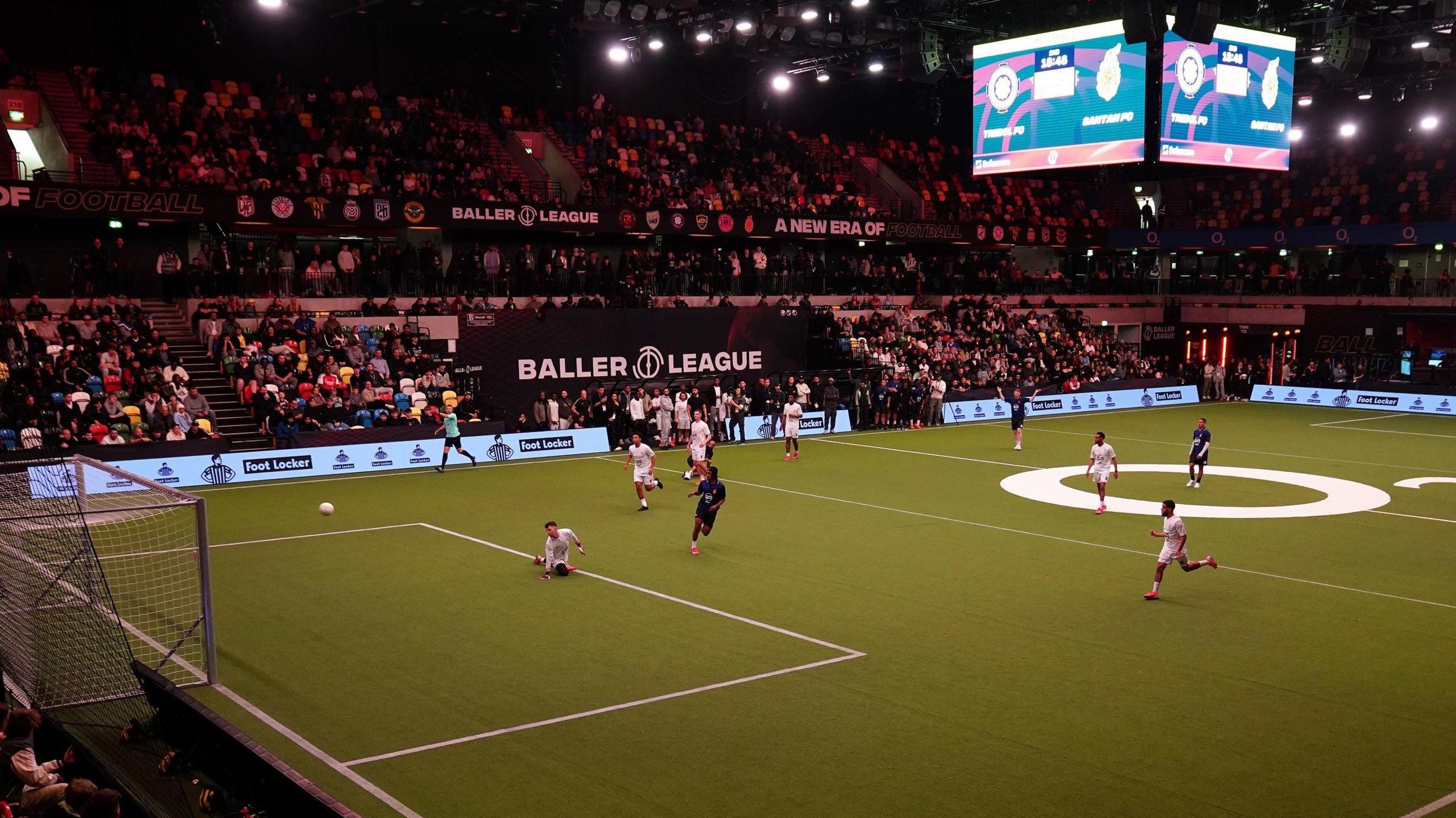
First, the set up. A masked man in a canary yellow shirt started dribbling with a football from his own goal-line. There was no goalkeeper behind him, no forward to pass the ball to. Beneath his shirt, jet black leggings extended into his boots; above, a balaclava that concealed everything but his eyes. He had the physique of a footballer and the vibe of a DC Comics villain.
The turf was a shade of artificial green, clearly machine-made, suited for television lighting, no grass or earth beneath it. The playing area was a rectangle, like football pitches go, but about one-quarter the size of an actual pitch. Just behind the sidelines, photographers stood with wildlife lenses and iPhones. Beyond them, tucked in at a small pass’ distance, the crowd, most of them with upright hands holding their phones.
Our man dribbled about eight yards, and shot towards the opposite goal. The ball skimmed the inside of the left post and nestled into the bottom corner. The shot of a professional. On the other side stood a less athletic man in a different kit. He picked the ball from his net, dribbled, and took a wild swing of his right foot. That shot ended twenty rows into the seating area.
Masked Man one, Joe nil.
This “match” happened on November 3rd, 2025, at the Copper Box Arena in East London. The masked man in yellow was The Mystery Player for a team called NDL FC in Season 2, Matchday 2 of Baller League UK.
What is Baller League?
Baller League is a celebrity franchise competition. Conceived in Germany, its first matches were live-streamed from a repurposed aeroplane hangar in Cologne. The craze has since spread like wildfire to UK and, soon, Miami.
Every match is played six-a-side on a futsal-sized court, fifteen minutes per half. Then, in the final three minutes of each half, the rules are altered according to a spinwheel. Goalkeepers may suddenly be forbidden from using their hands; the match may shrink to three-a-side; or a long-range strike may count double. The rulebook is intentionally designed for content.
Felix Starck, the league’s founder and chief executive, is a filmmaker and entrepreneur who once ran a production company in Mallorca. He created Baller League as an answer to the question: what if audiences want something other than what we’ve been selling them?
“Sport is no longer as easy as just saying ‘look, we’re here now, come and watch us,’” said Starck here. “That’s just not how sport works any more.”
The teams are managed by YouTubers, TV celebrities, and retired footballers trying their hand at new content. In the UK, the league president is KSI—a man who first became famous for playing FIFA on camera and has since become a boxer, a musician, and a seller of energy drinks. When the league launches in Miami in early 2026, its team owners will include Ronaldinho, Usain Bolt, Odell Beckham Jr, and iShowSpeed—a 21-year-old streamer with more YouTube subscribers than Yanni, Celine Dion, and Adele put together.
Matches are streamed for free on Twitch and YouTube. The first season drew north of three million spectators per matchday.
Funds
While Starck is the biggest shareholder, other co-founders include Mats Hummels and Lukas Podolski—former Germany internationals and World Cup winners. Having this kind of weight helps with pulling in names and funds.
Baller League raised a seed round of €7.6 million in the summer of 2024. Last year, they raised €23 million for the Series A round. They’re now expanding in USA and the Middle East. Dedicated arenas are in the works.
Narrative
One decision that strikes me as both brave and telling was their pitch to streaming platforms instead of TV. With the kind of names they have on their roster, it would’ve been fairly easy to aim for a prime time slot. Instead, they’ve positioned themselves as a different product from football—think FIFA Street vs FIFA in the video game market. It’s a shrewd call. YouTube and Twitch has enough of an engaged, burgeoning audience that traditional media doesn’t always reach.
Tennis tried something like this, about a decade back, with International Premier Tennis League (IPTL). Weird teams, weirder rules. Twice, the touring caravan stopped over at Delhi. The second time, the organisers managed to get Roger Federer play Rafael Nadal in a singles match. Think of it. The rivlary of 21st century tennis, in the middle of New Delhi, inside an indoor stadium with no history of hosting tennis of this scale, in front of a crowd that kept shouting, “Chak de fatte, Roger!” Of course I was there.
But, I digress. IPTL shut down after three seasons.
The most popular sports don’t like change. Even today, more than two decades after its inception, nearly eighteen years after all doubts about its potential were blown to smithereens by the bat of Brendon McCullum, you’ll hear ex-cricketers and commentators insulting T20 cricket. In the same way that many people in the 1970s called ODI cricket an obscene indulgence.
T20 is, in fact, one of the smartest structural innovations in popular sport in a generation. No other sport has been brave enough to mess with its conventions so brazenly. That the format eventually attracted a capitalist appetite so ferocious that it now threatens to devour the entire calendar is a different conversation. The format itself is dramatic, viewer friendly, and democratises an otherwise very, very complex sport.
I suspect Baller League will attract some of that spit. The money and attention within it will draw more athletes, which will bring more spotlight and louder criticism. But as long as the product maintains its distance from the real thing—which, I feel, there is a good chance of, given the density of ex-footballers in management and leadership positions—football will be fine.
It will, however, give us a hint about people’s appetite for something different, something a lot more fun and chaotic without the dense overheads of tradition and culture.
🥷 Theft
The India AI Impact Summit, held last week at Bharat Mandapam in New Delhi, was meant to announce the country’s arrival as a serious player in artificial intelligence. Over twenty heads of state flew down to the capital. Startups and founders from across India scrambled for floor space inside the main hall.
Young, small-sized teams were working on problems between predicting cardiac arrest to wearables that transcribe offline conversations. By all accounts, it was a creditable show of Indian enterprise.
But, on Day 2, we got the belle of the ball: a robot dog.
You probably know how the rest of the movie went. Its name was Orion. Galgotias University, a private institution based in Uttar Pradesh, presented it as their own creation. India’s IT Minister, Ashwini Vaishnaw, a keen social media user, shared the footage on social media, praising “Bharat’s sovereign models.”
It took mere hours for the veil to fall. Orion was actually Unitree Go2—a commercial Chinese product, available online for roughly $2000. Attention brought embarrassment, which, in turn, brought television interviews and shame. By the following afternoon, the ministry had cut power to the Galgotias stall and asked the university to leave. Vaishnaw deleted his tweet.
The rest of the fiasco followed an all-too-familiar plot—Indian entity takes a blow to its pride, tries to justify theft, then throws the easiest target under the bus, and eventually, forcibly, apologises.
But Galgotia, credit to their defiance, did not stop there. They have gone on a disaster management overdrive. First came the full page ads, on the day after leaving the summit. Then came the reels. And then, the coup de grace—a full, unironic, rap song by their student community.
Two things about this spectacle are especially rich. The first is Galgotias’ defence that the act of passing off a Chinese product as their own was, in some sense, an exercise in student empowerment and innovation. Second, someone got angry because someone else stole their work and repurposed it without credit. This happened at an AI summit. Incredible stuff.
Lastly, Chinese companies are dealing with an internal theft epidemic themselves.
A few months back, I was made aware—completely against my will—of a kind of doll called Labubu. I admire the writer of that article deeply, so I read through it, and immediately felt the transition to uncledom.
This BBC report explains that the name Labubu means nothing. It just belongs to a character in “The Monsters” toy series created by Hong Kong-born artist Kasing Lung.
Lung collaborated with Chinese toy company Pop Mart in 2019. And, boom! Labubu grew from niche toy to a global fixation. Rihanna was photographed carrying one, as was Dua Lipa. At Wimbledon last year, Urvashi Rautela showed up to the Centre Court with four of them.
Pop Mart’s current valuation is around $40 billion. And they have a problem. Because, according to this recent Economist article, factories around the country are churning out knock-offs known as “Lafufus”.
Worse still, there are cheaper variants called “Lagogo,” “Lababa,” and—I promise I’m not making this up—“Lapoopoo”.
One toy manufacturer in Dongguan, Guangdong, told CNN that at peak demand in July, it sold 150,000 to 160,000 fake Labubu toys, pulling in profits of up to 2 million yuan ($278,000). Last year, Chinese courts prosecuted 21,404 people for producing and selling counterfeit and substandard goods.
Theft and forgery, of course, have a history that predates Jesus Christ himself. There are records of bronze and silver theft in Egypt in 1129 BCE. It’s the oldest recurring pattern in collective human behaviour—when something accrues high value, someone will try to make it their own.
Theft of intellectual property is quite on-brand for 2026. An evolving pattern in this AI tsunami is the obsession with performance instead of craft. It is symbolised best, perhaps, by the mainstreaming of AI art. Last year, the Mumbai AI Film Festival drew representatives from Netflix India, Google, and many of India’s biggest film production houses. Many of the festival’s champions argued that AI makes filmmaking accessible; its detractors—among them Guillermo del Toro, who told NPR he’d “rather die” than use AI—were cast as gatekeepers. Cannes now has a category for AI films. BAFTAs an Oscars will inevitably follow.
That stayed on my mind a lot longer than the Galgotias nonsense.
AI music, similarly, is proliferating across YouTube and Spotify. Digital media platforms are willingly pushing AI prose, those endless stacks of, “this wasn’t hunger, but the quiet arithmetic of the intestines.” No sentence means anything.
Merriam-Webster’s 2025 Word of The Year was ‘slop’—defined as digital content of low quality, produced in quantity by means of artificial intelligence. Brian Phillips wrote an essay on this phenomenon, but these lines are worth highlighting and saving.
“The idea of integrity is antithetical to slop. So is the idea that purpose, need, or ambition can exist outside the realms of power and money. The worldview that produces slop is one in which only a sucker would make something for the love of making it. Slop is a radical extension of both the corporate cost-cutting impulse and the impulse in media and entertainment to chase the lowest common denominator. It encodes the belief that no one needs more, no one wants better, speed and convenience are all that matter, truth and beauty are fake.”
🌸 Bloom
Lastly, I want to speak about flowers.
Across from my window, there are three large trees. The one right in front is a rain tree (albizia saman). It’s a beautiful, wide, leafy thing. The width of its umbrella-like canopy takes up mine and the next building’s balcony. V-shaped nested branches curve outwards from a trunk that is formidable but not intimidatingly wide.
Next to it are two pink trumpet (tabebuia rosea) trees, currently in partial bloom. Every morning, I step out with a cup of coffee to check out the many strands of pink sprawled on a bed of green. I’ve tried clicking pictures, but I neither have the photography skills nor the camera to do the sight any justice.

Bangalore is currently in pink trumpet season. Of course, this being Bangalore, someone found coordinate data and geotagged every pink trumpet tree in the city.
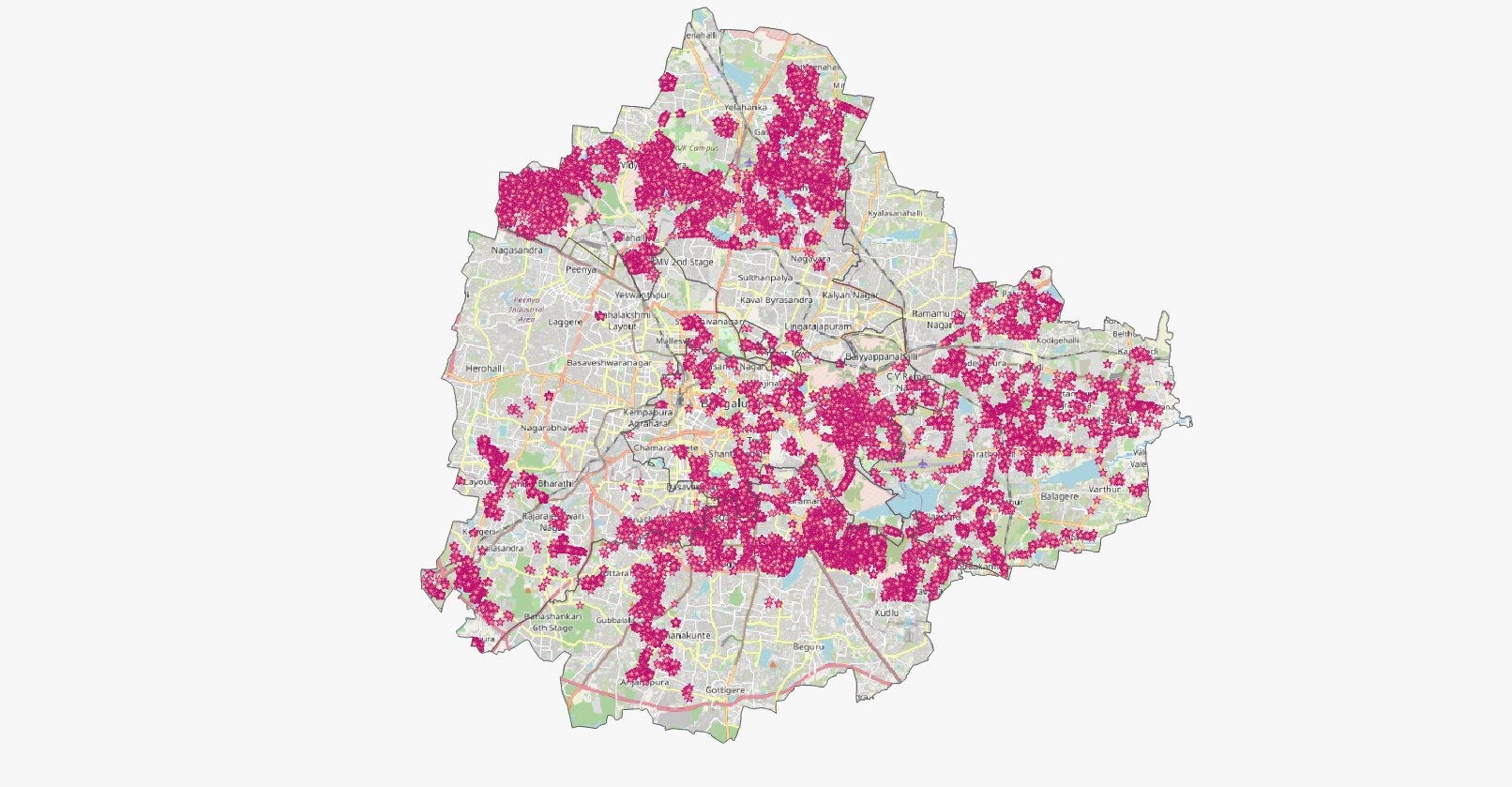
Someone else has built a tracker, where you can filter trees by their state of bloom. Oh, the joy of seeing technology used well.
On the theme of picking things from other markets and calling it your own, let’s play a small quiz. In 1973, two of India’s most accomplished singers gave their voices to a song—we’ll call it X—in a Bollywood movie. Composed by another luminary, that beautiful song is a family evening and karaoke hit till date.
However, four years prior, Dutch-Bulgarian singer Bojoura had released this track below. Listen to it, identify X, and let me know in the comments. :)
That’s all from this edition. See you in the next one!
Chura liya, by the legendary music director who occassionally got 'inspiration' or blatantly stole, Right? 😂
I spent a couple of weeks learning to pronounce tabebuia correctly :). That tree is such a treat. That and the one with lavender coloured flowers.