

Welcome the fourth edition of The Jukebox.
Lucy might be the quietest person I know. She speaks at a volume that requires you to lean in, avoids eye contact, and in any group larger than, say, three, she folds into herself. Ordering dinner with Lucy is a five-round negotiation in which she concedes nothing, not even a preference for rice over roti.
A couple of weeks back, I was at Lucy’s with three of our common friends, when she hit me with a diss. A vicious, piercing gaali built with perfect composition—a family member, a metal object, and an action that shouldn’t involve either of those two. Many of my batchmates from Delhi NCR’s premier educational institution would be proud. I hadn’t heard anything like this in the last decade that I’ve spent in southern India. And out of nowhere, this church-going Goan child, who’s barely ever said ‘fuck’, had fired a slingshot from five yards. There was, of course, silence in the room.
I hadn’t done much wrong apart from denying her a trade. We had been playing a board game for nearly three hours, Lucy was close to winning, and I was stalling—hoping that if the game stretched long enough, frustration would curdle into bad decisions, and I’d wiggle something out of the mess. Neither of us won, which probably warranted a second hit, but she let that go.
Monopoly and UNO can make people snap, but if you want to see real, deep, tectonic rage, get four people around a board of Catan.
📜 The Rules
For the uninitiated, a quick run-through of Catan’s rules.
The game starts with four settlers on an uninhabited island, and the goal is to build the most successful colony. The island is 19 hexagonal tiles, each producing a resource—forests give wood, hills give brick, mountains give ore, fields give grain, pastures give wool. For your turn, you throw two six-sided dice. The sum determines which tiles are in play.
And this is where Catan’s design becomes interesting: because the resources are unevenly distributed, no one can build anything alone. You have to trade. The table is an unregulated marketplace and players barter freely with each other.
The value of a resource is entirely dependent on the table’s current scarcity. In the early rounds, wood and brick are priceless currencies of expansion; by the late game, they are worthless, replaced by the hunger for ore and grain to upgrade cities.
So, effectively, your ability to anticipate and beat hoarding trends determines how well you go in the game.
There, too, is a potential banana peel. Looming over a board’s economy is the “Robber,” a black token activated whenever a ‘7’ is rolled—statistically the most probable outcome. When the Robber strikes, production halts on the blockaded tile, and any player hoarding more than seven cards must discard half their hand. The rich must pay higher taxes and all that.
📈 The Numbers
I first played Catan back in 2015. We had to look up the rules on the internet—most of us hadn’t even heard of this game. It had obviously grown since. During the pandemic, apps and websites propped up where players could log in and play a full game, trade et al included. I didn’t know Catan had become an industry behemoth.
As of 2024, Catan had sold over 40 million units worldwide and been translated into more than 40 languages. Three decades after a German dental technician named Klaus Teuber first designed it in his basement, Catan is one of the most popular board games in the world, only trailing Monopoly amongst the best sellers.
In 2024 alone, Catan sold 5.4 million units, generating approximately $162 million in revenue. It has even spawned video game adaptations and a world championship.
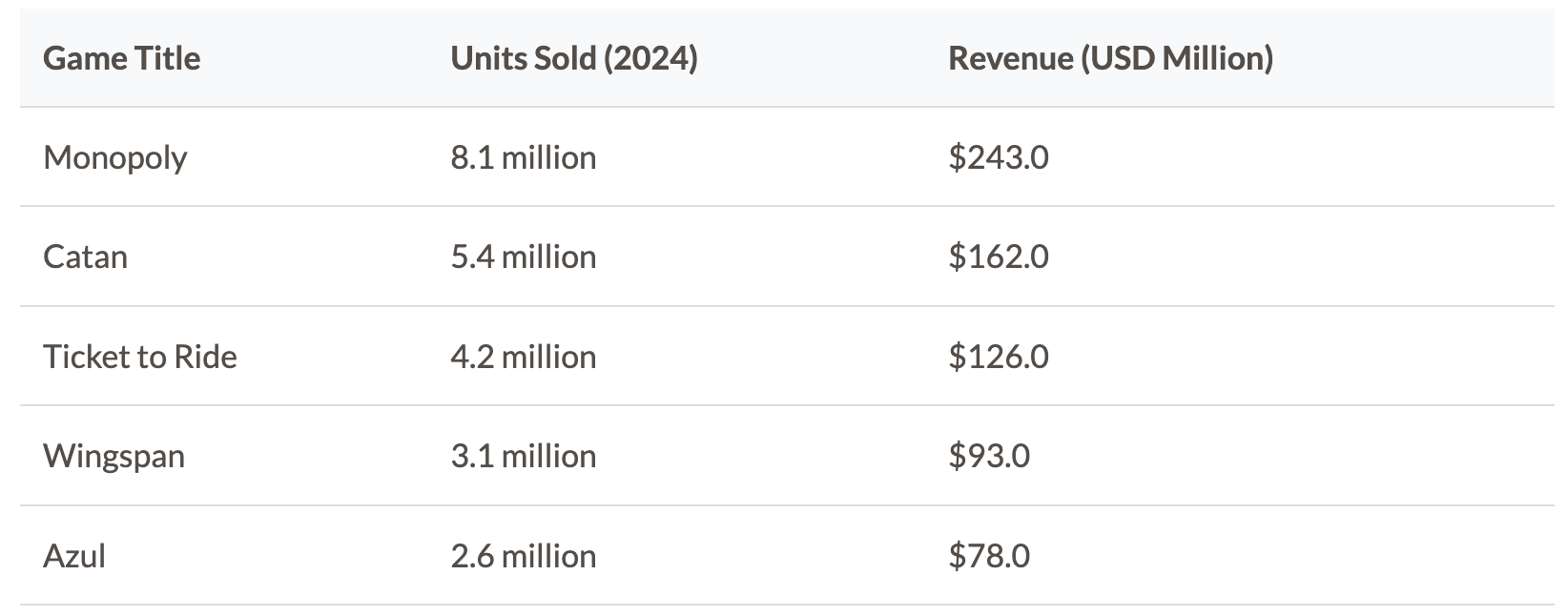
According to this report, the global board games market is now valued at somewhere around $13 billion. That is significantly more than the entire box office collection in USA in 2024. Habsro Inc. and Mattel Inc.—names you have read behind Monopoly and UNO boxes, repsectively—own the largest share of the market. And they’re perpetually expanding their reach. Monopoly now has officially licensed variants like Monopoly: Pokemon Edition and Monopoly: Game of Thrones.
Then there is the indie market. In 2024, Kickstarter board game projects raised $185.4 million, while Gamefound generated another $62.7 million. These are numbers of a growing, commercially muscular industry.
All of this is music to my ears. I love board games. I remember a period in Delhi, when we’d gather every weekend at my friend’s for a night of Ludo, UNO, and Monopoly. Most weekends involved at least a few hours around a game board, which meant carrying a stack of boxes.
Then, sometime in 2016, I stepped into a tiny coffee shop in Chennai to find one shelf with Monopoly, Scrabble, and Risk boxes. That shop, sandwiched between gigantic fast food restaurants overlooking the Besant Nagar Beach and the Bay of Bengal, was a minor discovery.
🛖 The Cafés
Now, board game cafés have mushroomed across India’s metros—three within ten kilometres of where I live in Bangalore, about a dozen scattered across Chennai, and a bunch in Delhi and Mumbai, each part of a buzzing “scene.” You’d be surprised to see the crowd—it’s not just us geriatric millennials. Gen-Z, in fact, leads the market at 38% of the player base.
This tracks. A few months ago, while reporting a piece on how matcha was having its black coffee moment, I spoke with the founder of a well-known coffee company. Both of us were convinced that this vile, grassy drink was more than just a fad. Gen-Z, he told me, doesn’t drink the way millennials or boomers did. Often, they don’t even want alcohol. Matcha has managed to catch their imagination—both as this fashionable product and as an alternative beverage, the kind of which India has never really tasted before.
It’s an evolving pattern, of the generation we sometimes box as too shallow actively breaking out of stereotypes. The same demographic that floods Instagram with dance reels and elaborate #GRWM exhibitions is also developing a fatigue of the phone screen.
Board games are benefitting from this. The tactile nature of the components—the weight of a poker chip, the snap of a card, the thud of dice—offers a sensory richness smooth glass screens just cannot. The industry has responded by doubling down on table presence. Modern games feature high-quality miniatures, hand-drawn cards, and multi-layered player boards. An official variant of Monopoly comes with credit cards and an electronic bank.
“Modern adulthood runs on chronic alert — notifications, deadlines, hyperproductivity,” says Dr Shilpi Chanda, a mental health professional, in this article. “But in a board game, time slows. Play becomes unscheduled joy.”
At a time when art, and life itself, is getting locked in a room with AI models, a board game is a refreshing getaway, where the scuffles and arguments are real, as is the thrill of rolling the dice on a Monopoly board and finding out you’re about to own a property on Mayfair. Or, in my case, the thrill of watching the quietest person in the room tell you exactly where to shove your cards.
🥮 Dessert Corner
A brief list of stories I loved reading this week.
Over the last month or so, The Washington Post have let go of more than 300 journalists, a lot of whom covered sports, arts, and books. Becca Rothfeld writes for The New Yorker about what the demolition of the book reviews section means.
Samreen Razzaqui writes about how the Afghanistan men’s cricket team, unable to ever play a “home” game, carry their homes with them. Come for the sabz chai, stay for the shoutout to Mazaar.
Neha Varmani lays out the archived history of Sohan Halwa.
This year marks half a century since Stevie Wonder released this groovy beauty. That Hohner D6 clavinet still sounds so fresh and crisp. Stevie Wonder was also an innovator with sound, like Jon Lord and Ray Manzarek. I guess all great keyboardists are, at some level. SW routed his clavinet through a rig of guitar pedals, just to make it fizz and dance like an electric guitar. You’ll hear the clavinet in both its shades in this album.
That’s all from this edition of The Jukebox. See you soon!
Now, I want me some Sohan Halwa. 🤤🤤🤤
There is a nice piece about Washington Post's deletion of book reviews in Frontline by Jinoy Jose as well. Do give it a read if you have time.