

On May 2nd, at about three in the afternoon, a hundred or so people gathered at the Yeouido Hangang Park in Seoul, on the western bank of the Han River. Some brought pillows, blankets, and soft toys; some came in loose cotton and nothing else. They were there for a 90-minute power nap contest organised by the Seoul Metropolitan Government. The winner, it turned out, was a man in his eighties.
The pictures show an easy afternoon. Not the best thing to see as you sit down to work.
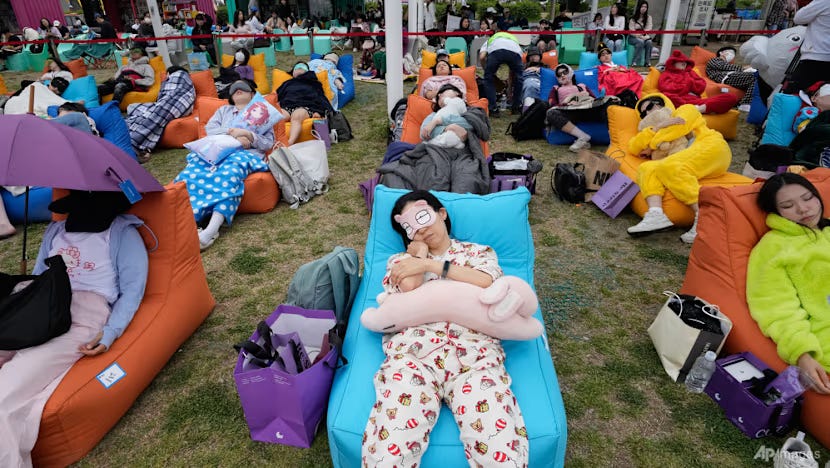
Now in its third year, the contest is South Korea’s eccentric response to a chronic-insomnia crisis that is, by all clinical measures, global. According to this Economist report from 2022, “The average American adult snoozes almost two hours less than their great grandparents did. More than a third of Americans get less than seven hours of kip a night.” For help, we’re turning to technology.
The worldwide market for sleep-tech devices—Oura rings, Eight Sleep mattresses, Whoop bands—is valued at nearly $30 billion, expected to soar to north of $100 billion by the next decade.1 Matteo Franceschetti, co-founder of Eight Sleep, thinks the addressable market for his company is “literally everyone in the world”.
The same Whoop band worn by a Bengaluru jogger to gamify her morning routine yields, on the wrist of a fast bowler, a data stream that can determine whether he starts the weekend’s match. And the first thing checked every morning is the recovery score—a measure of sleep.
Professional sport was the first industry to treat sleep as a performance input.
During the mid-to-late 1990s, Manchester United Football Club devoured English football. Their league title in 1993 was their first in 26 years, and it opened a dam that no team in England could hold back. Between 1993 and 2001, they won seven league titles, three domestic cups, and a European title. Their coach, Alex Ferguson, became Sir Alex Ferguson for his contribution to English football. Concealed behind his public persona as a red-fisted disciplinarian was a man fascinated by innovation and experiments.
It was around the first surge of titles that Ferguson met Nick Littlehales, a mattress industry executive who had become the marketing director for Slumberland. Littlehales approached Ferguson with a fundamental question: had the club ever considered how sleep affected performance on the pitch? The question was obviously rhetorical. No one was measuring sleep, anywhere in the world. Ferguson, intrigued, invited Littlehales to United’s Carrington training ground to speak with the players and medical staff.
The first practical application of Littlehales’ theories involved star defender Gary Pallister, who was plagued by chronic back problems. Littlehales evaluated Pallister’s sleeping environment and discovered that his bedding was contributing to his spinal issues. By providing personalised mattresses and pillows—and educating the player on spinal alignment during rest—Littlehales helped produce an immediate and identifiable improvement in Pallister’s condition. The experiment evolved into to a regular consultancy where Littlehales worked with the entire United team.
Under Littlehales’ guidance, Ferguson implemented radical changes to the club’s training schedule. Traditionally, pre-season involved gruelling morning sessions. Ferguson, however, decided to double up on training, instituting both morning and afternoon sessions, but with a critical caveat: players were required to sleep or nap in specifically designed recovery rooms between sessions. This was an early implementation of multiphasic sleep—the idea that recovery should not be limited to a single nocturnal block but should be distributed across the 24-hour cycle to meet the elevated metabolic and neurological demands of elite training.
Littlehales also introduced sleep kits for away matches and international travel. These kits ensured that players had personalised bedding and environmental controls (such as light-blocking tools) regardless of the hotel they were staying in, thereby minimising the “first-night effect” and other disruptions to the circadian rhythm. By 1998, the England men’s national team were commissioning personalised sleep kits.
Westwards, the NBA and NFL coaches took note, although they were slower to integrate sleep scientists into their conversations. In the 2009-2010 NBA season, the San Antonio Spurs, under Gregg Popovich, invited a specialist from Stanford University to help optimise rest. Simultaneously, the Portland Trail Blazers began a partnership with Dr. Charles Czeisler, the director of Sleep Medicine at Harvard Medical School.2
The NFL centralised sleep initiatives in 2018 when it announced a multi-year league-wide partnership with Sleep Number, providing every active player in the league with a 360 smart bed. These beds utilised SleepIQ—a non-wearable biometric sensor system built into the mattress that tracks heart rate, breathing patterns, and movement.
And while Manchester United and NBA franchises have the resources to innovate, the reach of sleep into professional sport became most starkly evident when, in 2016, Brentford Football Club, then in the second tier of English football, started working with Danish sleep expert Anna West, the founder of Sleep2perform.
In this interview with Training Ground Guru, West said, “At Brentford, we divided the players into a traffic light of profiles after doing the screening. Reds had a racing mind, problems falling asleep, nights when they never even went to sleep. This had a big impact on their performance and injury risk. Even if a player was a green, which meant they were sleeping well, there were still improvements that could be made.”
Today, almost all elite teams in the Premier League, NBA, and NFL have formal sleep protocols. They dedicate millions of dollars to sleep every year.
In Seoul, the man who won this May’s edition told a local newspaper he had no particular technique. He simply lay down on the grass, closed his eyes, and stopped trying to be awake. I wonder if he’s interested in becoming a sleep coach and making a couple of cool millions.
Before I go, here’s Max Richter’s eight-hour album, Sleep. “It's a piece that is meant to be listened to at night,” he says. “I hope that people will fall asleep listening to it, because the project is also a personal exploration into how music interacts with consciousness.”
There is, however, a growing concern regarding orthosomnia—a condition where consumers become so preoccupied with achieving a perfect recovery score that the resulting anxiety actually degrades their sleep quality. It’s an incredible, dystopian situation—your sleep affecting your sleep.
LeBron James tries to rack up nearly ten hours of sleep a day during the season. He uses the meditation apps and maintains a strict room temperature of 68–70°F (20–21°C).
Love your research ❤️🙏