

On 21st April, fifty-one days before the opening match of the World Cup, FIFA announced a flash sale of tickets. As an Indian and a cricket fan, I had heard this sound before—the late, nervous rattle of unsold inventory—but never from football. FIFA usually releases tickets months, if not a full year, in advance. Besides, hadn’t President Gianni Infantino told us, just two months back, that every match was sold out?
Sometime that afternoon, I wandered over to the ticketing website, just a passerby peering through windows. FIFA served me three scrolls of available matches. Second from the top, incredibly, was USA vs Paraguay—the host nation’s curtain-raiser and most anticipated football match in thirty-two years. About a third of the tickets were up for grabs. The cheapest ticket for the game, far up in the nosebleed section of the 70,000-seater SoFi Stadium in Los Angeles, cost $1940. That’s nine times the ticket price my friend Arjun paid to watch Lionel Messi-led Argentina play Netherlands in a quarter-final at the last World Cup.
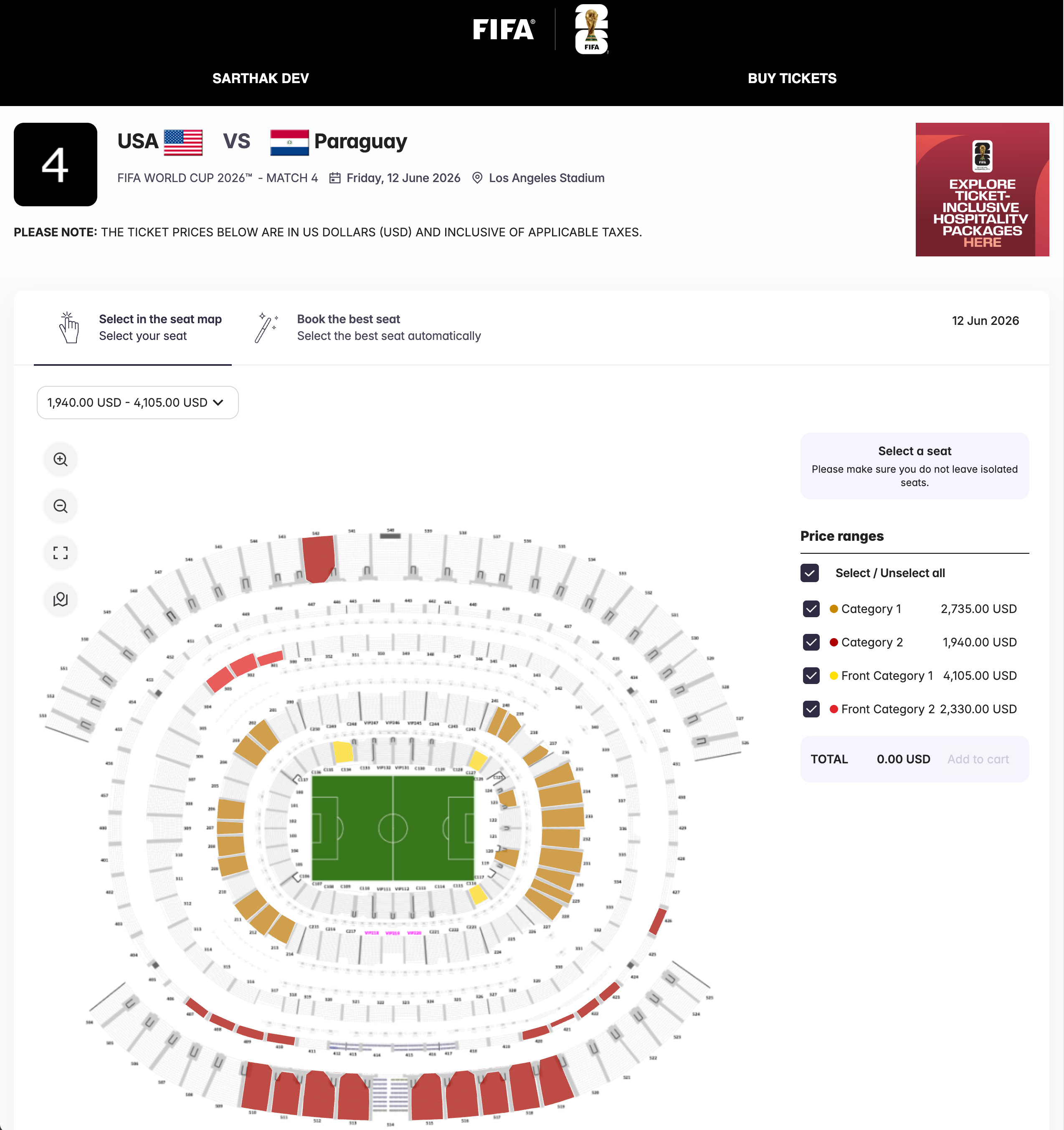
One day after USA’s opener, Haiti play Scotland in Boston. The Category 1 seats for that match cost $1250—almost enough to have bought you a pitchside seat to watch Messi lift the World Cup in Qatar.
**
Every FIFA World Cup montage begins with a scene from Mexico City and one from Pasadena, California. Maradona at Mexico City, eyes closed, arms raised, is a tableau of ecstasy and deliverance, genius turning into God. Baggio at Pasadena is a picture of pain. You see a ponytailed man in a brilliant blue shirt, number 10 on his chest, shoulders caved in, while, in the blurred background, canary yellow shirts flutter like confetti.
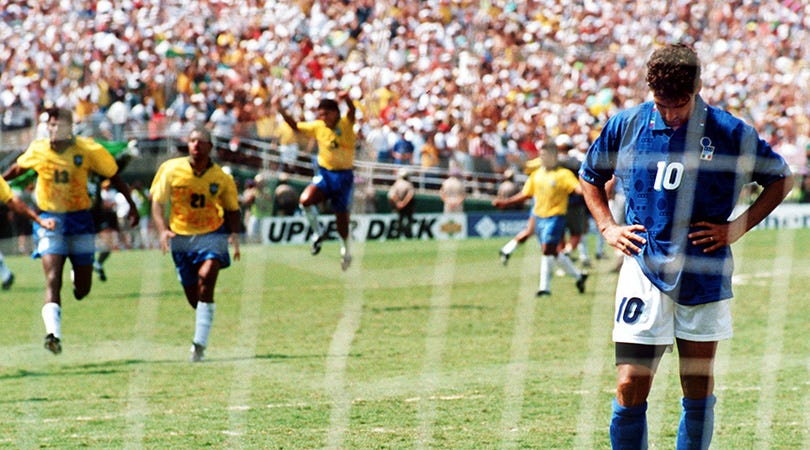
Baggio, the best footballer in the world, has just sent the decisive penalty over the crossbar. The 1994 final is over. Everything about him, his life, his career, is collapsing.
But look at that picture again. Not at Baggio; at the light. World Cup finals happen under floodlights, under the theatre and shimmer of night. Baggio’s devastation is lit by the afternoon sun. The sky is clean and blue, the crowd in pastels and beach hats and sunglasses. This is what football looked like in America.
The 1994 Men’s World Cup was the tournament’s first trip beyond its childhood homes in Europe, South America, and Mexico. Football had tried to break into America a couple of decades before, when Pele, Beckenbauer, and Johann Cruyff wore strange jerseys and played to half-full crowds. That experiment was shelved, but not for long. The world’s most popular sport had to find a way into its most powerful country.
Hence, 1994. The Cold War was won, rivals had dissolved, and American corporations were stamping neon logos onto every corner of the planet. The United States were unrivalled leaders of the present and future. Over 94,000 attended the final in Pasadena, where Baggio felt his right foot shatter his lifelong dream.
This was, still, an extended and elaborate trial run. So much about the tournament was late-1980’s-coded: baggy shirts, glossy prints, sunglasses that covered half the face, bald men with mild protrusions playing centre-midfield. All that would soon change. The next time football came to America, it would be a slick, 21st-century product.
**
And so, here we are, back to the land of milk and honey, Cruise and Kendrick, Trump and Tate. Here, David Beckham owns a team from a beach city and Lionel Messi wears its pink jersey. If you’re travelling from another country, you will likely meet an immigration agent in a kevlar vest, carrying an M4 rifle, before you see your luggage.1
The World Cup starts in seven weeks. The war in Iran and Lebanon has now stretched beyond fifty days. Meanwhile, Donald Trump’s dehumanising visa blacklist has swelled to 72 countries, amongst them Haiti, Egypt, and Cape Verde, participants at the World Cup. Fans from these countries may be required to pay a bond of $5000 to $15,000 to simply enter the USA.2
The bonds are technically refundable, but for residents of the many countries it is applicable to, it could cost months, if not years, of earnings. While some countries—like Tunisia and Algeria—have a couple of games in Canada and Mexico, where no such bonds exist, most, like Iran, don’t.
As of publication of this essay, Iran are scheduled to play their group matches in Los Angeles and Seattle. You will not see an Iranian fan at the World Cup, even if, through exceptional circumstances, you see their team.
Offside, a 2006-film made by Jafar Panahi, is a story of Iranian girls disguising themselves as boys to watch Iran play Bahrain in a World Cup qualifier at the Azadi Stadium in Tehran. The film is banned in Iran, lest it influence others to commit sacrilege. Since 1979, Iranian women have been forbidden from entering football stadiums. And yet, like water pushing at boulders, they’ve found a way. In 1997, they broke police barricades and entered the Azadi; in 2014, they wore thick veils to cafes and watched Iran play at the World Cup.
In March 2019, a twenty-nine-year-old woman named Sahar Khodayari put on a blue wig and tried to enter the Azadi Stadium to watch her team Esteghlal FC play in the AFC Champions League. She was arrested, and charged with appearing in public without a hijab. She spent three nights in a detention centre and was later summoned to the Revolutionary Court. After leaving the courthouse, Khodayari poured petrol over herself and lit a match, burning ninety percent of her body. She died a week later. Iranians called her the Blue Girl.
A month after her passing, under tremendous pressure from FIFA, Iran allowed women into the Azadi for the first time in four decades. The occasion was a World Cup qualifier against Cambodia. The initial allocation of 3,500 tickets sold out within minutes. Inside, the women who made it chanted Blue Girl, Blue Girl. Iran won 14–0.
**
World Cups are sundials one tracks life with. I was a boy in ‘98, and I remember the World Cup because the TV was new, the colours were bright, Ronaldo was rapid, and Zidane played like he had more time than others. The 2002 edition passed through my aunt’s wedding—a fortnight-long event that started with railway station pickups and ended with teary farewells. By the final, the house was empty, just the couple of us in front of a television watching Ronaldo bury his ghosts from ‘98. I was in college in 2010, pulling nights at a shady startup in 2014, and covering the tournament in 2018. The ball stayed round while the life around it changed.
The 2026 edition comes to us when we desperately need something to hold onto. The air outside, and behind our screens, is grey with ash. International and domestic laws apply only to the marginalised. Resistance feels both imperative and futile. I have never thought of a World Cup as a global sanctuary, but I have also never felt so depleted of hope about the world.
The football bits will happen, inevitably. Some underdog team will reach the quarter-finals, some teenager will carve his name into our consciousness, and a genius will make the impossible look pedestrian.
A World Cup, though, is made by the vibrant backdrop to athletic excellence. The sound of fifty beating drums in a tall stand, bodies painted in national colours, eyes red from all-nighters spent travelling between cities, fathers lifting children in the stands, a beardless twenty-year-old on his first World Cup, a seventy-five-year-old clutching a replica trophy. Stories of a city taking to the streets with brass and drums, and another, far away, seeking refuge in alcohol. This is the heartbeat of tournament sport, the light we carry home.
**
On paper, the decision to give the USA hosting rights was sound. The World Cups of this century—Japan/Korea, Germany, South Africa, Brazil, Russia, Qatar—were held in countries that had to build from scratch or improvise. The United States were ready with the stadiums, the airports, the hotel rooms, the highways, and the dollars. They hadn’t hosted the Men’s World Cup or the Olympics in three decades. This was the moment.
Predictably, the suits in FIFA and the USA were waiting for this moment too.
The first tranche of tickets for this World Cup was released in October. FIFA had promised accessible pricing like at previous World Cups. They arrived, instead, with ‘Dynamic Pricing’—a term borrowed from airlines and taxi-platforms, in which the cost of a ticket rises and falls depending on demand and availability. It was a thin, transparent smokescreen.
By April 2026, ticket prices had gone up exponentially. The most expensive tickets for the final are currently going at $10,900—nine times the amount fans paid for the same ticket in Qatar.3
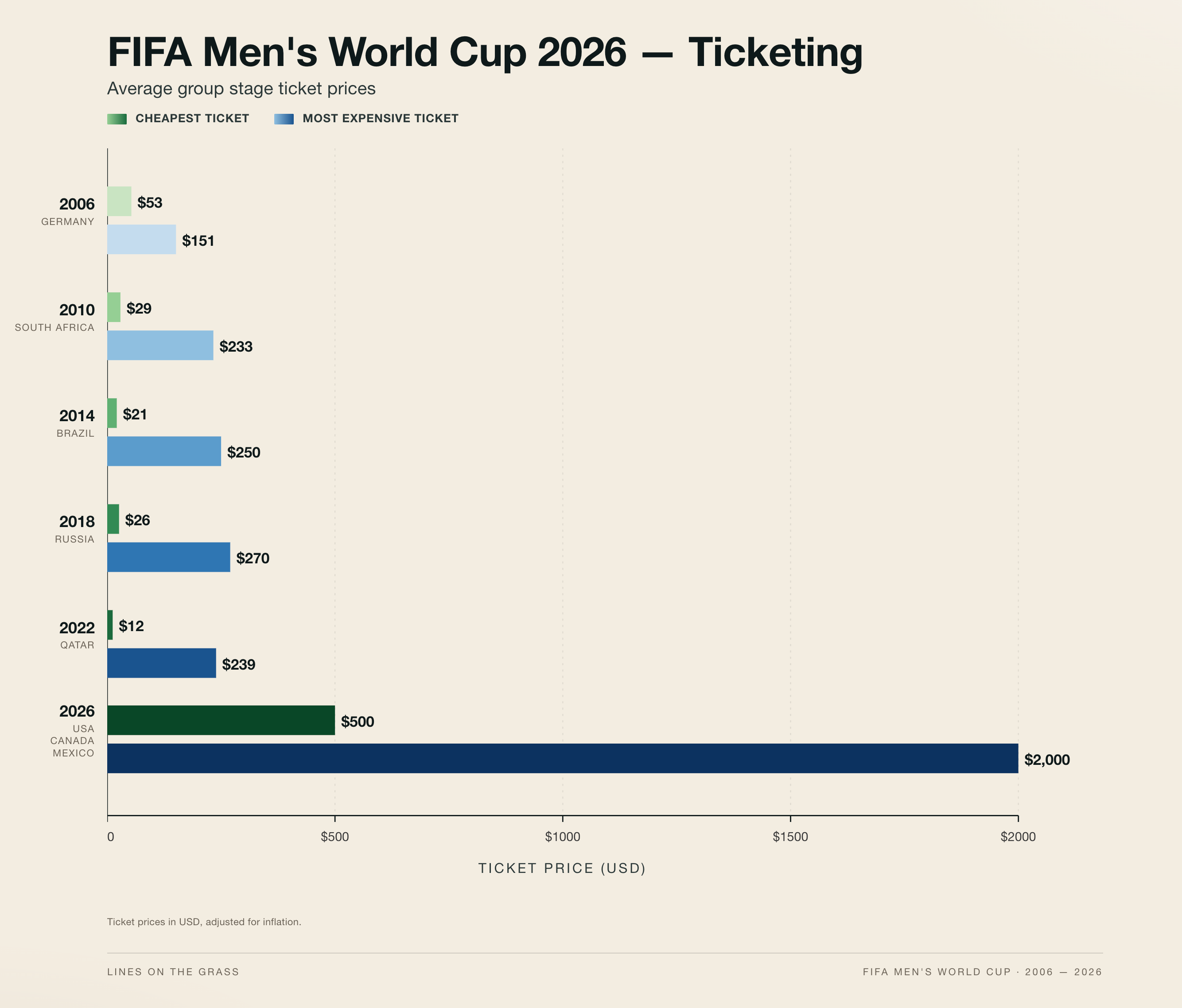
Even that sum doesn't guarantee you what you paid for. Fans who bought Category 1 tickets—the most expensive section—found their seats shifted without consent or intimation, to accommodate new VIP sections. They logged in on the ticketing portal to see a different seating map from what they had been provided during earlier sale windows. The Athletic spoke to Kiara Gilmore, who bought Category 1 tickets to a match in Arlington and found her seats moved to Category 2. “It’s just frustrating when you think you’re paying for one thing, and you get another, and then they change [the map] on you.”
Then, there’s the travel. A round-trip train from New York City to New Jersey’s MetLife Stadium costs $150—nearly twelve times the regular $12.90 fare for the roughly 15-minute, 9-mile ride. A parking spot across the highway will cost $225 per match.4
Dan Corry, an English economist who has attended the last eleven World Cups, told The New Yorker, “At other World Cups, the focus seems to be on making sure the fans have a good time. The ticket prices are reasonable, there are fan fests, and the host cities work out how to get fans to the grounds for free. It just doesn’t feel like this World Cup has the idea of making sure the fans have a good time at its center. There are all sorts of other agendas going on.”
Pannalal and Chaitali Chatterjee, from Kiddirpore, Kolkata, attended ten consecutive World Cups, from 1982 to 2018. They lived lives of attrition, rationing every purchase, whether rice or cloth, with one eye on their World Cup fund. “We don’t have kids,” Pannalal had once said. “Football is our only child and whatever we spend, we spend on something we love.” Pannalal passed away in 2019, aged 90, before he could raise ten to eleven.
Maybe Corry will travel to the World Cup this time, but Chaitali won’t. It’s unlikely FIFA will care for either.
More than a million fans travelled to Qatar between November and December 2022. The final, between Argentina and France, recorded nearly 1.5 billion views and an average live audience of 571 million. No sport, no spectacle, comes close. For FIFA, this is the money spinner, and they love money; no one who has watched FIFA operate for any length of time would pretend otherwise. But there used to be an unwritten law that the World Cup existed, at least in part, as an open-doors celebration of the sport. For the Dan Corrys and Pannalal Chatterjees of the world, for the Iranian women and Haitian men trying to escape their lives for one fleeting week, for a backpacker from Athens to share fries with a banker from London. That pact has not just been broken but mocked and spat on. What remains is a tournament designed, with great sophistication, to extract the maximum possible amount of money from those who give the tournament its life.
Every once in a while, you wonder who the sport serves. And then you open Twitter and get the answer. And, to think, the Los Angeles Olympics is two short years away.
To battle a staffing shortage and travel meltdown, Trump sent ICE agents to “help out” at airports.
Let's say you were handed genetic fortune at birth, and you’re eligible for a US visa without having to pay a month’s rent for an apartment in Manhattan. Your social media accounts will be scanned by US immigration. If you have publicly voiced your opinions on Israel and Benjamin Netanyahu, with anything other than a deferential tone, you'll be quickly sent a letter of denial.
The Athletic’s Adam Crafton has been relentlessly reporting about the World Cup’s cracks and crevices.
At the last World Cup, ticket-holders received free access to Doha’s metro system throughout the tournament.
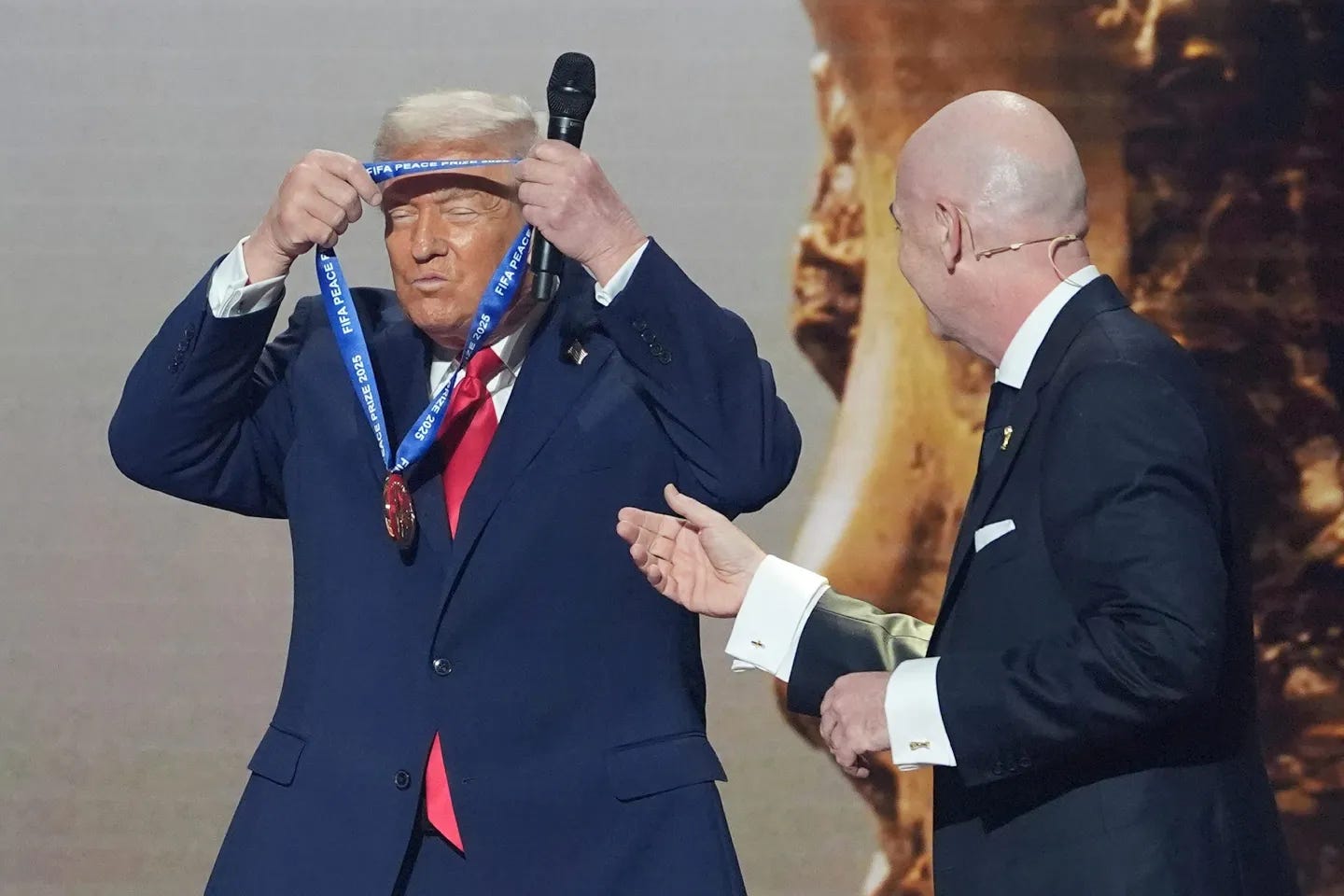
You are so right, FIFA does not care. FFS, they created, nay, invented, a Peace Prize for DJT. They are only into milking the universal popularity of Football, without caring for its future. Meanwhile, the world will continue to be full of greys, some of these greys spilling out of the pictures of children in the middle East. 🤦♂️
Where is hope? How do we dip ourselves in hope when a climate of viciousness and moral depravity among society, politics and everything that comprises our conscious being, pervades? There's fatigue. And football is life. A celebration of that very same life. Maybe we are all fatigued of life. Maybe I shouldn't generalise, but anywhere ypu turn, you're surrounded by a baton happily being wielded to bat us down. Yes, it's tiring. And everything that we hold dear is being morphed into something unrecognisable, unbearable and inaccessible.