

First ball. My eyes are half-shut, possibly even red from the rubbing. I am barely awake enough to walk straight. I haven’t bothered to comb my hair. Besides, who combs their hair at 3:30 in the morning? Jasprit Bumrah is bowling in a Test match in New Zealand. I’d wake up at odd hours for either; both together is a party. Many years back, Rahul Bhattacharya had said this about cricket from Australia: “There is something ethereal about cricket at dawn; staying up late is a lesser magic.”
For Australia, you wake up at dawn. For New Zealand, you wake up midway through your sleep. In days of youth and disdain for your body, at a couple of hours rest. Your sleep cycle and day are cooked either way.
The second delivery moves across captain Tom Latham’s eyeline and swerves back just in time. Latham, playing his 95th Test, has shouldered his arms, expecting the ball to ride its angle and leave him alone. He is an expert opener, adept at knowing when not to fiddle with danger. He discovers that Bumrah is dangerous even when you think he’s not. The ball jags back and takes his stump. My fist is clenched.
It’s a momentary release from disbelief and rage. India have dropped Mohammed Siraj, their second-best seamer and possessor of the largest heart within the team. Just fifteen months back, Siraj had bowled 1113 deliveries over a relentless English summer—running into the wind, pounding flat pitches while every other bowler in the squad, Bumrah included, got their rest. The last of those deliveries was a 90 mph yorker that sealed the epic series 2-2. That entire morning had been a show of Siraj raging against the dying light of the series, refusing to agree with the 3-1 scoreline that looked like a formality. It was quintessentially him. And yet, to speak merely of heart of effort is to undersell the enormous palette of skill Siraj possesses. Barring Australia, who have three all-time greats in their lineup, isn’t a team in the world that wouldn’t take him. And yet, for some reason, the India’s think tank didn’t consider him worthy.
The steam from my ears eventually subsides. And when it does, I realise that raging about not picking a world class fast bowler is such a privilege. India are playing four fast bowlers in a Test match, and their second-best is hanging out outside the boundary, occcasionally ferrying drinks. Not long back, India would field one top-class fast bowler in a squad. The rest ranged between decent to squad-fillers. I have watched matches where Sourav Ganguly has opened the bowling. Batting was India’s spine and spearhead.
Which brings me, perhaps predictably, to this week’s essay on The Cordon.
In the chilly winter of 2002, in the Delhi of my childhood, when it was still inhabitable, when a blanket of dust wouldn’t descend on it like it does these days, I used to wake up at 3:30 am and find the scoreline to be three or four-down for not much. The batters I plucked posters of had all been dismissed by bowlers we didn’t rate highly. India was a batting team, and our batting order was our pride. That batting lineup, great enough to evoke a moniker which became the title of a book, couldn’t score 200 across a month. The tour quickly unravelled into a Hitchcockian nightmare. Two hours of jumpscares in The Ring—which our cable guy merrily broadcasted weeks after its release—did not have as devastating an effect as this running loop of edges and caught-behinds. Every time you felt like you had seen the worst, there’d be one more dark morning lurking around.
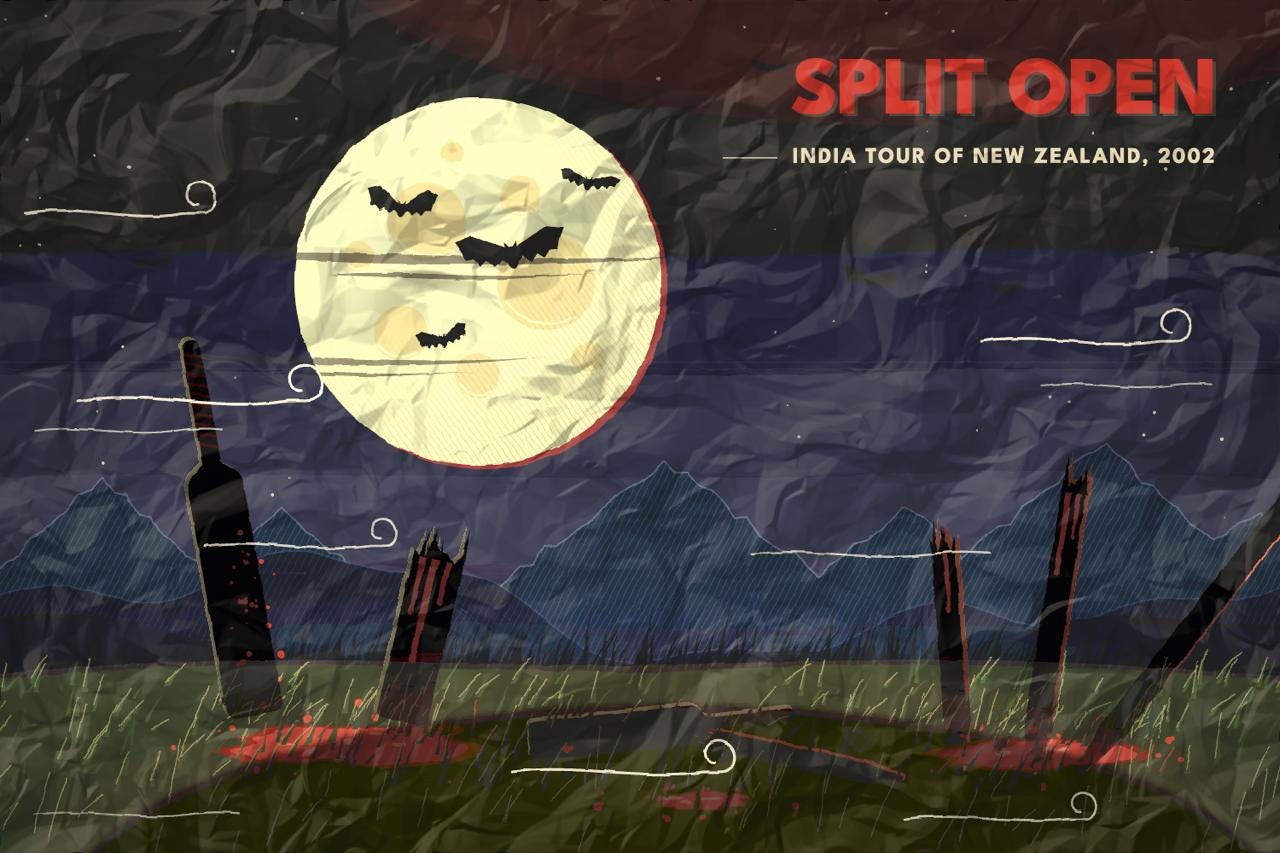
This essay is a rewind. It wasn’t just another series loss—those happened often enough then. This tour came about two years into a wave that had us all convinced that India were on the path to pre-eminence. Because it was New Zealand—the most remote Test nation in the world, considered harmless younger brothers by pretty much everyone—we didn’t foresee too many problems. After finishing up in New Zealand, India were going to South Africa to play the World Cup. A few good matches, a bit of luck, and…who knows?
And then, we were dismantled like a lego manhattan kept outside on a windy evening. This is the story of that winter, and how it felt.