

Haal is a beatific Urdu word, meaning the state a person is in. The weather of his soul, if you will. On the Hindi-Urdu plains, you greet a friend by asking about their haal, the way one might ask “What’s up?”. Haal is, of course, a moving phenomenon; your haal today could flip on its head by the weekend.
In 2013, the inimitable Osman Samiuddin wrote an essay, titled ‘The Haal of Pakistan’, illustrating the moshpit of electricity, chaos, and misery Pakistan cricket is infamous for washing up in. Watch closely, he says. “Pakistan are comatose flat. Bowlers, uninspired, are on autopilot, the fielders heavy and ponderous. Sometimes, but not always, it takes an unusual dismissal to turn on the light—a run-out, an electric catch, a part-timer taking a wicket. And then there is this total frenzy, so overwhelming and real you can almost hold it in your hands. Such is its force that it can be deeply moving even through the sensory dilution and sanitisation of TV, even on ball-by-ball commentary online.”
On the evening of September 9th, as offices in the subcontinent were winding down and traffic beginning to clog, Pakistan were bowling to England in Birmingham. It was the first day of the third Test. Pakistan had begun the day batting, and within two hours, been knocked over for 133. The series was already gone, the atmosphere toxified by some premium PCB headloss, and now, they were staring at the humiliation of a whitewash.
As the shadows lengthened across the Edgbaston turf, Babar Azam tossed the hour-old ball to Pakistan’s latest Test cap, Razaullah Mashwani. Razaullah was twenty-one, in his first year as a professional cricketer. Across the pitch stood Joe Root, fourteen years into his international career, within 1200 runs of Sachin Tendulkar’s previously insurmountable Test aggregate.
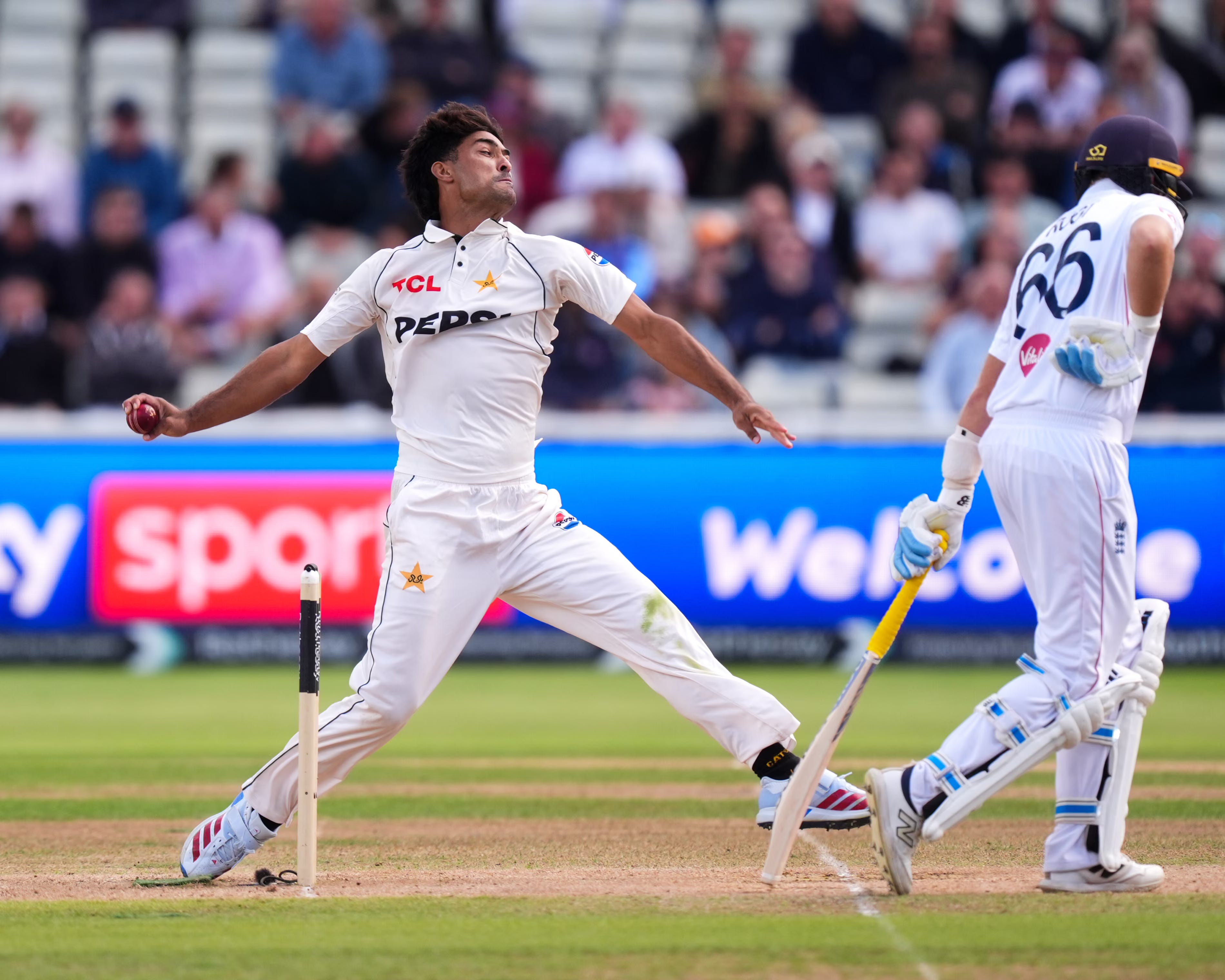
At the top of his mark, Razaullah looked every bit the boy still wondering if this was real, if he was truly about to bowl first-change for Pakistan in a Test match. He was supposed to be playing club cricket before the airlift call from the PCB. Now here, he gripped the ball tightly, glanced down at it, flipped it through the seam a few times before letting it sit. A half-smile broke on his face, which he folded to comply with the mood of his team. He tugged at the sleeves of his shirt, inadvertently highlighting his toned arms.
The card on the screen said “Right arm fast.” His face looked right-arm fast too, with its sharp features and a jawline sculpted for billboards. The joyously floppy hair at the back was likely inspired by an 80s fast bowler or a film hero. His first ball zipped across the pitch, onto the upper portion of Root’s bat. 143 kilometres per hour. Root looked back across the pitch, acknowledging the rush he had just felt. The second ball was quicker and fuller; Root defended again, not with much comfort.
There was something about Razaullah’s run-up too, something catchy, like faint notes of a classic. We had to wait for the third ball to investigate. So, he came, at a steady gallop, gathering speed as he approached the crease. His leap was economic, just enough to propel him forward. Then, the lines revealed themselves. He opened up his torso side-on and pulled his right arm behind his body, holding for half a breath before snapping it forward like a slingshot. This is Waqar! The action wasn’t an exact copy—in fact, it was closer to the honed movements of late-stage Waqar than his ‘Burewala Bombshell’ youth—but the influence was unmistakable.
But, it’s one thing having an action, completely another having the edge to make a batter fear for their wicket. Waqar came up in the glory years of fast bowling, when almost every cricket nation had a stock of their own: four of the five most revered cricketers in the world were fast-bowling all-rounders; the West Indies, having bid goodbye to the generation of Holding and Roberts, had welcomed Ambrose, Walsh, Bishop, and Patrick Patterson; and Marshall was still doing his thing. Waqar also followed in the lineage of Wasim Akram, Imran Khan, Sikandar Bakht—great Pakistani fast bowlers who, roughly eight balls in ten, attacked the stumps. Whatever else they could do, and they could do literally everything, they held close to the chest like trump cards.
Razaullah was entering a different world. Through this English summer, under damp air on pitches generating exaggerated movement, precision was everything. Ollie Robinson and Mohammed Abbas had been nearly unplayable with their gentle 80 mph darts. Wicketkeepers had stood up to the stumps all summer, as if to suggest: forget speed, just put it on a length.
To that end, Razaullah was a complete crosswind. His fourth ball was as quick as the previous three, but sharper, more vicious. It landed on a good length—too full to cut, too short to drive—and jagged inwards, pinning Root on his crease, his body bent, trying, unsuccessfully, to negotiate the heady cocktail of speed and lateral movement. Hitting middle and leg, clearly. The boy from the mountains of Khyber Pakhtunwa had a Test wicket within four balls.
The next over, he went one notch faster, up to 148 kmph. This is the register where fast bowling goes from discomforting to scary. Consider, for a second, the kinematics between batter and ball: the distance between the batting crease and the average release-point is about 19 yards; at 90 miles an hour (144 kmph), ignoring air resistance, the ball reaches the batter in 0.43 seconds—the time it takes to complete a blink. One blink. Consider then, computing all visual cues to figure out the correct shot. Razaullah started here.
Annie Dillard, who passed away this week, once wrote about writing that pushes the envelope of convention: “The writer knows his field—what has been done, what could be done, the limits—the way a tennis player knows the court. And he, too, plays the edges. That’s where the exhilaration is: he hits up the line. He pushes the edges. Beyond this limit, here, the reader must recoil. Reason balks, poetry snaps, some madness enters, or strain. Now courageously and carefully, can he enlarge it? Can he nudge the bounds? And enclose what wild power?”
Exhilaration—that’s the word. Most of us would never know the feeling of facing an international quality fast-bowler, thankfully so. But we know how it feels watching one from the sides. It’s exhilarating and wild, when a true fast bowler raises the battle between bat and ball from technical to physical. You hear it in the hush that sweeps through the stands and drawing rooms, in the voice of the commentators, see it in the sharpened eyes of the batter and fielders. Cricket, in that moment, develops a theatrical air. Only fast bowling can have this effect. No cover-drive, however glorious, can evoke the sensory thrill of a fierce, inswinging yorker uprooting a stump or two. The crack of a pull can make you stand up, but the whoosh of a ball fizzing past a batter’s helmet gives you gooseflesh. Batting and spin bowling can make you think of art and mischief; fast bowling, simply, is cricketing aphrodisiac.
Razaullah kept his pace up, and slowly, predictably, the radar began to wobble. Between the good stuff came some wide and some too-full. Harry Brook can hit perfectly decent balls for boundaries; quick and loose was dinner. He hit Razaullah for three boundaries in an over, about four or five in a ten-minute period. And, instead of fearing for the kid, it felt like a gift.
See, good fast bowlers, who can land the ball on a coin, are visually boring. Their control makes them monotonous. Yes, you will pick them if you’re ever asked to select a Test team, but you probably won’t take a flight just to watch them live. The real contraband is the wild fast bowler, the kind Pakistan grows like a crop, who can produce an unplayable delivery and get hit for fifteen runs in the same over. They aren’t shackled by control or caution. They live for the sensation of watching a batter take a step back.
Us Indians would know. Twenty-seven years and some months back, a young fast bowler from Rawalpindi was thrown the ball at Eden Gardens. At the top of his run up, there was no awe, just fire. He sprinted fifty yards, muscles rippling under his shirt, and in two balls he cracked open the two best defences of Indian batting. The second, to Tendulkar, was a lightning bolt, darting into the base of the stumps at nearly 95 miles an hour. Tendulkar was the best batter alive at the time, and he couldn’t get near the ball.
Shoaib Akhtar is the box-office archetype both Pakistan and Test cricket miss desperately. He couldn’t give a flying fuck about control as long as he was in the realm of sending the stumps cartwheeling. Shoaib was also as much a physical as a mental marvel. You have to be a bit nuts to bowl fast on the dusty grounds of the subcontinent. You have to be completely bonkers to bowl nearly 100 miles an hour and willingly wreck your knees, back, and ankles. He was larger than life. Razaullah isn’t anything like Shoaib; few can be. What Razaullah has imbibed from him is the raw edge that can turn games.
In his 23 overs, he got carted around plenty, but none of it dimmed his spirit. He just ran in harder and bent his back further. And he always, always, aimed at the stumps. The result was: when he got it right, he made the batters hop and flinch. They were uncomfortable, perhaps a bit worried about losing their defence. His four wickets could’ve easily been five or six. The one word on the commentators’ lips, through his spell and after, was ‘impact.’
He’s a natural. This recent profile on Dawn quotes his academy coach on the day he turned up for the Under-19 trials: “wearing spikes bigger than his size. With his first delivery he sent the batter staggering with his speed. I asked him not to bowl another delivery for fear of causing injury to any young and inexperienced batter.” In the academy, he asked for shirt number 14—Shoaib’s number.
And, as if the wickets and a rockstar’s hype weren’t enough, he held the encore for his batting. Pakistan were minutes away from another embarrassing defeat. Razaullah came out seven-down, his role merely to delay the funeral. And he came swinging.
To Josh Tongue’s welcome-to-the-crease bouncer he swivelled on his back toe and pulled for a six. A near-yorker was creamed through the covers for four. Then, another six. Then, another. The harder they bowled, the further they were dispatched. He hit Gus Atkison for three sixes in an over; he hit Jofra Archer for two in two balls. Like addicts, we roared louder with every six: One more! One more! When the spinners came on, the boy reached peak Clint Eastwood-western—full-sleeved and helmetless, hair ruffling in the wind, the bat now an axe. One of his nine sixes landed inside the hotel under construction along the walls of the stadium. For a brief while, we were teleported into the 90s, when Pakistan could conjure magic out of shreds, when fresh-faced bowlers could raze through batting lineups, when a debutant batter could flay good balls from good bowlers into the stands. After a month of Pakistan cricket at its most wretched, here they were at their most brilliant. Then he got out, and we broke out of the daze.
Pakistan lost early the next morning. 3-0, as if it was ever going to be anything else. They have now lost 16 out of their last 21 Tests. Their ODI and T20 sides aren’t any good either. Their cricket board is in predictable, perpetual turmoil. It’s important to place Razaullah’s debut against this backdrop. He took four wickets and scored 81 runs. Nothing changed.
So why were we cheering him on from four thousand miles away? Why were Nasser Hussain and Michael Atherton gushing about him on Sky Sports? Why was he received in Islamabad with garlands, confetti, and music? For that, we turn to Osman Samiuddin again. There’s a Sufi description of haal he pivots that piece around: “it has come to be interpreted, more often than not, as one ultimate state of ecstasy, much sought after but rarely achieved, in man’s journey to get closer to God. ‘In the ecstatic state,’ explains Idries Shah in his book Oriental Magic, ‘Sufis are believed to be able to overcome all barriers of time, space and thought. They are able to cause apparently impossible things to happen merely because they are no longer confined by the barriers which exist for more ordinary people.’”
To have seen Razaullah’s opening spell and batting innings, especially the bowling, is to have felt the magic of wild, uncontrolled energy, the prospect of ecstasy. Men’s Test cricket is packed with elite fast bowlers right now: Starc, Cummins, Hazlewood, Rabada, Jansen, Bumrah, Matt Henry, Archer, Robinson, and Mohammed Abbas. All of them are inevitable wicket-takers across conditions and situations. Many of them are seriously quick. But, and this is crucial, none of them are pulse-raisers. Barring maybe Nahid Rana of Bangladesh, it’s hard to think of another fast bowler who can make a dud match come alive through pace alone.
I have no idea if Razaullah becomes any good. Pakistan cricket have a spotless record of losing gifted fast bowlers. All I hope is that he never loses his pace and fire. A Pakistani fast bowler tearing through the wind and hurling 90 mph yorkers is the kind of stuff fifty years of Test cricket lore is filled with. We don’t want it as much as we need it. It makes cricket a better place. After all, as Shoaib Akhtar once said, pace is pace yaar.
Sarthak, Thank you.