

To play badminton at the highest level is to inhabit a body tuned for feline physics: razor-quick reflexes, explosive lower body agility, wrists that stretch and snap like resistance bands. All of this is widely agreed upon. In India, the game asks for a little more. You will need to make your peace with monkeys swinging between the ceiling bars, and you should develop a near-Holmesian instinct for the precise moment a pigeon overhead decides to relieve itself. Any dissent is an overreaction. The voice behind these words is of Himanta Biswa Sarma—the chief of the Badminton Association of India (BAI).
Sarma was speaking to a gathering of reporters at Indian Express’ Idea Exchange, last week, when questions about hygiene and safety were posed to him. This January, at the India Open in Delhi’s Indira Gandhi Indoor Stadium, monkeys were spotted moving between spectator galleries. Then, a pre-quarter final match between HS Prannoy and Singapore’s Loh Kean Yew had to be paused because of pigeon droppings. Several visiting shuttlers, far from home and unaccustomed to sharing a court with the local wildlife, let their displeasure be known.
Sarma couldn’t understand the displeasure or the post-mortem questions. “What’s the problem? We get monkeys at my house too,” he said, with an earthy, sing-song lilt to his speech, as if breaking down the obvious to a naughty classroom. “Pause the play for a couple of minutes and move on.”
Himanta Biswa Sarma is an influential member of the Bharatiya Janata Party (BJP) and the sitting Chief Minister of Assam. His stint at the top of BAI started in 2017, first as an interim president, and then flourished with consecutive unopposed election wins for the presidential post. In January, his BAI brushed off all criticism—including the world number 3 skipping the tournament, officially citing Delhi’s AQI as the reason—as foreign players acting too precious.
His clip from last week’s Idea Exchange surfaced and sank almost as quickly, carried off on the great tide of the FIFA World Cup. Against the noise from a hundred football matches, the fanfare and the filth, there’s been little attention to divert anywhere else, least of all an Indian administrator saying the bizarre. So we giggled and moved on, back to the stories taking off from the USA and travelling around the world.
The most stirring of them all was Cabo Verde, an archipelago of volcanic islands in the central Atlantic Ocean, populated by 525,000. They arrived as cardboard targets for the big teams to pummel and knock over on the way to the latter rounds. Instead, they qualified from their group into the knockouts, and there they held the defending champions Argentina by the throat until the very last minute of open play. The face of that spirit was Vozinha, their 40-year-old goalkeeper, who, during the World Cup, went from fifty thousand to 28 million Instagram followers and—of all the honours a life in sport might bring—had a new species of marine mollusk named after him.
And, it was somewhere during that Argentina match that I noticed India’s favourite sporting question touching its quadrennial fever pitch: “If this tiny group of islands can hold Messi and co., why can’t India have a World Cup-worthy team?” You must’ve heard this question too—in drawing rooms and casual WhatsApp conversations, from observers much older and many years younger. The other version of this, asked when the summer Olympics rolls around, goes: “Why does India not win more medals?”
Both are good questions. It must be stupefying that the world’s most populous country, youthful and ambitious, cannot make a 48-team football World Cup, or has an unblemished record of finishing bottom of the Olympics medal table when factored for economy.
The football question nags a little more, because we play it and watch it lovingly. It’s an oft-told, convenient lie that football only exists in the metropolitan cities, amongst the nouveau-riche, where weekends bring the Premier League and weekday nights the Champions League.
It was in India that Asia’s oldest, and the world’s fifth-oldest football competition, was born. The Durand Cup, played to this day, goes back to 1888. The Calcutta Derby packs out stadiums of sixty-seventy thousand. And, away from the top-flight, visiting Malappuram for the Sevens competition or Mizoram for the Inter Village tournament, or while reading Sandeep Menon’s wonderful book, Sacred Grounds, you are reminded that in much of this country the game grows outwards from sand and swamp to Manchester United, not the other way around. There are many reasons India is not at football’s biggest gathering; communal indifference and a shortage of grassroots talent are not among them.
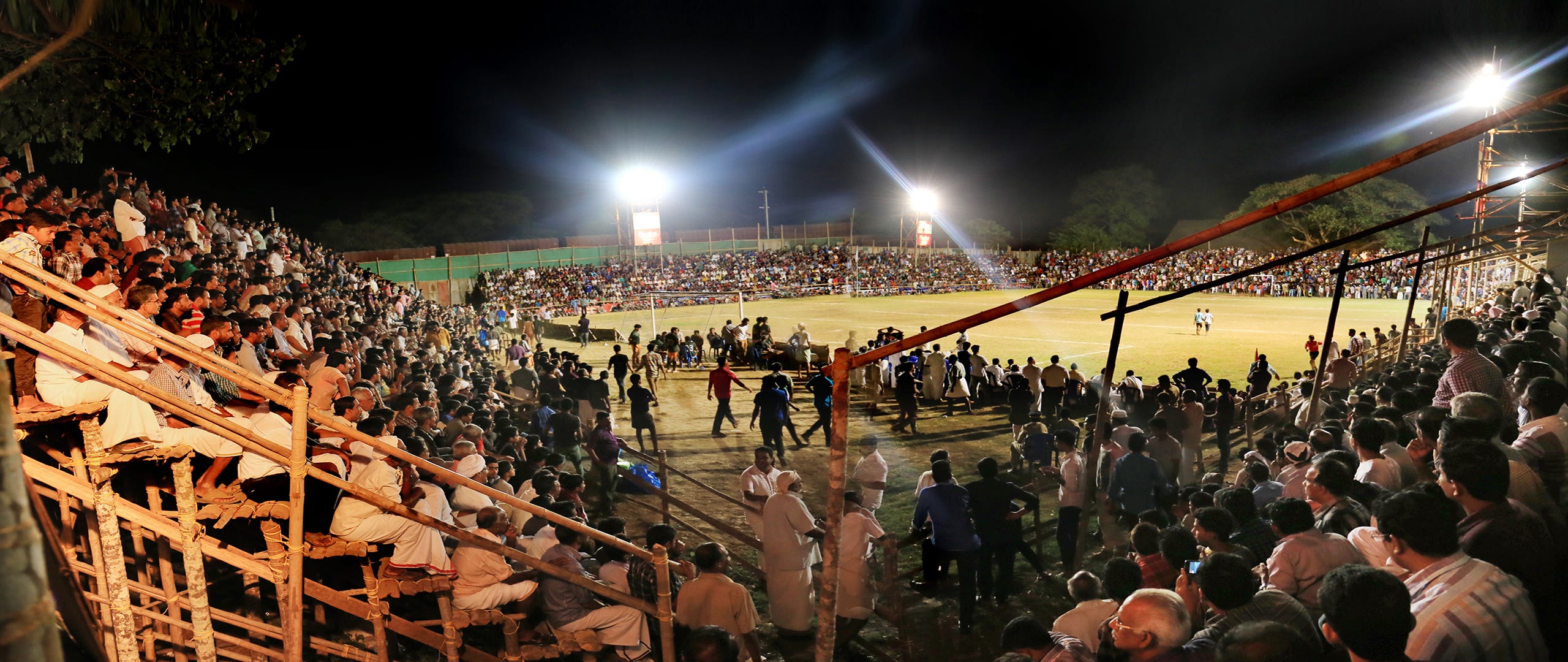
During this World Cup daydream comes another punch to the gut: India will not be sending a football team to the Asian Games this September. Despite qualifying for both the men and women’s draws, a sports ministry rule—mandating a team to be amongst the top eight in Asia for clearance—has closed the door on their faces. This rule, the seasoned journalist Marcus Mergulhao tells me, was in place for the last edition of the Asian Games too, but was waived on judgement, making this year’s enforcement even more bizarre.
“The Asian Games is not an exposure tour,” says India’s sports minister, Mansukh Mandaviya. “It is a platform to win medals. We only want athletes who will deliver the medals.”
What perhaps counts as exposure, evidently, is a sudden trip to New Zealand—at the time they should’ve been preparing for the Asian Games—to play a couple of friendly matches while two heads of state clap from the presidential box. The India vs New Zealand “series” will be part of ‘100 Years of Unity’—a celebration of the long friendship between the two nations. And, as such matters go, only the men’s team have been called over.
The women’s team will be left to marinade in the irony. If anything, they deserve the away tours and outsized support. Just last month, they won the 2026 South Asian Football Federation (SAFF) Women’s Championships in Goa. They are ranked 69th in the world. Their qualification credentials are indisputable, as is their star power. In 2022, Manisha Kalyan became the first Indian to play in the UEFA Champions League. Over the years, she has travelled through Europe, club to club, accumulating precious experience and validation of her ability. Similarly, Dangmei Grace has won leagues and cups in Uzbekistan.
Years later, when we look back at these careers and find a missing Asian Games at the peak of their powers, maybe even an outside possibility of medalling, how many lines do you reckon we will find about the men who stood in the doorway?
The domestic game, too, is in a stormy place. India’s primary domestic league—the Indian Super League (ISL)—is still recovering from the commercial breakdown that left last season in limbo before it eventually resumed in a compressed format. Clubs kept bleeding money; some were almost pushed to a precipice. The commerce of Indian football, we’re often told, is a tricky business.
In the middle of all this, in December 2025, came Lionel Messi, for a “GOAT Tour” that wound through Kolkata, Mumbai, Hyderabad and New Delhi. Kolkata, where the pilgrimage began, promptly turned into a riot. Thousands who had paid dearly for a glimpse found themselves staring instead at a scrum of politicians, VIPs, and security personnel. Messi was in the stadium for barely twenty-five minutes and left amidst security concerns, after being pushed, shoved, and yanked around like an actual goat. In Mumbai, he was handed cricket jerseys at the Wankhede Stadium, then taken to the Ambani residence and then their totally-legal wildlife facility.
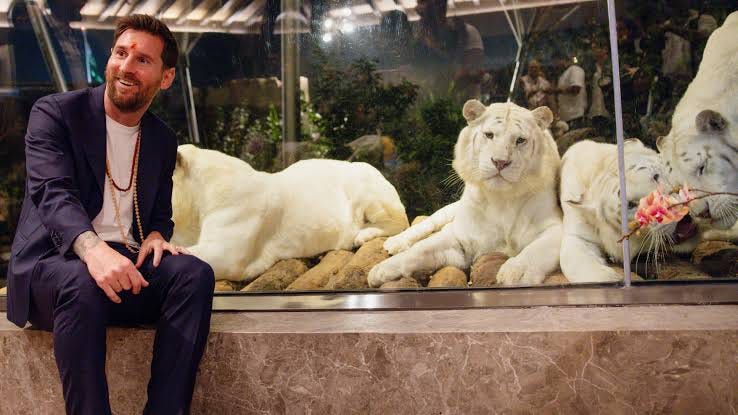
The tour became, almost effortlessly, a metaphor for Indian football: the whole apparatus tripping over itself to summon the world’s brightest star, pouring lakhs of private rupees on shaking hands with him, without making a single minute about football. They even dressed Sunil Chhetri in a Messi t-shirt and set him amongst a line of salivating dignitaries.
The organisers spent close to ₹100 crore, of which roughly ₹89 crore reportedly went towards Messi’s appearance fee alone. That’s enough to keep a dozen elite residential academies running for a year; or to cover the central revenue losses for half a dozen ISL clubs. But it won’t get you a selfie with the GOAT.
And that selfie, effectively, is the distillation of an Indian administrator’s relationship with sport. They queue up after Olympic and Commonwealth medals, after World Cups, promising land and cash rewards, when they’re never found in the same pincode during the years of toil and preparation. If India sweep the badminton medals at this summer’s Commonwealth Games, watch Himanta Biswa Sarma organise an elaborate evening of photographs and speeches.
An Indian administrator is the most vivid illustration of a moth drawn to the flame of money and fame. Sometimes, like this incredible report by Mihir Vasavda reveals, the money you make—or rather, siphon out of dedicated sports funds—gets you swanky residential complexes with pristine swimming pools and wooden-floor badminton courts.
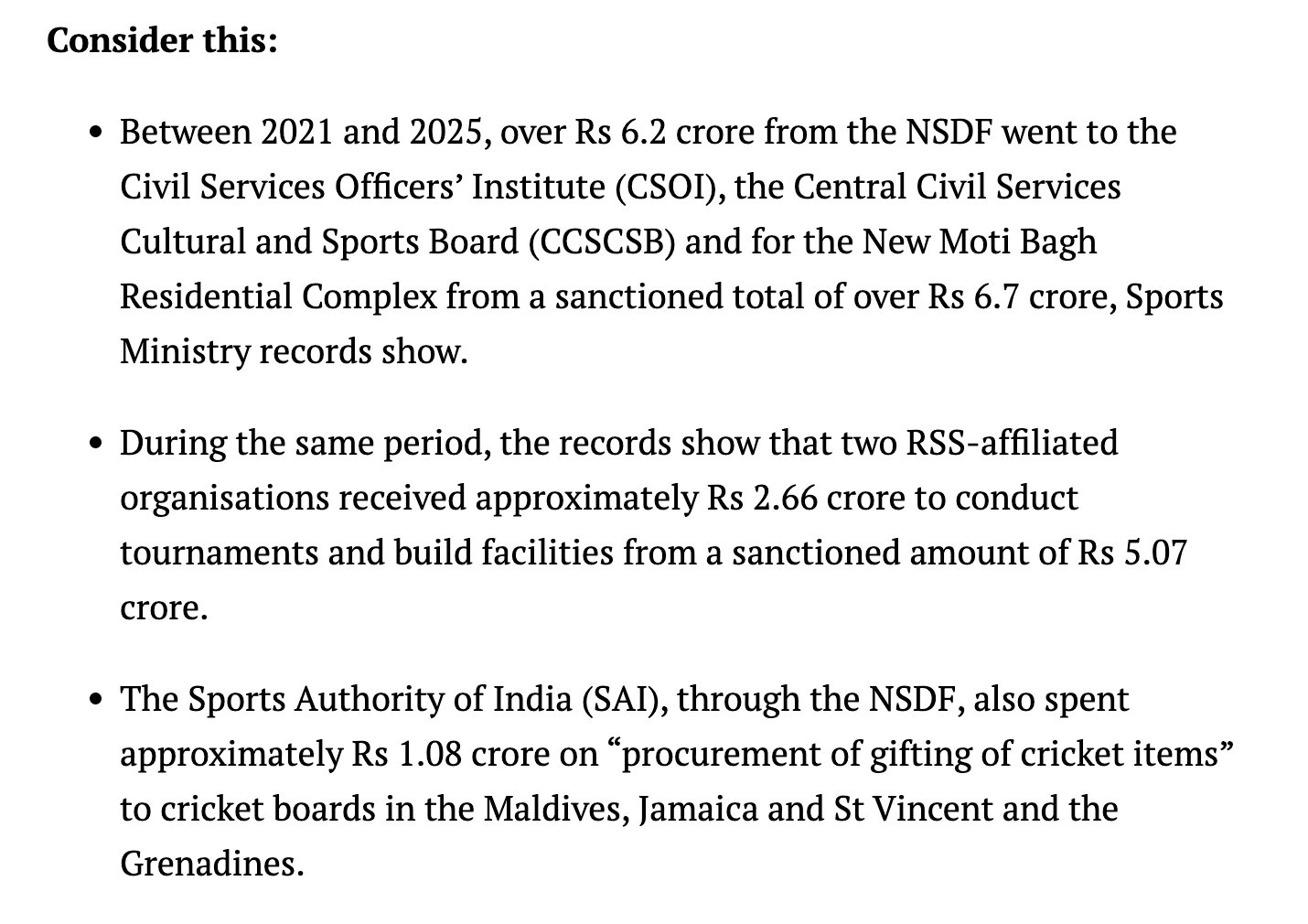
Sometimes, the post itself carries you by private jets to global events, on taxpayer money of course.
And sometimes, as with Himanta Biswa Sarma, sport becomes another page on an already expansive political portfolio. Sarma is no outlier. The presidents of India’s national federations for football, archery, hockey, shooting, tennis, cycling, fencing and volleyball are all current or former politicians, or have well-established political affiliations. When the BJP MP Brij Bhushan Sharan Singh had to step down as Wrestling Federation of India (WFI) president after India’s leading wrestlers accused him of rampant sexual misconduct, the post went gently to his close associate Sanjay Singh, ensuring seamless continuity in affairs.
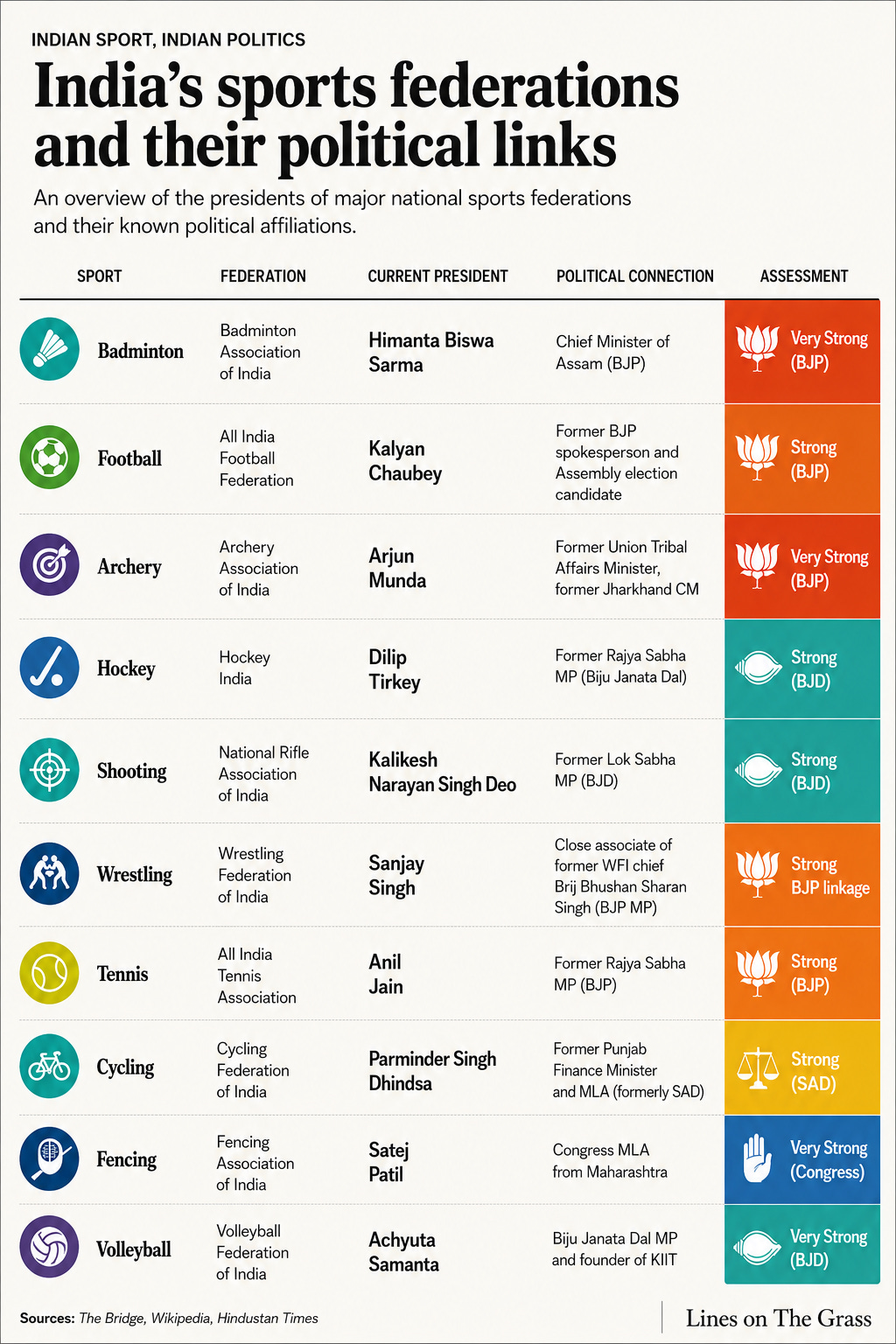
What standards, really, can one expect? It is impossible to build sporting institutions when sport itself is almost an afterthought. India’s national federations are led by people inexperienced and unaware with coaching pathways, talent development, and competition structures. Their core competence, and focus, lies entirely elsewhere.
Himanta Biswa Sarma’s interview was poetically timed. One year back, almost to the day, an Indian delegation landed in Lausanne, Switzerland, to lay before the International Olympic Committee (IOC) their official bid for hosting the 2036 summer Olympics. The IOC’s response was to suggest, sternly, a deep clean of our house—every room, from governance to infrastructure—before inviting guests. How amazing and perfectly on-brand, then, that one year on, we’re doubling down on dirt and excreta as interior design.
In the time since the bid, India’s handling of sport makes for quite a painting: qualified football teams left at home; athletics programme placed under enhanced international anti-doping scrutiny after it emerged as one of the world’s worst offenders; at the World University Games, six selected badminton players barred from competing because Indian officials failed to file the paperwork correctly; and, even after sports governance was rewritten into a new law, multiple national federations remained paralysed by disputes, forcing government intervention while athletes waited for green lights at every step. It takes a mind of steel to chose the life of an athlete in this country.
Know this while watching the replays of Egypt and Cabo Verde at the World Cup, or the next time you see an Estonian runner, or an athlete from the Philippines: talent exists everywhere. The nourishment, development, honing—that’s where the difference begins to show.
Good football countries do not stumble into World Cups. Their success is an accumulated sum of thousands of calculated, farsighted decisions. Administrators sketch the flow of money with care, build pitches, hire coaches, and pump support towards domestic leagues of all scales. Their travel budgets are dictated by what a team needs, instead of their returns. Japan spent years studying how to build a proper football ecosystem. After collecting all the knowledge, they built a 100-year plan for winning the World Cup. That’s right. Every architect of that dream will probably be dead before it turns into reality, and yet, they’ve stood by it for the last thirty-five years. The target for a men’s World Cup title has now been brought forward from 2092 to 2050.
A sporting nation is, almost always, a structural achievement.
The FIFA Men’s World Cup will likely expand from 48 teams to 64 soon. Maybe that might help India qualify. If it happens, every politician and administrator you know of, and everyone you don’t, will line up to take a bite of the credit for making it happen. Messiahs will emerge from every gully. Maybe the Prime Minister will get a few speeches of thanks—he always does.
But, until we fix the foundations, we will not be a good sporting nation, just a populous, perhaps lucky, one. We will keep building 100,00-seater stadiums because, in this country, we mistake scale for quality, and those stadiums will still have narrow exits and seats with a three-digit AQI. The pigeons, too, will keep flying in, leaving behind a reminder of who runs our sport and how they run it.
Great incisive detailed writing ! And so depressing to read these truths about the pathetic state of sports ( other than cricket )
Uff, so utterly depressing... And so masterfully told.
I wonder Sarthak - is India particularly bad in sports corruption and apathy? What makes other poor nations (say from Africa) do so much better...?