

On his first working day in London, just two years into life as a professional football manager, José Mourinho walked into the media room at Stamford Bridge, dressed in a creaseless black blazer over a sky blue shirt, short black hair greying neatly at the sides, jawline sharp and clean, and told the English press that he was special.
The year was 2004, the summer still fresh, and Mourinho, only 41, was the Champions League-winning coach from FC Porto. Porto’s route to the trophy had gone through Old Trafford, where they beat Manchester United with a last-minute goal, which Mourinho celebrated by sprinting the entire way from the dugout to the corner flag and diving into his players. I was thirteen, and I don’t remember what rankled me more: my team getting knocked out by these “minnows,” or their manager celebrating wildly in our faces.
Then, he landed up in the Premier League. Chelsea were one of England’s traditional big clubs, but they hadn’t won a league in fifty years and were considered a rung or two below Manchester United, Arsenal, and Liverpool. But, they were newly bought over by Roman Abramovic, a Russian oligarch with yachts moored in Monaco and Sardinia, a passion for football, and a greater passion for success. For Chelsea to succeed, they first had to build a good team, and then topple the duopoly of United and Arsenal—winners of eleven of the previous twelve league titles. Imagine then, a young Portuguese, who looked like he should be auditioning for an MI:6 role in Hollywood, telling them that he was coming for their jugular.
Chelsea is the starting point of Joe Pearlman’s new Netflix docuseries, “Mourinho”—a three-parter that tracks José Mourinho’s life, career, and legacy through his three most unforgettable coaching stints.
The show begins in Setúbal, on the south-western coast of Portugal, where the land turns west and opens to the North Atlantic. It’s a city of pebbled beaches and grassy cliffs, and roads sloping down past tiled houses with pastel-coloured walls. The waves here are soft, the breeze steady but serene. This is where José Mourinho lives.
Present day Mourinho, 63, has wavy grey hair, almost white. His jawline has curved a little, and his torso has the shape of an old-but-somewhat-fit man. The chin is specked with white, unshaved stubble. His voice is much softer than it used to be. He wears loose t-shirts, hoodies, and running shoes. He remains, unapologetically, unflinchingly, the same man as before.
Early in the episode, he takes the camera crew down a corridor into a room, where the first thing you see is a wall-sized solo poster of himself celebrating a title. “Welcome to my little box,” he starts, as the camera picks out full-sized replicas of the Premier League and Champions League trophies. The entire room is taken up by trophies, awards, and medals. It’s a museum he has built to himself. Around these trophies, he has kept pictures of his children, and memorabilia he has collected from his three decades in the sport—amongst them, Diego Maradona’s boots, signed.
Pearlman revealed in an interview that the producers set clear terms to Mourinho about the nature of this series: this wasn’t going to be a hagiography. And yet, you never once doubt who’s running the script.
“We were being manipulated constantly as well, and we knew that. But going into a show with someone like José Mourinho, if you're not being manipulated, then we're not doing our job right,” Pearlman says here.
Mourinho drives around the crew and the narrator in his limited edition Ferrari 612 Scaglietti with “The Special One” written on the right door. Later, he tells them that his success brought them to him, like a magnet describing its physical force. He even saves a jab for the others: “you don’t make a documentary on the guy that won nothing.”
**
José Mourinho, as he likes to say, was born into football. His grandfather was the president of the local club, Vitória de Setubal. His father, Felix, played once for Portugal but had a longer, more successful career as a coach. Young José travelled with his father’s teams, hung around the players, and, over time, began scouting opponents and running drills. He played too, but realised, quickly, that his athletic talent had limits.
So he went to the Instituto Superior de Educação Física, in Lisbon, to study Sports Science. Jonathan Wilson writes here about the influence of Professor Manuel Sérgio, “who believed that football knowledge was not enough, that a coach also had to be a psychologist, a public speaker and have a grasp of the sciences.”
That’s how José Mourinho reached Bobby Robson, the famous English coach, as the connective tissue between him and the dressing room. Robson didn’t speak Portuguese or Spanish, and Mourinho was a polyglot. Mourinho tailed Robson from Sporting Lisbon to Porto, and then to that team in the city of cathedrals, Barcelona, where he went from interpreter to much more. Mourinho stayed on at Barcelona beyond Robson, into the next coaching team.
Following these teams, Mourinho observed a pattern: high profile jobs in football almost exclusively belonged to high-profile football men. All coaches at the top level were ex-footballers of substantial pedigree; the assistant coaches too had played football at the highest level. Even the talking heads in television studios were former players from superclubs. Which is why, at Barcelona, he was known publicly as Bobby Robson’s translator. He didn’t have the career to be thought of as anything more, or have much to contribute to their football.
“It’s bullshit,” Mourinho says in the first episode. “I ran opposition analysis, I ran scouting reports, I ran coaching sessions, I spoke to the players. There were times when I’d be in another city scouting our next opponent, turn in the report at 3 am, drive back to Barcelona just in time for the match, helping the first team out, and just as soon as the match ended, be back on the road for the next scouting assignment.”
Mourinho is a man of great angst, and this bit, of not belonging to football, of feeling like an outsider, gnaws away at him. It’s evident that he carries the extra weight of wanting to be better than the “football men.” He isn’t satisfied by what most would consider success. Throughout the series, Jose keeps repeating, “I want to make history,” like a leitmotif he wants the narrator and viewer to hear.
**
The football that resulted out of this angst is now considered Mourinho’s signature, his personal revenge against the narrative peddled by those football men, that possessing the ball gave you control. He thrived, instead, on provocation and defiance. While most great teams are remembered for how artful they made the sport look, Mourinho’s best stood out for how well-drilled and precise they were.
In the deeply controversial and oft-contested book, The Special One: The Secret World of Jose Mourinho, journalist Diego Torres writes about Mourinho’s ideology for big matches: games are won by the side that commits fewer errors and provokes more; away from home, the aim is not to outplay the opponent but to force them into making mistakes. And the kicker—having the ball makes a team vulnerable; the team without the ball is thereby much stronger.
Torres also recounts an incident from the Real Madrid training ground, when Diego Maradona visited Jose Mourinho. On one side was football’s greatest, the man who treated the ball like a lover; on the other was the anarchist, doing most of the theorising, convinced the ball can pierce your skin.
**
Mourinho’s first managerial job was at FC Porto, where he had once been a translator for Bobby Robson, and he began his new life by promising to win the league title that very season—in public. He kept his promise, winning the league title in his first two seasons, and accompanying domestic success with the highest continental glory, while playing an attritional but disconcertingly efficient style of football.
The size of that achievement—winning the Champions League with Porto—is worth examining. Porto were a big club, with a great history, but they didn’t count amongst European royalty. For that list, take the five Champions League winners before Porto: Manchester United, Real Madrid, Bayern Munich, Real Madrid, and AC Milan. Or the five after: Liverpool, Barcelona, AC Milan, Manchester United, and Barcelona. Before that 2003-04 season, Porto hadn’t reached a Champions League semi-final in ten years. They haven’t reached one since.
Mourinho was the outlier. And, as soon as he lifted that big-eared silver trophy with blue and white ribbons on either side, he was gone, towards bigger targets.
**
His first match in England was a home game against Sir Alex Ferguson’s Manchester United. Injuries had ravaged United, but even so, this was Manchester United. They lined up with Ryan Giggs, Paul Scholes, Roy Keane, and Gary Neville.
My memories from the game are faint and unaffectionate. I remember the searing irritation from watching Chelsea’s players tackle and shove our guys every chance they got. Chelsea, if memory serves me well, didn’t tear United apart—that would’ve been acceptable. They were set up to piss United off, and they managed that to perfection. Sometimes, the camera would pan to the Chelsea dugout, where Mourinho sat leaned back, smirking. The home crowd lapped it up.
As a freshly-minted teen, I was incapable of hating a stranger properly, but I wanted Mourinho’s team to lose every match till the end of time. Of course, some of the grudge was carried over from the night when his Porto knocked United out, but this game felt like those wounds reopened and scratched anew. And this arrogant prick, instead of getting his team to play football the respectful way, had turned the season-opener into a dirty rugby match. The match finished 1-0 to Chelsea. Mourinho didn’t celebrate like he did for Porto; he just shook hands and walked away, as if this was expected.
Chelsea won a lot that season, mostly that way: 1-0 or 2-0, and done. By the time winter turned to spring, they were en route to the Premier League title. They reached cup finals and semi-finals. Honestly, watching this unfold felt like an insect crawling up my skin. Arsenal, when they won, did it with spellbinding artistry: Henry, Bergkamp, and Pires put on a show worth watching irrespective of your club loyalty. This was barely watchable.
Then, Chelsea won the league again the next year with an even more watertight style of play. Winning, it was evident now, was the be-all-and-end-all of Mourinho’s ideology: do just enough to win, and that’s all there is to the sport.
He smirked through it all. And, in the press conferences and media interviews, he went hunting. Once, to describe his team as better than others, he said, “in the supermarket, you have eggs—class 1, class 2, class 3. Some are more expensive than others. And some give you better omelettes.” He often shot pejoratives at Arsenal and Liverpool coaches, Arsene Wenger and Rafa Benitez. He even called Wenger a “voyeur.” Nothing was too far, no blow too low for him.
Mourinho—the whole package, on and off the pitch—turned English football into a weekly soap opera where the vamp won every episode, and there was nothing anyone could do about it.
During this time, another phenomenon was slowly spreading. Chelsea were a big club in England, like Porto were in Portugal, but they were not globally big. Sportscenter wouldn’t always carry their highlights; no one I knew spoke of Chelsea as a team I should catch over a weekend. But, by the end of Mourinho’s first season, some of my friends in class, in a city on the outskirts of Delhi, had become Chelsea fans. And not fans as in the casual, curious way that most start sport with. They went from not watching football to intensely believing Frank Lampard was better than Paul Scholes. Me and a couple of others had been supporting United and Arsenal for years, and here were these punks, telling us with complete confidence that their team would beat ours and win the title. Worse still, they were right.
I am a fairly non-violent person, even in arguments. I don’t get into fights. You say jackfruit is better than mutton seekh, I will judge you, but I won’t fight you. I got through school life without a single fight about Tendulkar vs Lara or Sampras vs Agassi, but for United vs Chelsea, I had to be pulled away by my friends. We didn’t come to blows—I was (am) a wuss that way—but I don’t think my vocabulary during that tete-a-tete would’ve been too pristine.
**
That was the atmosphere outside the building. Inside, it was feverish.
Zlatan Ibrahimovic, a man whose public position is that he is second only to God, wrote in his autobiography that “Mourinho would become a guy I was basically willing to die for.” Marco Materazzi once said something about jumping into fire for him. Frank Lampard and John Terry chose less extreme metaphors, but they speak with a smile about the lengths they readily traveled for him. Across the three episodes this theme keeps repeating, in different accents.
It’s the effect he had on people. Mourinho always wanted to be more than just a football coach. He says, somewhere in episode two, “my team is a group of human beings playing football.” He often spoke to his players about their families, their parents, their dreams and aspirations, their heartbreaks. He sometimes used love and inspiration during big-match team talks. On Sundays, he would invite players’ families over to training and ask silly questions to their kids. If there was ever a family emergency, a leave was assumed.
There is a famous video of Mourinho, from the gates of Estadio Santiago Bernabeu, on the night Inter Milan won the 2010 Champions League. Mourinho had known that he was going to sign with Real Madrid after the final, whichever way the result went. The news had become public in Italy, and he didn’t bother covering or denying it. The video shows a black car pulling out of the stadium and then suddenly braking. Mourinho alights from the car and walks into a lane where Materazzi—an ex-World Cup and multiple Serie A title winner—is waiting by the team bus. They hold each for a long time, faces buried in each other’s shoulders, bodies shaking. Then Mourinho lifts his head, pats Materazzi’s shoulders, and walks away, still weeping.
To this day, Inter fans speak of Mourinho with a glint in their eye. A decade after he last coached Chelsea, there are banners at Stamford Bridge with Mourinho’s name. In the show, one Chelsea fan, drunk from a title win, says, “There is God, then there is Jose.”
**
Every Mourinho team succeeded beyond expectations. Porto, Chelsea, and Inter won titles they hadn’t won in decades; Real Madrid became coherent and broke, even if briefly, the dominance of Pep Guardiola’s all-conquering Barcelona; Roma won a European title; Tottenham reached a cup final in the middle of a tumultuous season. Driving these teams was a sense of purpose fuelled by Mourinho’s intensity.
But intensity, of course, doesn’t flow just one way. What happens when you don’t get a response that makes you happy, or a response at all? During the show, the same players who spoke about running through brick walls for Mourinho also revealed how he was an expert in pushing their buttons. It was almost a way of life for him. Some, like John Terry, Frank Lampard, and Zlatan, used it as motivation. Zlatan says, in episode two, “Mourinho told me, during half-time of a match, that I should be ashamed of winning the award of the best player in Italy. I went back out angry, to show this fucker how good I can be. That’s why I respected him.”
It’s a bizarre thing to say, but it completely explains Mourinho’s relationship with his most trusted players. “It’s never about the manipulator,” Mourinho says in the show, “but about those who open themselves up to get manipulated.” You had to know, by instinct, how to read him. If you didn’t, or when you didn’t, you perished. This is considering you were on his good side; if you weren’t, he’d find innovative ways to wreck you in public. Besides, even if you did get along with him and read between his words, how long could go on being told you’re worthless in order to make yourself worthwhile?
The answer, empirically, is between two and three years.
Post Porto, whom he quit by choice, Mourinho’s career reveals another pattern: sacked after three seasons at Chelsea, sacked in his third season at Real Madrid, sacked again in his third season at Chelsea, sacked in his third season at Manchester United, sacked in his second season at Tottenham Hotspurs, sacked in his third season at Roma, and sacked early in his second season at Fenerbahce.
Without exception, these sackings came after his players stopped responding to his instructions at the same pitch as before. It’s well documented how defeat made Mourinho burn. Now, rack a series of losses up, as is normal when a team loses form, and you get an already manipulative man going nuclear. Frank Lampard reveals in the first episode how the mood in the Chelsea dressing room changed drastically in the third season, after their form nosedived.
Team owners don’t have long memories, and Mourinho understands this side of football’s business deeply. On Christmas Day in 1984, when Jose was 21, the Mourinho family got a call on their landline. Felix, who was coaching Rio Ave at the time, had been sacked because of a poor run of results. The episode became something of a life lesson: prepare meticulously for a game, give your everything to it, but the recognition of your efforts depends on the result.
Rewinding through his first sacking at Chelsea, which he’s still bitter about, Mourinho gives us the warmest quote of the whole series. He takes a piercing shot at the rich men who buy football clubs and then overreach: “Football belongs to the people like me,” he says, “football belongs to the players, belongs to the coaches, belongs to the fans. The other ones are intruders.”
**
Mourinho has a room to himself in football’s memory. He is an undeniable tactical genius, with a body of work most would die for. He has made a career out of making teams overachieve. Players and fans respond to him. He understands people and society.
And yet, he is the same person who poked an opponent coach in the eye, who ostracised Spain and Real Madrid captain Iker Casillas for hugging a Spanish team mate, who made it a daily routine to mess with Paul Pogba, who mocked his own players in press conferences, who has, without doubt, mocked the coach and player of your team if they’ve ever ran up against him. The man capable of incredible humanity is also capable of incredible toxicity.
The evidence of Mourinho’s mental gymnastics is visible, like a trail of breadcrumbs, in his narration of himself through the show. He says I don’t like talking about myself but maintains a mini museum to himself in his own house. He says, “I want to be loved everywhere I go,” in the same breath as, “I am not nice, and I say that with pride.” He says his players are human beings first but hates when the injured ones take a breath. He calls Barcelona a great club, he wanted to become their head coach, but his entire career has been a long journey of proving them and their kind wrong.
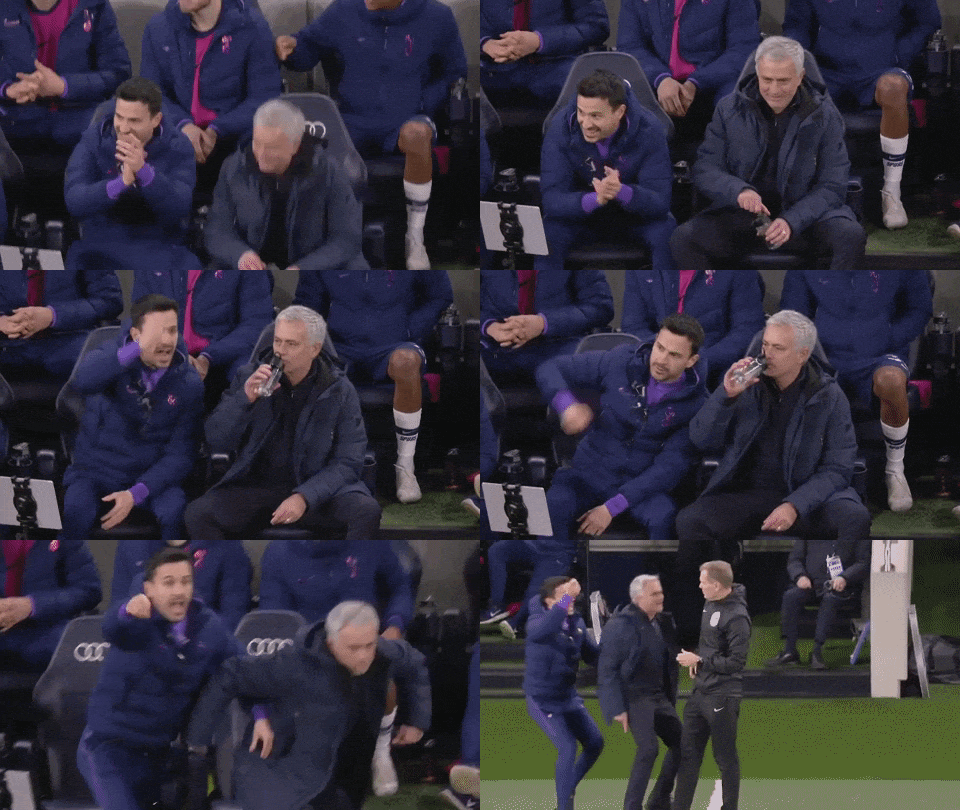
Maybe it is this—the several voices, the ease of moving between them, the turn to the camera and winking at the audience—that makes him irresistible as a dramatic experience.
My only sadness about the show is that it tries to condense in three hours what some of us witnessed over a decade and a half. It was an impossible task to tell the story at a pace that does justice to the character, but it’s a worthy watch, if for nothing then just to understand the level of gaslighting that was once part of mainstream football discourse.
The show ends as José Mourinho is announced as the new manager of Real Madrid. The timing of the release couldn’t have been better. Pre-season is over, and club football is back with its breathless rhythm of matches and media and more matches and more media. So is Mourinho.
Real Madrid need some rescuing. Their dressing room was a knot of clashing egos last season, evident in the way the team came apart under new coach Xabi Alonso. They’ve now gone two seasons without winning anything substantial. Mourinho has been brought, primarily, to restore order into a group of superstars who could all be alphas in different teams but have to play somewhat diminished roles in this environment.
He has been brought, then, to win. Mourinho always wins—or used to, until about a decade back. Across the country, arch rivals Barcelona are strengthening every week. They now have the best player from the World Cup and the most dazzling teenager in the world. They also have a group of elite homegrown talent. Mourinho has been hired to break that spell. He has done it once before, but it has been fourteen years since.
There is no guarantee that he’ll be able to do this again. But, either way, the most watchable coach in football is at the helm of the biggest football team in the world. It will be spectacular television, even with this older, calmer, grey-and-white haired Mourinho. He’s coiled, ready to jab; he always is.
In his first pre-match press conference back at Real Madrid, José Mourinho was asked if he could share some team news. “My players know,” he said. “Now we’ll wait to see which of you [journalists] has the best contact with the players.”
Superb mate. I've been wanting to write something about the Mourinho documentary since watching it, but I think you've done it. "On one side was football’s greatest, the man who treated the ball like a lover; on the other was the anarchist, doing most of the theorising, convinced the ball can pierce your skin." - A Superb passage, which captures the tension/chasm between Mourinho's brutal win at all costs surgical precision, and those who long for the poetry of the beautiful game that Diego Maradona represented.
Well written. I can now imagine Nolan's dilemma in trying to abridge an epic journey lasting over a decade to 3 hours...😂