

Every year, for a couple of weeks, there are traffic jams at the top of the world. Their schedule is known in advance, which makes them stranger. And there are no cars.
The South Summit Ridge is a narrow straight opening to the peak of Mount Everest. Every May, it fills up with climbers in bright, puffed up nylon jackets, looking like the Michelin Man, thick sunglasses, oxygen masks, and layer upon layer of insulated clothing.
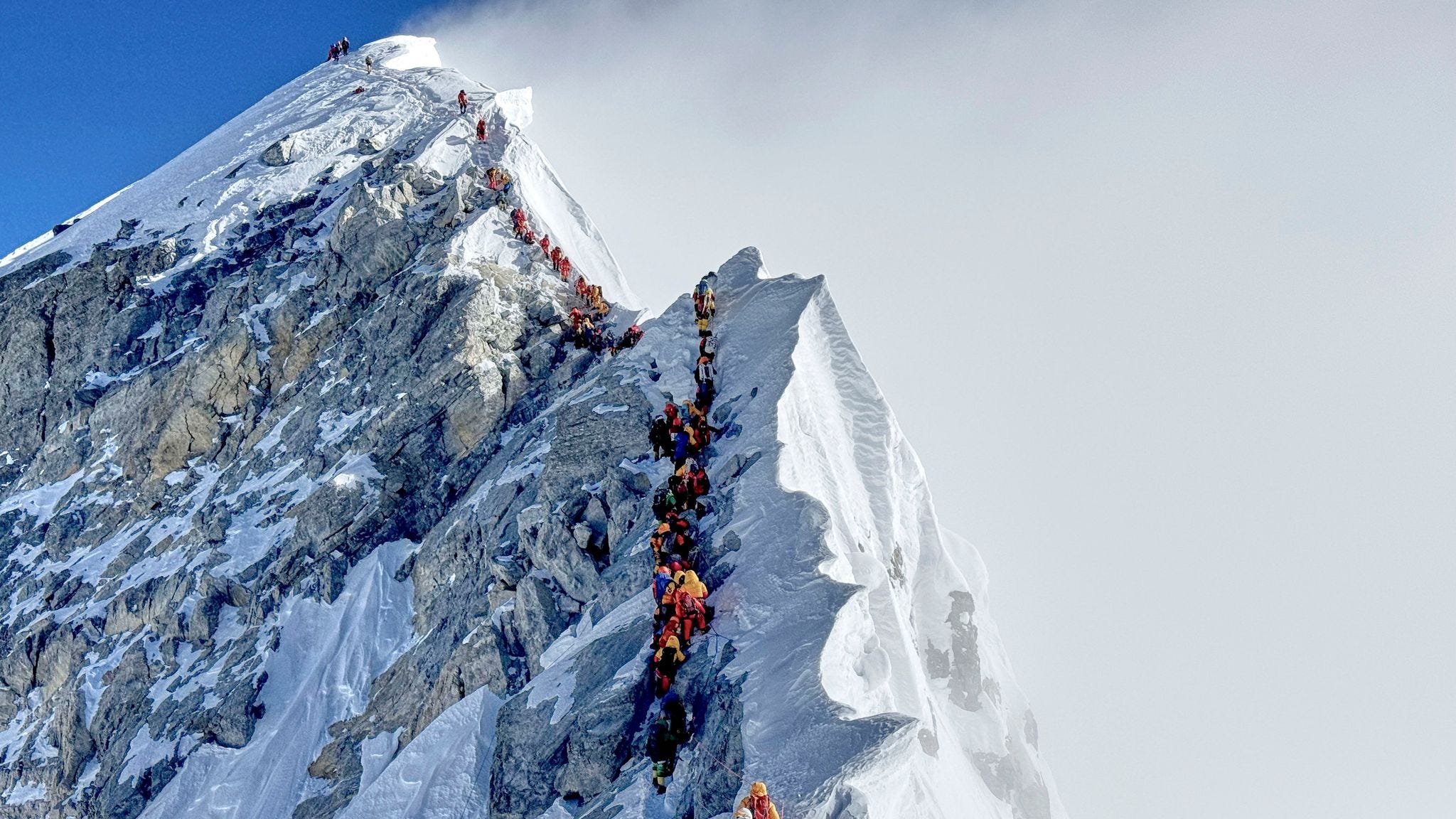
More than 800 climbers reached the summit in 2025 alone. Amongst them was Sherpa Kami Rita, on his 31st visit. In the 21st century, more than 12,000 have reached the top of Everest. It has now become a thing people do.
These are insane numbers. They, of course, come with an asterisk of accompanying sherpas often made to carry the climbers’ luggage, but reaching the top of Everest, with its fat dossier of fatal warnings, is staggering nonetheless.
Tenzing Norgay tried five times and failed. On one attempt, he reached within 400 metres of the summit and had to turn back. Then, Edmund Hillary arrived from Auckland, a beekeeper with years of Himalayan climbing experience, and together they left basecamp in early April of 1953. For seven weeks, they climbed and paused, with primitive equipment and oxygen systems. On 29th May, they reached the top of Everest and clicked a few pictures.
It’s a bit different today. The route is known, the camps are planned months in advance, sherpa teams do most of the grunt work. Climbers acclimatise for weeks at Basecamp and wait for the weather to turn kind. Once the window opens, they can go from camp to summit and back in less than a week. Climbing the highest mountain in the world is now a sliced project.
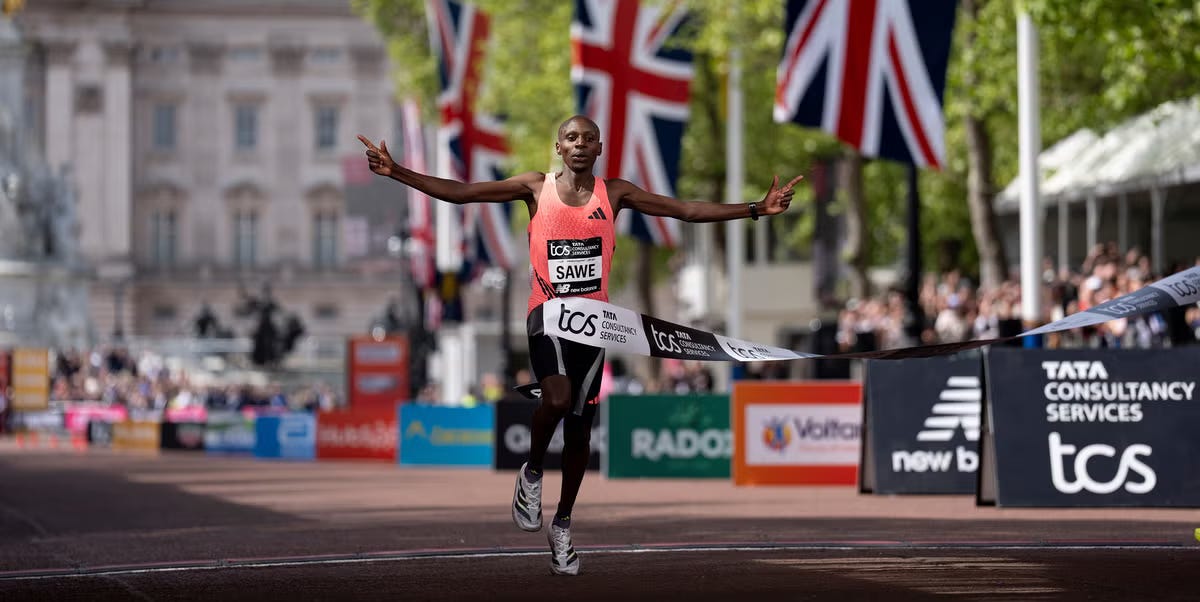
I have been thinking about Norgay and Hillary recently, especially while watching, on loop, the winning lap of the 2026 London Marathon. Sabastian Sawe, from Kenya, and then, eleven seconds later, Yomif Kejelcha, from Ethiopia, running past the finish arch while the first digit on the clock was still 1, sprinting 21kmph through the tape, and then through the idea that a human being cannot run 42.2 kilometres in less than two hours.
Running is hard work. Distance running, harder still. In the incredible book Born to Run, author Christopher McDougall recalls a Sports Injury Bulletin article about long distance running. “Athletes whose sport involves running put enormous strain on their legs. Each footfall hits one of their legs with a force equal to more than twice their body weight. Just as repeated hammering on an apparently impenetrable rock will eventually reduce the stone to dust, the impact loads associated with running can ultimately break down your bones, cartilage, muscles, tendons, and ligaments.”
To finish a marathon in less than two hours, one needs to endure this demolition while maintaining an average pace of 21.1 kmph. Most of us wouldn’t dare try this on a treadmill, even for 10 seconds, even with an ambulance service on speed dial. The nutrition, in the lead-up and on race day, must be precise—sufficient fuel without a gram of excess weight. Oxygen uptake must be exact. The weather must be mild, the course flat with long straights. This sort of feat exists more on paper than in reality.
There is an odd cruelty in sport. When someone does something incredible, we celebrate it, and then immediately cast our eyes forward, waiting for someone else to do it better. It also strangely illustrates the point of sport: the idea of pushing past limits, often internal, sometimes collective.
This wait, for someone to breach the sub-two barrier, had been our preoccupation for 128 years, since the first ever marathon at the London Olympics and Johnny Hayes’ finish time of 2:55:18. For the first few decades, the minutes dropped rapidly on the world record, like an overweight man losing kilos after regularly hitting the weights. Then it moved it fractions: ten seconds here, one minute there. Between 1968 and 1998, there was a reduction of two minutes in the record time. A 1991 research paper suggested sub-two hour marathon could happen, but don’t hold your breath.
Generations of the greatest runners we’ve known tried and came back with personal bests of 2 hours and sundry. Even Haile Gebrselassie took 239 seconds too many. Long distance running matured and became a million-dollar industry. Runners wore perforated vests and shoes with engineered foam. Entire departments at medical colleges dedicated themselves into calculating the combination of physics and biology that might get us there. Nike poured a few million dollars into Breaking2.
In 2017, Ross Tucker, a sports scientist at the University of Cape Town, showed us the numbers. Marathon times had improved by two per cent in fifteen years. The record then was 2:02:57. To break two hours meant shaving off another three minutes from a time that had already been shaved and shaved. “We want to do a double Usain Bolt on the marathon record?” he asked.
Our Roger Bannister moment just wouldn’t come. It has now arrived, thanks to Sabastian Sawe and Yomif Kejelcha, who, by the way, was running his first ever marathon. One of the first to offer congratulations was Eliud Kipchoge.
Two years after Tucker conveyed his concerns, Eliud Kipchoge went to Vienna and ran 42.2 kilometres in 1:59:40. Twenty seconds to the good, the ultimate barrier broken. But—and this is a pretty significant detail—the event was an exhibition, not a race. Kipchoge ran alone, behind pacemakers arranged in an arrowhead formation, parting the air so he could move through a pocket of reduced drag. His nutrition and hydration were calculated to the last granule. His shoes were prototypes too advanced for official racing. The entire thing was a proof of concept funded by Nike and INEOS, and performed by a champion runner. Kipchoge’s finish made it a pathbreaking day for sport, but it was still a mundane, slow Saturday for the bookkeepers.
Come to think of it. One of the greatest runners of all time, holder of two Olympic gold medals, effectively spent the two fastest hours of his life showing others what could be done.
At the halfway point of this year’s London Marathon, six runners had formed a pack behind a set of pacers. The projected finish time was 2 hours and 1 minute. The last pacer dropped out after 25 kilometres. Running nearly 10 miles without a pacer to block the wind should’ve pushed Sawe back. Instead, he sped up. He broke the record for the fastest mile in a marathon somewhere around his 24th or 25th. Alongside him, step by step, was Yomif Kejelcha. Sawe surged past Buckingham Palace and down The Mall, past the thousands lined up on both sides, and crossed the finish line at 1:59:30. He did not know his time before finishing. Eleven seconds later, Kejelcha came through.
Records are celebrations of singular achievement, but their real life begins after, in what they made possible. A record says: here is where the boundary stood, and here is a human being standing beyond it, and now the rest of you know that the ground over there is reachable. Kipchoge’s two hours in Vienna did not count in any official register, but it counted in the minds of every elite marathoner alive.
Similarly, when Bolt finishes 100 metres in less than 10 seconds, when Nadia Comăneci lands a perfect 10, when Phelps wins eight gold medals in one Olympic Games, the achievement is collective, at a species level. It’s a dot on the timeline of human progress, like astronauts circling past the dark side of the moon and splashing back on Earth.
The Roger Bannister Effect refers to the notion that once an impossible barrier falls, others follow quickly. Within two and a half years of Roger Bannister breaking the four-minute mile, ten more runners did the same. Ten thousand Test runs was once considered an unimaginable achievement, just like twenty Grand Slam singles titles. Both have been passed, many times over. The magnificently-named Gout Gout from Australia will one day finish a 100 metres race quicker than Bolt’s 9:58, if not by LA2028 then by Brisbane 2032.
Sometime this month, a traffic jam will happen again at the South Summit Ridge. May, after all, is peak climbing season. Five hundred climbers, give or take, will reach the top of Everest, walking through the pass that Hillary and Norgay opened seventy-three years ago.
Sawe and Kejelcha have opened a comparable pass, though theirs is on flat ground, at sea level, measured not in altitude but in seconds. A sub-two marathon, inconceivable just a couple of decades back, is now part of our folklore. Somewhere in the world, a young runner will wake up with the first ray of sunlight, and chase their dream. And that dream will not start with the digit 2 anymore.
Superb article Sarthak. You are my top 3 favourite indian sports writers , others are Bharat sundaresan and harsha bhogle, not in any particular order. Shekar Gupta’s Cut the clutter on Sebastian sawe is also very good.
I got Goosebumps Sarthak. Thank you so much for always enlightening your readers. Otherwise all of this is just news headlines, when it is written like you do, it becomes so much personal.
I actually touched my legs and checked them when you mentioned the amount of pressure it takes when we run. 😅