

About two minutes into the Brazil vs Scotland group-stage match in Miami, the cameras panned to the VIP boxes, as they have done all tournament, the royalty an inextricable part of the spectacle. Sat in the front row of one box was David Beckham, wearing a beige jacket, chrome watch on his right hand, sipping wine from a giant glass. The stadium screen picked up the broadcast feed, and, from home, I could hear an eruption of noise as the footage cut to Beckham.
He has been everywhere at this World Cup. In the VIP boxes, yes, but also on every screen, every break, every segue, and the long commercial hours between games. Sometimes, he’s making coffee on a Nespresso machine; then he’s flipping pancakes for Ninja Flex Flame; showering in a black Boss underwear, one appreciative shot of his butt included; then, driving to McDonald’s, drinking Pepsi, munching on Lay’s, and lacing up Adidas trainers. Sometimes he even walks you through the aisles of Home Depot, and counsels you on the loan options at the Bank of America. He’s almost working as hard at this World Cup as a French midfielder.
Beckham has chosen this illustration of him as football’s high-society import to showbiz. That’s his life these days, World Cup or not. He has a honey brand, appears in documentaries about his life, hobnobs with oligarchs and sheikhs, and generally lives the life of the world’s most famous influencer.
The chyron under his face at matches sometimes reads “ex-England captain,” which, if you ever saw him play, feels like a ludicrous reduction, like calling Pavarotti a singer. For about a decade, between 1996 and 2006, Beckham was the best of England. Until last week, he was the only English male to have scored in three different World Cups; he led England in two of them.
And he was in the centre of the frame for England’s two most famous World Cup moments in the last forty years.
**
On June 7, 2002, England played Argentina in their first group match of the World Cup. Beckham had drawn the flashlights and the headlines from the moment England landed in Japan. He was the team captain, Manchester United’s talisman, husband to a Spice Girl, and suddenly, the wearer of a blonde, punk-rock mohawk. The cameras tailed him everywhere; he’d long since learnt to live with the flash as his shadow.
The game was stiff and cagey, moving this way and the other but never quite releasing its handbrakes. Then, in the 43rd minute, England forward Michael Owen was fouled in the penalty box by Argentina defender Mauricio Pochettino. The referee pointed to the penalty spot. And it was as if the rest of the field paused and spread out for David Beckham to take the ball and the occasion.
Beckham was known for a wand of a right foot. He could make the ball curl, dip, and swerve over long distances. If he played cricket, he’d open the bowling with his swing. His passes had a beatific quality, a sense of artistry. So when he took penalties, he hit them similarly, with the inside of his right foot, and the shot often traced a small curve.
This one he bludgeoned. He ran his right foot through the ball as if he wanted to tear through the leather. The ball went low, hard, and straight into the centre of the net—one of the most ungainly of his 146 career goals. But it was amongst his most significant.
England 1-0 Argentina. Beckham ran off to the left corner flag clutching his shirt, pulling at it, kissing the crest, screaming into the void. It was hard to tell whether he had a tear in his eye, because they were crunched tight. That moment gave us this picture.
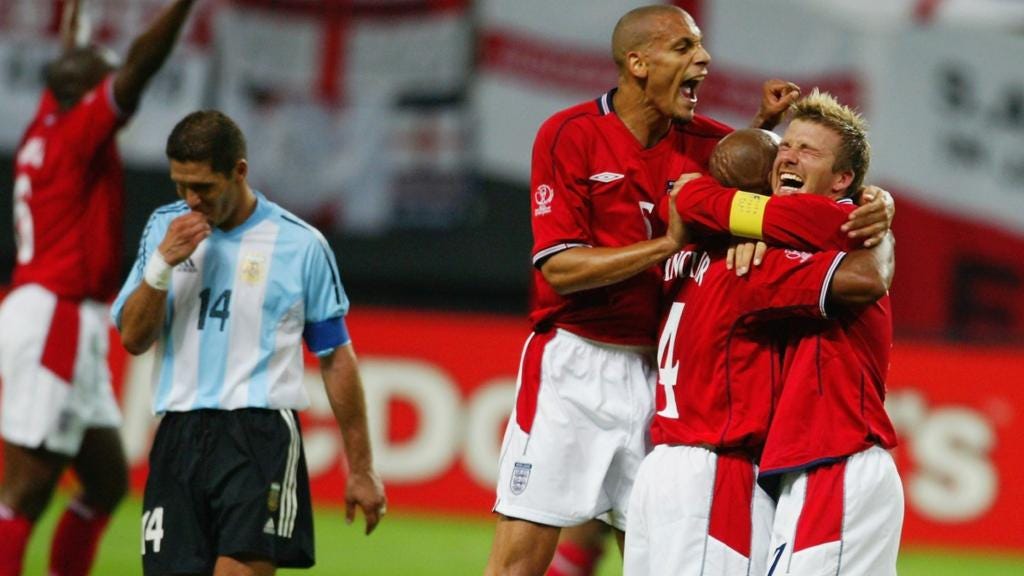
This picture was twenty years in the making.
**
The Falkland Islands, Las Malvinas in Spanish, is an archipelago of 778 small, windswept dots of land in the South Atlantic ocean, around 300 miles east of Patagonia in southern Argentina. It had been a British territory since 1833; Argentina, however, always felt they owned the land instead. In April 1982, Argentina’s military invaded the islands. Margaret Thatcher’s Britain responded with a hundred war ships. On June 14, 1982, seventy-four days after the invasion, Argentina’s military surrendered. 649 Argentines were killed, many of them young conscripts who had been sent to the islands without proper food, clothing, or shelter. The survivors returned to a country, already suffocated under the debris of economic and social rubble, in complete mourning.
Thatcher, meanwhile, gave victory speeches and organised parades, asking the British public to “rejoice.”
**
The next time England faced Argentina in a major game, it was the quarter final of the 1986 World Cup, under an upright and unrelenting Mexico City sun. A lot had changed in the four years. Democracy had arrived in Argentina. The world’s greatest footballer was a proud, outspoken Argentine.
In Mexico, the Argentines maintained that football had nothing to do with the war. It was necessary fiction. Members of the 1982 squad had unfurled Las Malvinas son Argentinas banners before friendlies in the run-up to that tournament, wrapping themselves in the cause. By 1986 the banners were gone. There was silence instead, which was its own kind of statement. Diego Maradona, who understood theatre better than most, admitted later that it was all a facade. They thought of nothing else.
Argentina were the superior team, but couldn’t break through the dogged English defence in the first half. Six minutes into the second half, a mishit clearance lobbed up the ball in the England penalty box. Maradona ran towards it. The English goalkeeper, Peter Shilton, ran towards it too. Shilton was six foot tall, Maradona five-five. And yet, Maradona seemed to rise above Shilton and head the ball into the goal. Nine blue shirts converged around Maradona near the sideline while the replay was broadcast to the watching audience: Maradona had locked his left hand into a fist and raised it above his head, and the ball had bounced off it. Too late; 1-0.
Four minutes later, Maradona—now the centre of every play—received the ball in his own half. He pirouetted past two defenders, turning on the ball almost, then ran twenty yards along the right edge of the pitch, cut inward past one defender, then shimmied past one more, then around the goalkeeper, and dinked the ball into the net.
On Uruguayan radio, journalist Victor Hugo Morales held the mic.
“Maradona on the ball now. Two closing him down. Maradona rolls his foot over the ball and breaks away down the right, the genius of world football. He goes past a third, looks for Burruchaga. Maradona forever! Genius! Genius! Genius! He’s still going… Gooooal! Sorry, I want to cry! Good God! Long live football! What a goal! A memorable run from Maradona. The greatest solo goal of all time. Cosmic Kite, which planet did you come from?”
Within eleven seconds and eleven touches of the ball, Diego Maradona had pierced through the entire English defence, and, evidently, their spirit. The match finished 2-1 to Argentina. At the post-game press conference, when asked whether he had handled the ball, Maradona said the goal was scored “a little with the head of Maradona and a little with the hand of God.” Forty years on, the English still froth with rage if you mention this match.
“It was like beating a country, not a football team,” Maradona wrote in his autobiography. “Although we said before the game that football had nothing to do with the Malvinas War, we knew that a lot of Argentine kids had died there, that they had mowed us down like little birds. And this was revenge.”
**
Four years later, England went to the World Cup in Italy. They had, this time, a genius of theirs: Paul Gascoigne, Gazza to the English—twenty-three years old, bulky and brilliant, capable of doing things with a football that no Englishman had managed in a generation. Carried by Gazza and Gary Lineker, England reached the semi-final. They played West Germany, runners-up to Maradona’s Argentina last time around. In the other semi-final, Maradona’s Argentina faced the hosts. England were one game away from delicious, beautiful revenge.
Argentina beat Italy; England lost to West Germany in a penalty shoot-out. And if this wasn’t deep enough a cut, they failed to qualify for 1994, which turned out to be Maradona’s last sighting as a major, prime-time footballer. The moment had passed.
**
While the world prepared for the World Cup, England were welcoming a new order in their football. Manchester United, coached by the iron-fisted, granite-faced Scot, Alex Ferguson, had just won their second successive Premier League title, after waiting for twenty-six years for one. Ferguson’s eyes, though, weren’t set on the senior team alone. Working alongside youth coach Eric Harrison, he had turned United’s age-group sides into a production line. The batch that came through in 1992 won the FA Youth Cup. Among them: David Beckham, Ryan Giggs, Gary Neville, Phil Neville, Paul Scholes, Nicky Butt.
By 1995, Alex Ferguson was jettisoning experienced first team players into the transfer market to make room for the teenagers. The football establishment, which in England was both conservative and sentimental, was appalled. Alan Hansen, who had won everything worth winning as a player at Liverpool and now dispensed wisdom from a television studio, delivered his verdict: “You can’t win anything with kids.” Ferguson, ever the rebel against convention, brought them all in.
Beckham made his debut in April 1995. Fresh faced with a crew-cut, a London boy growing up in Manchester, he looked like any other young footballer trying to find his feet. He was not like any other young footballer. Technically, he operated on a different frequency to everyone around him. Soon, he was beginning to stand out even amongst the big boys. By the start of the 1996-97 season, he was a starting lineup fixture. The crew cut was replaced by a blonde middle-parting that curved over his forehead and fell to the sides. He looked like a young Hollywood star. In a football culture that prized grime and distrusted flair, abhorred it even, Beckham was a lavish art gallery exhibit. He was beautiful and brilliant and he didn’t seem to think the two were incompatible. United handed him the number 10 shirt.
On August 17th, 1996, the opening day of the Premier League season, Beckham, too, received the ball in his own half with his team in the lead. And, like Maradona, he did what he did best. He planted his left leg, took his left arm around his torso, as if he was drawing the rings of Saturn, and with his body leaning to the left, hit the ball with the inside of his right foot. The ball rose and floated, cutting a parabola across 57 yards, over Wimbledon goalkeeper Neil Sullivan, and dipped into the net.
David Beckham became an overnight superstar. England—the football nation, the public, the television media, the songmakers, the theatre artists, the tabloid editors—were obsessed. By the time the 1998 World Cup came around, he was twenty-three, a first-pick for the national team, and already the most famous young man in the country.
**
In France, for their third group game, England faced Colombia. In the 29th minute, Beckham stood over the ball about thirty yards away from the Colombia goal, centre-aligned. Free-kick specialists like an angle to work with. From straight on, the goalkeeper can plant himself in the middle of the goal and wait, and the ball has to do something extraordinary to beat him. Beckham created the angle by approaching the dead ball from the side, curved it over and above the Colombian wall, swerving leftwards and dropping into the bottom corner. For England supporters who had spent years grieving the lost Gazza opportunity, this was evidence that a new genius had arrived.
England finished second in their group, and reached the first knockout round, the pre-quarter finals, where the draw coughed up their old foes, Argentina.
The match was a taut, nervous affair, missed passes turned over to attacks turned over to counter-attacks and tackles and fortuitous saves. In the 47th minute, the score 2-2, Beckham was shoulder-barged to the floor by Diego Simeone. Several seconds later, lying on his chest, Beckham kicked back out at Simeone. The ball wasn’t in play anymore, which meant the referee didn’t have a decision to make. Red card, in possibly the biggest match of his life.
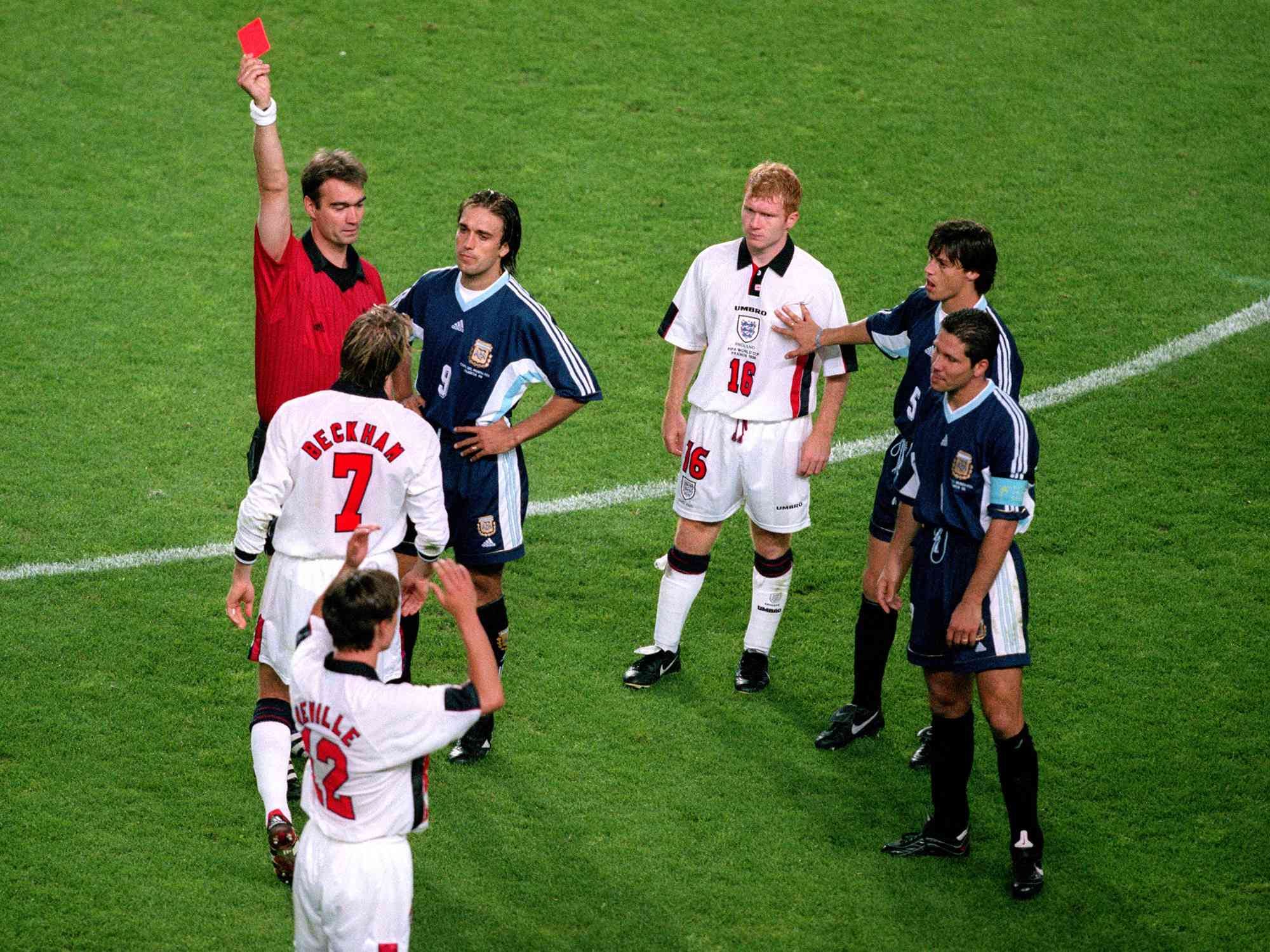
England held on, somehow, and reached the penalty shoot-out, which proved a challenge too asphyxiating. Beckham, one of England’s best penalty-takers, watched from the dressing room.
The first blow came from an exasperated Glenn Hoddle, then the England coach; the red card, he said, “cost us dearly.” At home, fans burned effigies and protested with posters. The Mirror ran “10 Heroic Lions, One Stupid Boy” on their front page. The television media, too, stuck their fork in: fame had ruined him; he was too soft, too pretty, too distracted by his pop-star wife to handle the demands of international football. Beckham would reveal later that, after the match, he broke down in his parents’ arms.
The next morning, Alex Ferguson called him up. “Don't worry, go away for a few weeks ... come back to the club, and you've got us.”
**
Back at United, Beckham was surrounded by a team that functioned simultaneously as a brotherhood and a machine. He rediscovered the joy of football, and the ball kept tracing beautiful shapes off his right foot. From the right flank, he sent in cross after cross, pass after pass, and they all lined up to feast. This was the strongest United had been in a bit; they just wouldn’t lose. And when the ball was dead, either on a corner or just outside the penalty box, no one in England could match up to David Beckham. He scored a typical long-distance curler, albeit from open play, against Arsenal in the FA Cup semi-final.
In the last ten days of the season, United faced three finals: Tottenham Hotspur at home to secure the league title, Newcastle at Wembley in the FA Cup final, Bayern Munich in Barcelona in the Champions League final. If they won all three, they’d become the first team in English history to complete the “treble” of league, cup, and continental titles in the same season.
Tottenham at home, first. As the clock ticked towards half time, with Tottenham leading 1-0 and a nervousness setting around Old Trafford, Beckham found the ball just outside the right side of the penalty box. He curled the ball into the far corner. Andy Cole scored in the second half. 2-1 Manchester United; league champions.
The FA Cup final, next. With one eye on the Champions League final, Alex Ferguson rotated his team. He kept Beckham, though, who turned in a near-flawless ninety-minute shift. United strolled home 2-0.
A few sleeps later, Manchester United arrived in sunny Barcelona with a gaping hole: Paul Scholes and Roy Keane, their first-choice centre-midfielders, were suspended. Scholes and Keane were United’s engine—Keane the bruiser and the midfield general; Scholes the metronome who brought control and precision. Beckham’s shoulder was tapped again, to fill in.
All great football teams are eventually judged for their continental success, like how tennis players are judged for their Wimbledon titles. United had won the Champions League only once in their history, thirty one years prior. It was more than just another final.
Bayern Munich went ahead in the sixth minute. United were competitive, but only in spurts. Bayern were better, physically stronger, and like a typical German team, innately knew how to handle the big game. For ninety minutes, United hustled and pushed, threw everything they had, but couldn’t break through. When they did, standing in the Bayern goal was the imposing wall called Oliver Kahn.
Ferguson threw all his forwards onto the pitch. In the 91st minute, less than two hundred seconds left on the clock, United received a corner on the left hand side. On commentary, Clive Tyldesley asked, “Can United score? They always score.”
Beckham stood over the ball in the narrow corner of the Camp Nou pitch and whipped the cross in. The ball rebounded off one player and another, hit a Bayern shin and a United head, and fell onto Teddy Sherringham’s path. 1-1. On the next play, United went again. There was no turning back now. Corner, again. Beckham, again. Pitch perfect cross, again. Sherringham flicked it behind, “AND SOLSKJAER HAS WON IT!”
Twelve months. That was all it took. Twelve months from burned effigies and front-page abuse to an open-top bus parade through Manchester, tens of thousands lining the streets, singing the name of the boy they had wanted to destroy. Manchester United won the league again the next season, then again the season after. At the centre of it all, orchestrating, delivering, bending the ball to his will, David Beckham.
England made him national team captain.
**
The luscious hair was gone by now, replaced by a Tyler Durden buzzcut—a lot less showbiz, a lot more rugged. The footballer was the same, jaw-dropping aesthete, but the leader had acquired an edge.
England, meanwhile, good ol’ England, ran head-first into a problem: they reached the brink of missing their second World Cup in three. When Greece came over for the final qualifying game in October 2001, England needed a draw, if not a win, for automatic qualification. Defeat would mean the indignity of a two-legged playoff, and a metaphorical knife-fight on the edge of a cliff.
The match was played at Old Trafford—Manchester United and Beckham’s home patch. He led the team out to seventy thousand singing throats. And, obviously, Greece took the lead within half an hour. England were their usual selves, the dissonance between their technical ability and collective cohesion stark as ever. And yet, around those fumbling white shirts, Beckham was extraordinary. He wasn’t running so much as pounding grass on behalf of everyone else. We often use the term, “captain’s performance” to describe a captain clinching the decisive moment. This was the purest distillation of a captain’s performance: one man trying to drag a talented-yet-clumsy team to the World Cup by sheer force of will.
In the second half, England equalised, then Greece scored again. Beckham took about half a dozen free kicks, many of them earned through his forceful dribbling, but couldn’t find the target. The regulation time ended, and the fourth official signalled for injury time.
In the 93rd minute, England won another free kick. Central to the goal, about thirty yards out—the hardest angle there is. It was, in all possibility, the last chance of the match. The digital scoreboard read England 1-2 Greece. David Beckham stood over the ball, facing the famous Stretford End, which had seen him go from boy to wunderkind to genius to villain to genius to leader. Here he was, England’s World Cup tickets, his reputation, his captaincy—all on the line.
And so we arrive at Sapporo, Japan, on a sweaty, balmy evening. Another World Cup, another match against Argentina.
The ball, dead and still. Over it, David Beckham, England’s David Beckham, surrounded by the shirt that had given him and his country so much agony.
You’re on a great run mate. Really enjoying your stuff.
Proper throwback, this one. :)