

There is a Hindi idiom that goes: ‘aam khao, gutliyan mat gino.’ It translates to ‘eat the mangoes, don’t count the pits,’ but its connotation is rarely confined to fruit. I have faint memories of our Mathematics teacher using it to smother our protests every time she kept extra classes after school. Harsh Sir, the school football coach, had a variant whenever he asked Ravi, our centre-forward and no doubt an exceptional footballer, to run fewer laps than us. At school picnics those words would emerge effortlessly from the supervisor’s lips—justification for handing us a plate of stale potato chips for “refreshment.”
The grown up version of the idiom is, ‘don’t sweat the small details,’ and adulthood is also where you discover the saying cuts both ways across the table. The sinner uses it to excuse the sin in service of the larger picture. For the sinned, it is often a pass to drape themselves in a robe of willing ignorance. On June 11th, around 10:30pm, I felt the weight of that robe as I sat down in front of my television. The FIFA Men’s World Cup 2026 was less than an hour away.
For close to a year, perhaps longer, I had been writing about the noxious smoke enveloping this World Cup. It was follow-through from the previous edition in Qatar, an enterprise that had left behind trapped workers, airless quarters, and dead bodies. And yet, somehow, this one felt worse.
There was first the long courtship between Gianni Infantino, president of FIFA, and Donald Trump. Infantino spent weekends at Mar-a-Lago, inaugurated a new FIFA office at Trump Towers—which, by the way, lies empty—and awarded Trump a Peace Prize in the same week the man spoke about reducing an Iranian city to rubble. Ticket prices started exorbitant and soared to a stratospheric realm. FIFA cited fanatical demand while manufacturing the scarcity themselves, by hoarding tickets and dumping them on their official resale website. By April, a group-stage ticket cost four figures, a knockout five. Public transport and hotel tariffs shot up alongside. The Trump administration, meanwhile, rolled out one dehumanising immigration policy after another, several of them concerning participating nations, and Infantino just nodded along with a clap and a smile that stretched to his cheekbones.
I recorded all of this in an essay and gave it a working title of, ‘Football Behind Paywalls.’
Just a few days after filing the piece, here I was, in front of a television, waiting for Infantino’s buffet. When the broadcast cut to Mexico City’s Azteca Stadium—its elliptical concrete bowl, so tight and steep that the collective sound of eighty thousand pours down to the grass, the sheet of emerald green jerseys, the flags on the rim of the roof, the Ajusco volcano rising above it—the World Cup had sucked me in.
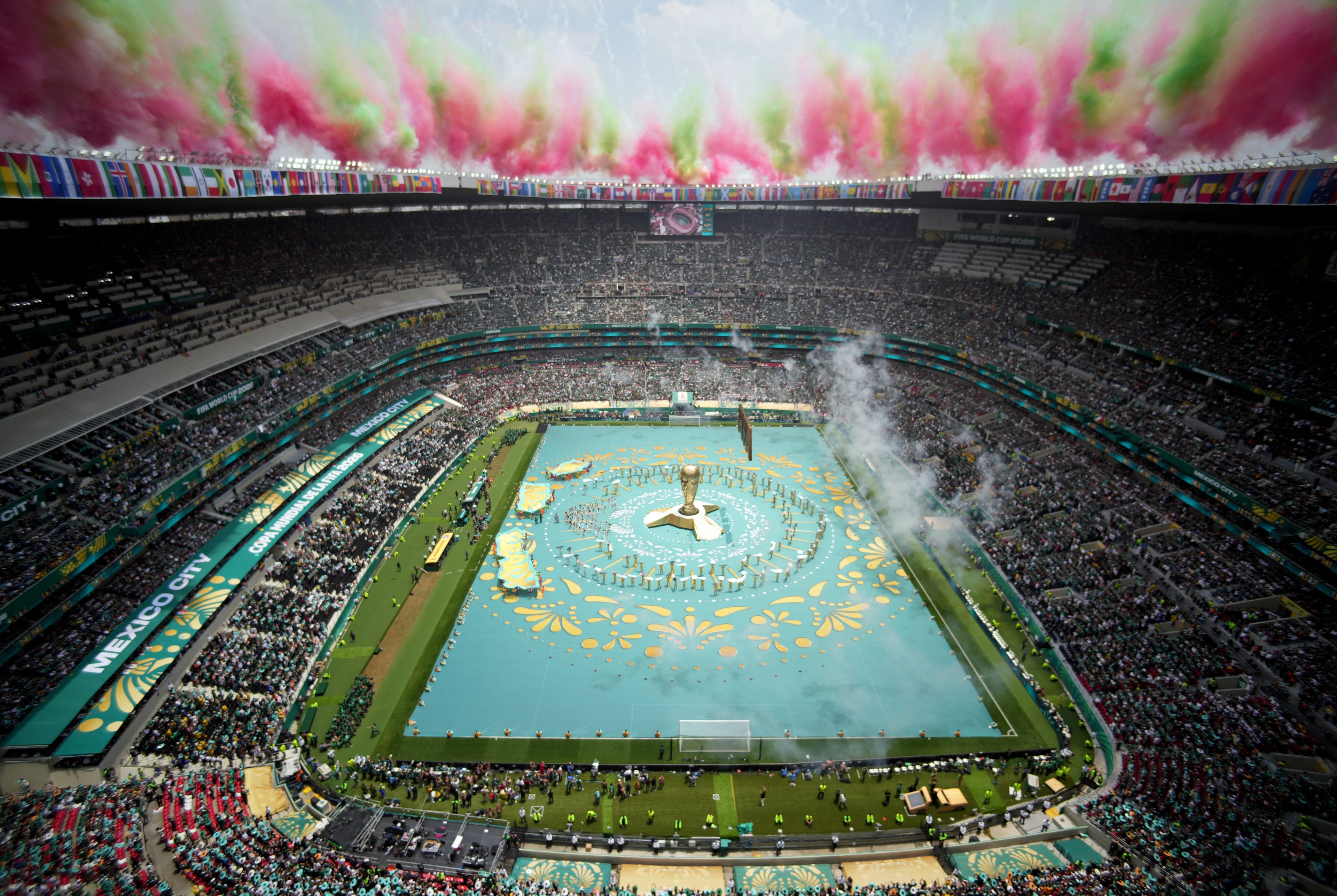
You first read about the Azteca in one of those pre-tournament centrefolds that walk you through the history of the World Cup. You saw the name next to Pelé and Maradona, both holding aloft a golden trophy. Tintin, you remembered, had visited the Aztecs once; maybe this had something to do with them. Later in life, you watched broadcast footage and official films from when your parents were children—the balloons rising to the sky, the bleached shade of grass, Pele and Rivelino’s slow dance, Maradona’s theft and magic separated by four minutes. You understood the reason so many writers called it a cathedral.
The Mexico team walked out to a tremendous noise, and I felt a shooting jealousy for those experiencing the sound and sight of the Azteca in person. The opening match, Mexico vs South Africa, was a replay of the opener from Johannesburg in 2010, now immortalised by Siphiwe Tshabalala’s thunderous strike and Peter Drury’s voice. This one was as dramatic, though the captions belonged to the referees. South Africa received two red cards, one of them very hard to understand.
Officiating interference would become a counterpoint ostinato through the tournament, a new layer of mockery on football’s intended tempo, which the “hydration breaks” had already dented by breaking two long, breathless passages to four short movements. The Video Assistant Referee—VAR, for shorthand—became part of our daily lexicon.
“The supposed precision of V.A.R., which purportedly can tell when a Croatian player’s hair has touched a ball (but apparently not when a ball hits a camera wire suspended in the air) or when half a kneecap pokes itself offside, makes everything worse, because these tiny infractions feel like violations of the spirit of the world’s beautiful game.” - Jay Kaspian Kang, here.
VAR, inadvertently, gave us 4K footage of the tournament’s internal machinations when pushed to stress. In the first knockout round—the Round of 32—USA’s Folarin Balogun was sent off, harshly, against Bosnia and Herzegovina. Now, FIFA don’t have an appeals mechanism for World Cups, so the red card had to stand and Balogun had to miss USA’s next match against Belgium. The appeal—push, rather—came from Donald Trump, who called Infantino personally, with the White House’s World Cup task force and Howard Lutnick, the Commerce Secretary, holding parallel lines. FIFA flipped out Article 27 of its disciplinary code—a rule never invoked before at a World Cup—and suspended the ban for a year, freeing Balogun to face Belgium. Belgium, enraged, beat the USA 4-1 and captioned their social media post, “Overturn this.”
The Round of 32 as a knockout stage was itself a novelty. Since 1998, the World Cup has meant thirty-two teams: eight groups of four, the top two advancing to the knockouts. Now the tournament had swollen to forty-eight teams: twelve groups of four, two automatic qualifiers from each and then eight of the best third-placed sides stacked up to make an even knockout tree.
You welcomed it, of course; more teams meant newer faces and newer stories. There was, however, a lingering fear that some of these newer teams might get trampled.
These teams were a revelation. Cape Verde, Curacao, and Congo went punch for punch with the heavyweights. It was as thrilling as it was humbling, as we rediscovered the shallowness of our general football gaze. Congo and Cape Verde reached the knockouts. Cape Verde, by then, had become the neutral’s favourite, the universal second team. Their 40-year-old goalkeeper Vozinha thwarted Spain almost single-handedly in a 0-0 draw in Atlanta, then stood amongst his celebrating teammates at the final whistle, in tears. First, for the occasion, then for his mother, who had to watch from home, her visa having never come through. She was one of millions kept away by rejections and the cost of a bond.
The USA’s immigration department was having a busy World Cup. Iran’s group matches were in Los Angeles and Seattle, but they were not allowed to stay within USA’s borders. So the team was stationed in Tijuana in Mexico. On the day before each match they were permitted to fly in; on the night of the match, they were required to fly out again. It was an inhumane expectation of a professional sports team—to play deep into the night and then, still in their kit, be bundled back across an international border. Their request to arrive merely two days early was refused every time. Head coach Amir Ghalenoei called his the “most oppressed” team at the tournament.
You looked for Iranian jerseys in the stands and found small pockets of diaspora, barely registering on the naked eye. Theirs was the only shade entirely missing from the great wash of colour spreading through the USA.
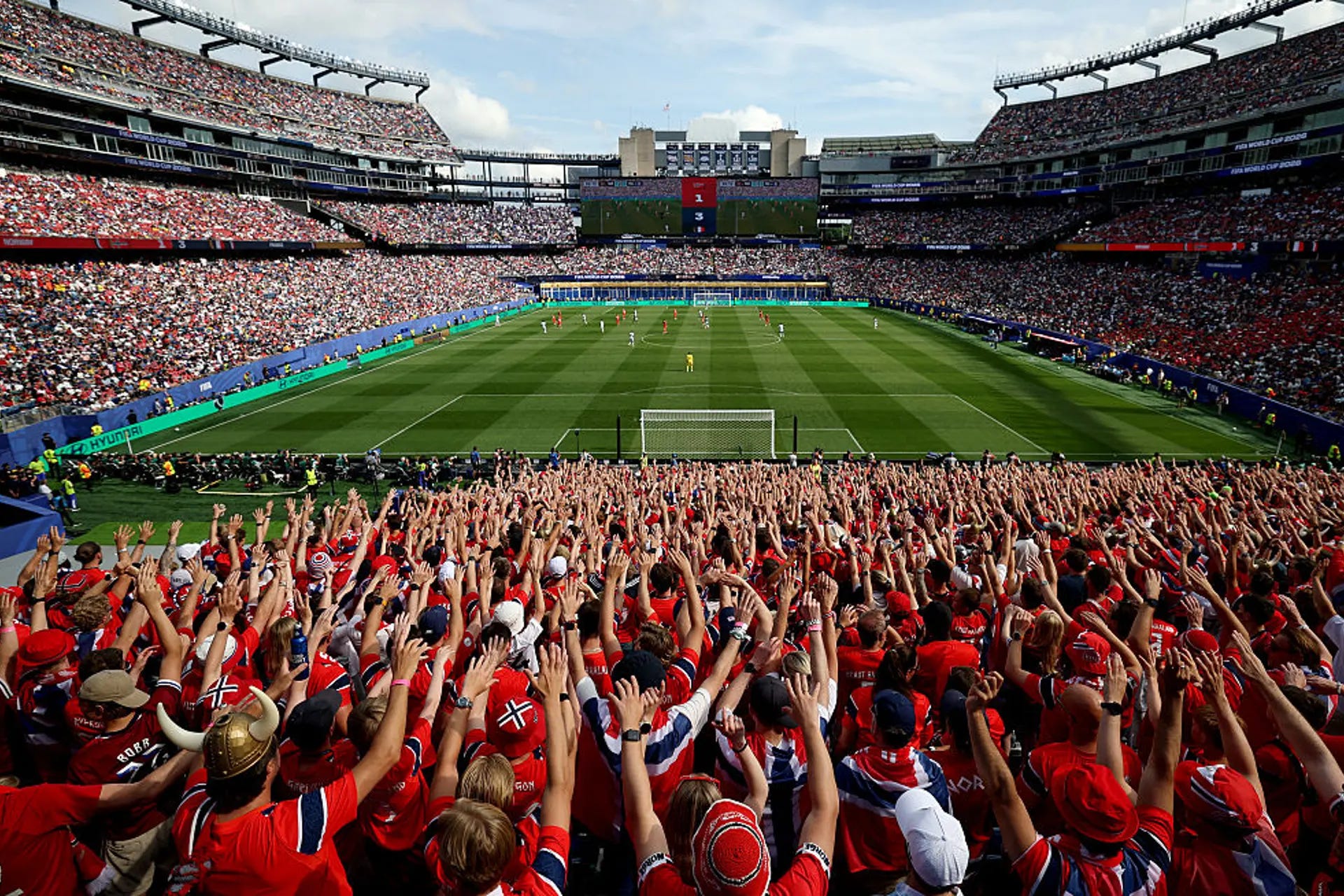
The scale of the crowd was, at least initially, a bit surprising. The ticket prices hadn’t drastically dropped, the immigration policies stood steadfast, so who, really, was attending?
Albert Samaha’s report found an engineer from Norway, a delivery driver from the Netherlands, and a data scientist from France—all paying in four digits per ticket. The matches confirmed what they were saying: there were hundreds of thousands of takers for this “once in a lifetime experience.” Alongside them, there was the local diaspora who could avail domestic subsidies, and the federation parties, accredited and flown in as a body, their ticket prices too substantially lowered.
The travelling support from the Global South was missing, but that’s the kind of detail FIFA would love for you to gloss over. “At three matches in the U.S. that featured either Côte d’Ivoire or Senegal,” Samaha writes, “I spoke with dozens of those teams’ fans, and couldn’t find a single person visiting from those countries.”
And yet the crowd, whatever their composition, behaved like a crowd. They streamed in with jerseys and hats and drums, and spilled out of the grounds into the neighbourhoods. The Norwegians took over Times Square and rowed their imaginary viking boat, the Brazilians danced to Scottish folk tunes, and the Scottish drank Boston dry. It was, even from within the bubble of the fortunate and the well-connected, a glimpse of the thing we had hoped the World Cup might be. And it occurred to me, watching, that this was likely the very picture Gianni Infantino kept in his head too. That overlap made my stomach burn.
The football, thankfully, was stupendous. If the group stage was a mixtape of the good and the middling, the knockout rounds delivered one classic after another. Canada pipped South Africa in the last minute; Brazil, too, needed a last minute-winner against Japan; Germany and the Netherlands were sent out on penalties by Paraguay and Morocco; and Norway left it until the final five minutes against Ivory Coast. Senegal led Belgium two-nil with four minutes to play, which in this tournament was not a lead so much as a dare; Belgium levelled the score, then took the game in extra time. All of this was just from the first two days of the knockouts.
England vs Mexico at the Azteca was an all-time classic—a game of tremendous push and pull, a heaving crowd, goals and red cards, wave upon wave of attack meeting a resolute wall of defence. You couldn’t take your eyes off it. At the end, the England players, red-faced and wrung out, walked to their corner of the ground and stood shoulder-to-shoulder while some twenty thousand travelling fans sang Wonderwall down at them. It became a ritual, repeated at every game, a touching sight of a team and its fans serenading each other in public.
And so, twisting and turning, we arrived at the semi-finals: France vs Spain, Argentina vs England. The four highest-ranked teams in the world, carrying four or five of the outstanding performers from this tournament.
Kylian Mbappe and Lionel Messi, light years apart in their career arcs, had practically made the World Cup their own. Their teams, though, took different routes. France had bludgeoned through their field. Argentina nearly lost to Cape Verde, then Egypt, and were held late by Switzerland. It had taken some divine intervention, a bit of refereeing generosity, and a generous serving of Messi’s genius to drag them this far. On the morning of the first semi-final, a France vs Argentina final, a repeat from four years back, felt inevitable. Until it wasn’t.
In the semi-finals, we got the best football of the World Cup, and both matches peaked when their scoreline read 1-0.
In Dallas, Spain went ahead and tightened the noose on France. Amidst the overwhelming current of France’s attacking prowess, we had forgotten that Spain were reigning European Champions and unbeaten for nearly forty games. In the semi, they moved the ball as if they were drawing lines on the ground, as if they wanted the pass-map from the game kept in a glass box at the Guggenheim Museum. The players glided up and down, left to right, barely letting their heels touch the ground, the whole thing from above looking like a synchronised ballet. Spain’s second goal of the night was a delicious 55-second move that started deep inside their half and ended with Pedro Porro—the defender tasked with marking Kylian Mbappe—scoring at the other end of the pitch.
After the game, Thierry Henry, who spent three years at Barcelona, supplied the context: “It doesn’t matter who is touching the ball. You can take one player out and put another in. This is what they’re taught since they’re 8 or 9 years old.”
In Atlanta, England took the lead against Argentina. Forty years back, at the Azteca, they never got the chance. Diego Maradona had won that afternoon. This evening, with thirty and some minutes left on the clock, England were the dominators. And then, amazingly, bizarrely, they shrunk—like they had against Croatia in the 2018 semi-final and Italy in the 2021 European Championships final. Their coach, Thomas Tuchel, replaced the two creators of the goal with tall, muscular defenders. They signposted their nerves to their opponents, which, in a list of bad ideas against Argentina, lies pretty close to the top. Between the 66th and 84th minute, England completed three passes; Argentina, 122—most originating from, or landing at, the feet of Lionel Messi.
The minutes ticked by, and Messi kept whipping crosses into the England box, like an archer finding his range. By the eighty-fifth minute, all ten England outfield players had crept deep inside their box, guarding the goal. So, Messi passed it outside, to Enzo Fernández, with acres of space to take a shot. 1-1.
Seven minutes later, with the dread of the inevitable descending on the English, with ball after ball finding Messi and Messi finding space, another play led to another cross—this time, with his right foot, as if the 92nd minute of a semi-final would be a good time to show off. The cross was surgically perfect, floating beyond a line of craned English necks, curving to exactly where Lautaro Martínez was waiting. 2-1.
Two different genres of magic, then: one, a triumph of football as a collective, choreographed show; the other, a more chaotic creation, no less thrilling, a tireless team willing it into existence, and a genius timing his flourish to perfection. In the highest-pressure game, these two great teams had found their way to individual expression and identity. Come to think of it, Spain’s show was extremely Spanish, Argentina’s typically Argentine.
Which brings us to tonight, and to New Jersey, where the final of the World Cup will be played on a ground the Azteca was passed over for. This is the biggest match in football since December 2022, and will remain so until July 2030.
Spain and Argentina have met exactly once at a men’s World Cup, sixty years ago. They haven’t met at all since March 2018. Yet, they aren’t strangers. Seven from the Argentina squad play their club football in Spain. Lionel Messi spent twenty-one years at Barcelona, where, in 2007, he bathed an infant in a bathtub for a charity photoshoot. He was a nineteen-year-old right winger then. The infant, Lamine, grew up in Barcelona, plays for Barcelona, and will start on the right wing for Spain tonight.
FIFA have planned a grand evening. The show will open with an assortment of Hollywood and the internet—Tom Cruise, iShowSpeed, and the like. Then, in one final blow to football traditions, the half time break has been extended from fifteen minutes to thirty to include a Superbowl-style event. Eight artists will play, amongst them Shakira, Justin Bieber, and BTS. Donald Trump will watch from the stands. At the presentation ceremony he will descend to distribute the medals, and it is safe to assume that he will not leave without a speech, a medal of his own, and possibly the trophy itself held aloft. Infantino will only be happy to oblige.
Many times through the evening we will wonder what it is we’re watching. Somewhere between the fourth and fifth artists during the half-time break, we’ll wonder if this sport is now a different being from what we fell in love with, and whether football itself is the half-time show to a billionaire event.
And yet. If there was ever a night to eat the mangoes without bothering about the pits, it’s this one. Because the alternative would be to cede ground to Trump and Infantino. Tonight, they are irrelevant, no matter how much they hijack the broadcast frame. BTS and Bieber will come and sing, and their words will not matter. Tonight belongs to Spain and Argentina. Tonight, I hope football can rescue us one more time.
The curtains have fallen and Spain have been crowned the Champions. That fact does not detract at all from the quality of your essay. ❤️
What a lovely piece of writing. Thank you for this.