

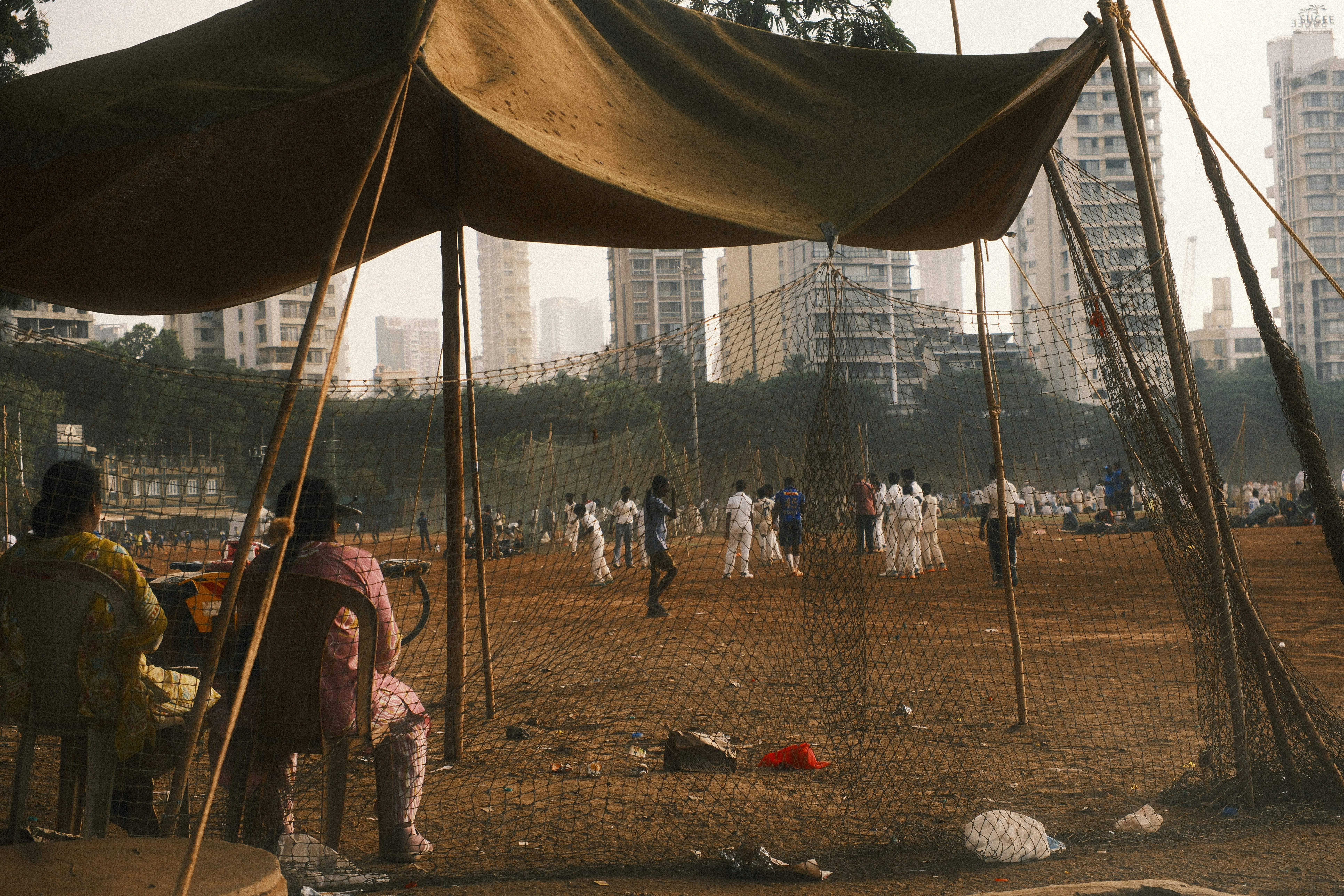
In the nearest net was a boy, no more than fifteen, probably thirteen. He had bony arms and a wiry torso, on which his kit flapped like a shirt on a clothesline. He was trying to tonk every ball into a different postcode; thrown off his feet, sometimes, by the force of his heave. After a while, he and the bowler, a boy his own size, set a target: 20 off 6 balls. He swung hard and missed the first. “Shit yaar.” He swung even harder on the next ball, and didn’t get near the ball. “Nooooo!” He hit the third cleanly and shouted “Six!” no sooner than the ball had left his bat. There was another six, a four, but he fell short of his target.
Further afield from Mahendra Singh Bony (sorry), an older boy was belting every bowler. His shots emanated a thick, muscular sound. Even his defensive shots had a venom, as if to make a statement. I noticed coaches and other trainees stealing glances at him, some pausing and looking like spectators at a maidaan. He hit a square cut that made me go “ooof” almost involuntarily. And then a couple of balls nearly took his stumps; his balance went awry. “Good bowler?” I asked from behind. “No, not at all. Just got lucky. I will hit him.” The next shot would’ve fetched him six runs at the Chinnaswamy Stadium. He turned around with a side-mouth smile. “Told you.”
I spent two hours yesterday watching young cricketers at the Karnataka Institute of Cricket (KIOC) in Central Bangalore. On the other side of a wooden fence, some 25 nets curved in a semi-circle, holding about a hundred batters and bowlers. Their ages ranged from, say, 10 to 18. They wore dark jerseys with KIOC emblazoned on the front.
I was most caught by the batters, belief and conviction beyond their bodies, opening up the entire catalogue of a modern strokemaker: full-bodies heaves, ramps, reverse laps, the whole lot. I don’t remember seeing anyone leave the ball.
The KIOC is a 30-year-old institution placed on the shoulder of Maverick’s, my favourite cafe in Bangalore. The Ulsoor Lake is ten minutes away on foot. Earlier this week, a friend and I went to see the founder and director, Irfan Sait. We were chasing a story about why the stream of elite first-class cricketers coming out of Karnataka has thinned. The pictures lining the staircase to Coach Irfan’s office suggested we had come to the right place. They record more than 100 first-class cricketers for Karnataka, and internationals for India’s men and women.
Coach Irfan’s lament was about patience and taste. Patience, because you need to give yourself and your coaches time to mould good foundations. Taste, because the kids are dazzled by T20 cricket’s glitter and sound, and they all want to build the kind of game that gets you noticed for T20s. “You won’t find too many here who’ll be willing to bat for 2 hours. Similarly, bowlers want to start their spell with cutters and slowers,” he said. The first ball of a spell, in other words, is already a variation. It’s not a KIOC problem, he’s convinced, nor a Karnataka Cricket problem. In his office, beside a wall of gleaming golden trophies, hangs a white certificate from the England and Wales Cricket Board for Level 3 coaching, amongst its most advanced grades. He has seen the children there too. “You’ll see the same everywhere. I get kids from all countries. They’re all obsessed with strike rate.”
It made me remember an afternoon in March, when I was waiting for a friend outside the Matunga Gymkhana ground in Mumbai. I caught about half an hour of an inter-school match. The kids, here, were dressed in white. The coach of the batting team, leaning back on a cane chair, wearing a floppy hat, was barking instructions from the sideline: “Neeche khel! Kya kar raha hai?” What are you doing? Play low. The batters obeyed and kept their strokes low. Perhaps this was an oddity, or perhaps this was Mumbai school cricket clinging onto its own tradition.
What about Test cricket? Do the kids watch?
India have a Test series coming. The first match is in Wellington, four days from now. Some of us will set alarms for 3:20 in the morning. Waking up in the dark for cricket from New Zealand or Australia has been a winter tradition for as long as we’ve been watching this sport. As Rahul Bhattacharya once put it, there is something about cricket at dawn, unlike and beyond cricket at night. I asked Coach Irfan if too many of his hundreds of students will look forward to watching the first ball. “No chance.”
Coach Irfan could find just one Test match from memory that moved his students: the last day at the Oval in 2025. England needed some 30 to win the series, India needed 4 wickets to square it. There was an eruption of sound at the KIOC campus when Siraj’s yorker went past Gus Atkinson’s bat, but it didn’t carry over to the next series, a few months later.
We smirked. We were three 20th century relics, all thirty and above. For us, Test cricket has always been the holy grail. That was why so many of us beamed when Virat Kohli, minutes after winning his first, emotional Indian Premier League title, spoke of Test cricket as his Everest. But Kohli is a child of the nineties. He speaks with great influence, but he speaks from a bygone era. So do we.
These children speak a language they know and see no reason to give it up. It’s a different language to ours, and that’s why it sounds jarring. But, instead of flinching, I’m keen to sit beside them and ask them who they idolise, which shots they play in their dreams, and what surroundings they play them at. There may be a story here.
***
Speaking of which—and, apologies for the spam coming your way in the next few weeks or months—the first essay of our new magazine, The Cordon, is out! It’s a gorgeous story written by Mohsin Kamal, and he travels through Kashmir to tell us about the unknown universe of local cricket.
Click here to read the article.
***
Back to this, international cricket is fast adapting the new lexicon too. In Durban, Australia played their first Test in South Africa for eight years, after a series so fractious, so fiery, it evoked a documentary, a book, year-long bans, and a completely new cycle of allegations and rebuttals this week. And yet, the stands were empty. Durban wasn’t an exception; Test cricket struggles to fill seats at most places. Meanwhile, franchise T20 cricket spreads its net wider and wider. This week, the Indian Premier League’s creator and a franchise owner were having a Twitter conversation about why the IPL cannot own the most premium international cricket window—after all, it’s the most popular and the most financially jacked. Nothing will come out of that conversation, obviously. For IPL to shift its window from post-spring to winter, too many parts will have to move. That the question is asked at all shows how far the conversation has already travelled. There is now a global circuit of these leagues, and many, many players are choosing that life over international commitments. You can’t blame them.
And so, cricket is nearing a moment of reckoning. The generation currently playing understands the prestige of Test cricket, partakes in it, but knows which way the wind is blowing. The generation coming through does not care for heritage and history. In fact, the debates about Test cricket are held almost entirely by the old. Test cricket’s charm is real, but it’s argued and narrated far more than it’s watched. Unless you’re a tragic, it’s a lot to ask you to sacrifice seven hours of your day, four or five days in a row, for an average of five emotional spikes an hour.
“Why watch Test cricket?” is a tough question to answer, because we’ve not considered the possibility of having to answer it. It will not stay that way for too long. The old will be too old by the time this moment arrives. The obligation to transition will land on us, the midnight’s children, who grew up around Test cricket and were young enough to see the breeze of T20 cricket turning into a gale, sweeping through our world.
On the way out of KIOC, I asked Coach Irfan, since Devdutt Padikkal is a creation of these nets, and often comes over, might the trainees get inspired by him? “They know and love him because he plays for RCB. Many of them don’t know that he was player of the series in the Tests in Sri Lanka.”
The game is changing I guess. It’s probably equivalent to what happened to long form journalism with the advent of twitter.