

On the morning of June 28, Ben Stokes gathered the England Test squad and backroom staff in the home dressing room at Trent Bridge. This was Day Four of the third Test against New Zealand. The series was on the line at 1-1 and slipping away. Standing in front of the balcony door, slapping a piece of paper against his palm, Stokes gave an impassioned retirement speech. “I’ve had many trips to the well before, for the team, for you blokes,” he said. “I’ve got one more left in me. The only thing I ask, please, is just can everyone do the same?” To his right sat Jacob Bethell, nine Tests young, gobsmacked. Bethell is England’s superstar-in-making, just like Stokes a decade and some back. From across the room, the official videographer recorded the whole speech.
This was supposed to be Stokes’ comeback after serving a one-match suspension, along with Gus Atkinson, for a long night out in London. Rumours had swirled in the days since that he was shuffling between giving up captaincy and giving up cricket altogether. So there was relief when he turned up for the mandatory press conference and said the right words. England needed him, as a leader and a cricketer, in a summer they hoped would bring success and restore respect into their cricket team. Three days and one soft dismissal later, he was done.
The England and Wales Cricket Board (ECB) didn’t announce the retirement publicly just yet. They and Stokes wanted to land it on the right beat. So they waited till the afternoon, ten overs into one of his typical back-breaking bowling spells, exactly fifteen minutes from the tea break. The announcement went via radio and broadcast commentary, then social media, and soon rippled through the crowd at Trent Bridge.
Stokes came back to bowl the next over to a standing ovation and, because it was him, took a wicket off his first ball. English cricket grounds rarely throb like English football grounds, but Trent Bridge, for a few minutes, was as close as one could get. New Zealand were all out soon. Stokes ran to the boundary as England walked off, then hopped up the pavilion stairs. He usually bats in the middle-order; on recent form, he should be at lower-middle order. But, with 373 to chase, he decided to open the innings. Stokes said afterward that he opened in order to “cause a little bit of chaos.”
And so he came, to even more raucous noise, swinging his Gunn & Moore bat. New Zealand gave him a guard of honour. He immediately stepped out to Nathan Smith. Next ball, he tried a reverse sweep. A few balls later, he stepped out again, and smacked Zak Foulkes for a six into the white cloaking behind the sight screen. Then a flicked six, a dabbed four, a crisp square drive. Then, on 30 from 19, he found the lower edge of the bat, and that was that.
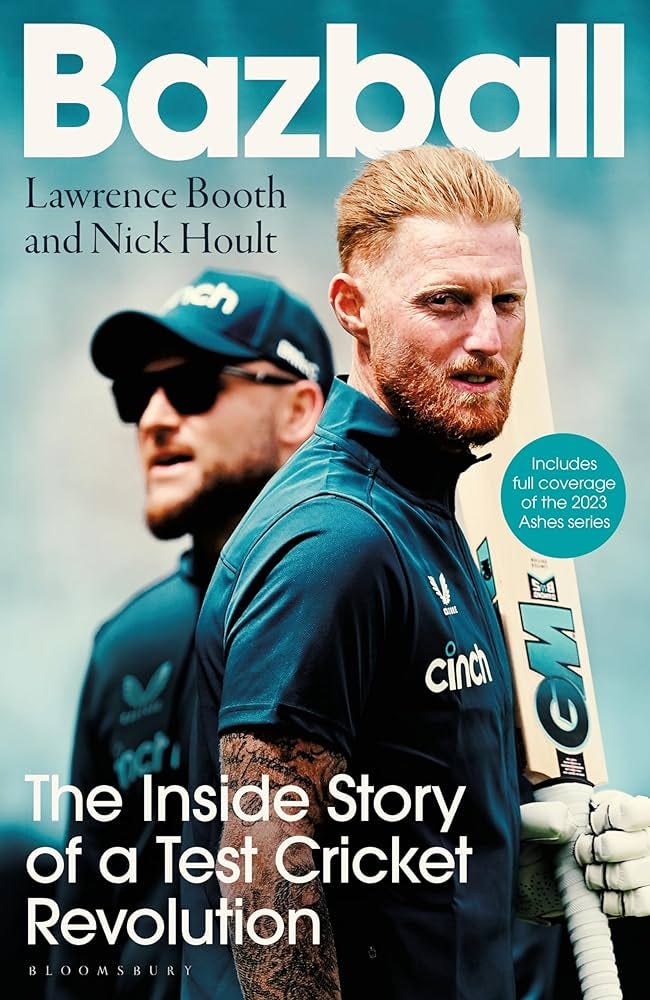
England’s innings went up in flames that evening itself, batting in a manner Stokes and coach Brendon McCullum had championed for four years: attack when logic suggests defence or pragmatism, and then keep attacking. This genre was given the loving moniker of Bazball. Within months, it transcended from style to gospel (read: cult), inspiring literature from seasoned journalists.
After the 1-4 drubbing last winter in Australia, and a longer period of no real success against the best teams, the powers that be in England cricket had vowed to re-evaluate Bazball’s cavalier methods and make room for intelligence. On their first series back, what we got instead was some cricket, a drinking incident, two weeks of tabloid, and an utterly lunatic afternoon that all but guaranteed another loss.
Vithushan Ehantharajah, who has followed the England cricket team closely for many years, described the final afternoon as Stokes burning the church he built. It might be true, but I think he wanted to put on one last show for his captive audience. It was clear that the match situation had become irrelevant for him—he said as much in his retirement speech.
It wouldn’t be Stokes if he went out with a whimper. There had to be fire. His two memoirs are titled “Firestarter” and “On Fire.” An authorised movie on his life is titled “Phoenix From the Ashes.” He wears a phoenix tattoo on his right arm. This, I guess, was Stokes leaving as he wanted to be remembered.
**
Retirement allows us to draw the outline on how we’ll remember a cricketer. An active cricketer exists in fragments—this innings, that spell, the relentless argument about form. The moment he stops, the fragments settle into a shape, and we get to discuss the whole. Ask any English cricket fan, and they’ll tell you, without pausing for breath, that Ben Stokes should be in the conversation about the greatest all-rounders of all time. On talent alone the point is worth consideration. But talent alone has never been how we settle these things. So we choose other, seemingly bullet-proof but utterly arbitrary, methods.
Great cricketers can be broadly classified into three archetypes. First and easiest come the obvious all-timers: Tendulkar, Lara, Warne, Sobers, Bradman, Murali, McGrath etc. So heavy is their body of work, so prolific their production, they escape all partisan filters, tick every box. No right thinking person would begrudge their position on cricket’s pedestal. If cricket could be thought of as a problem-solving endeavour, they are its most meritorious respondents.
Stokes leaves as one of only two cricketers to have scored more than 7000 Test runs and taken more than 250 Test wickets, which is a remarkable place to stand. But those numbers need an asterisk: his career spanned an era in which England played more Tests than anyone, more than most teams ever before. He played 122 Tests; Imran Khan, Garfield Sobers, Ian Botham, Richard Hadlee, Keith Miller—none of them enjoyed a similar buffet of opportunity. Stokes’ career batting and bowling averages, laid next to theirs, puncture the argument of him being an all-time great.
After the all-timers sit the aesthetes: Laxman, Mark Waugh, Saeed Anwar. You’ll find fewer bowlers here because bowlers who are lovely to watch but short of wickets don’t last long. Which leaves us the batters.
Batting, you see, is a largely capitalistic exercise. The most successful ones know how to accumulate in bulk. The aesthete is therefore a rebel, an artist in that market, who wants the dough but isn’t ready to sacrifice his soul for it. In his meditation on batting beauty, Samanth Subramanian speaks to ex-Australia captain and certified great, Steve Waugh, who offers the perfect throughline: “They’re relaxed and loose, and it all seems to come easy to them.”
That is the tell. From the artist, the art must look effortless. For the cricketer, art comes from the limbs. Elegance necessitates limbs moving in extension of one another, with a feline softness, as if strung by a thread, the torso as the puppeteer. Think Azharuddin’s flick off his pads or Aravinda’s front-foot pull. Rahul Bhattacharya once wrote of VVS Laxman, “VVS does not charm so much as woo. Inevitably, we fall.” The artist may not always succeed, but he makes you appreciate the fluidity of the human body. Out of all the archetypes, the artist is, by far, the most sensual.
There’s, of course, a wide overlap between greatness and beauty. Warne and Lara were artists worth crossing oceans for. Joe Root, on the other hand, proves that accumulation can happen in slow jazz.
Beauty was not one of Ben Stokes’ many attributes, and I doubt it troubled him. The dirt on the shirt was the point, symbolising a day spent slugging it out against the weather.
The third archetype of cricketer is harder to find and harder still to file. They’re the ones blessed with flair and freedom, rawness and skill. Their statistical profiles are often ordinary, but when the mood strikes, they win games and tournaments. Glenn Maxwell averages a lowly 33 in ODI cricket, 26 in Tests, and yet, only he could’ve scored that unbeaten 201 on a humid, draining Mumbai evening, his body beaten by cramps and spasms, dragging Australia to victory all by himself.
No cricketer or fan in the world has an idea when Maxwell might click, but they live in fear: if he does, he’ll take the game. Shahid Afridi, albeit substantially more accomplished, was made of similar fabric. Shoaib Akhtar too, to an extent.
Then, within the showmen, there’s a smaller subset: the ones with an uncanny feel for the moment a match turns into theatre. Put them in a dead rubber and they’ll sleepwalk through it. But when the match tightens, as the crowd leans in, as the broadcast director starts cutting to tense faces, something in them wakes up.
They are, in a way, ideological opposites to the artist. The artist can exist without the context of a match; this breed exists for the context. They don’t chase the spotlight so much as arrive, repeatedly, at the exact coordinates where it’s about to switch on.
England holds this archetype close. Perhaps a country that invented the game and then spent a century watching others perfect it kept a soft spot for the redeemer. The founding text is written by Ian Botham. Every English cricket fan of a certain vintage can describe the photograph: Botham in the Headingley dressing room, 1981, lit cigar in his mouth, beard like a hedge, pads still on because taking them off would’ve closed the innings. He’d just made 149 not out, swinging his bat like an axe in the Yorkshire wind, and turned a series that already had England’s obituary written into one they’d name after him.
Ask any English fan who watched and they’ll tell you where they watched it. But ask them Botham’s average against the West Indies—the best team of his era—and they’ll change the subject. That’s the deal with these players: you don’t judge their careers by averages, but by the giddy morning-afters in school. Botham gave many. Andrew “Freddie” Flintoff was the same. His career numbers were middling; the summer of 2005, and what it did for English cricket, immortal.
Around fourteen minutes into Phoenix From the Ashes, there is footage of a teenage Stokes and his mates in Cumbria, scrambling up a ridge and sliding back down, his narration voice speaking over it: “You want to be known as that person who’d go above and beyond to do something on the field that some other people might not.”
In his second Test match, Stokes, just twenty-two, walked out to a Perth pitch scratched with craters wide enough for a mobile phone to slip through. England needed about 400 more to save the Ashes. Mitchell Johnson, with a Dennis Lillee-moustache, was sending the red ball at 90 miles an hour slowest. Stokes scored 120 off 195 balls, pulling and cutting anyone who tried to bounce him, driving when they went quick and fast, chopping every Australian bowler, Mitch Johnson included, to size. England lost anyway, as they always do in Australia, but we got to know something about Ben Stokes that afternoon. Some years on, when South Africa had England in trouble at Cape Town, Stokes scored 258 in five hours.
As a batter, Stokes was hugely gifted—on technique alone, perhaps one of the five best England have had in thirty years. On the field, he was amongst the best in the world. He’d cover ground like a sprinter and holding catches he had no business reaching. Stokes the bowler nobody enjoyed facing: quick without being express, swinging it like a banana, forever leaving you playing the wrong line. And that was only the shape of it. He could bowl for hours without shedding pace or zip, and turn a passage of play into a dogfight.
A couple of months after that Cape Town knock, England needed to defend 19 in the last over of a World Cup final against the West Indies. Stokes took the ball and Carlos Brathwaite hit him for four consecutive sixes. As the last of the hits disappeared over the field, Stokes sank to his haunches, covering his eyes with palms. He played two more World Cup finals after that evening; he was England’s saviour and Player of The Match in both. You can make a movie from his bowling spells that brought England back into a contest.
I think of Stokes the all-rounder like this: if I’m building an all-time XI, I wouldn’t have him; but if I’m building a team to play a World Cup final, or a Test match on which hangs my life, Stokes would be one of the first names on the team sheet.
Like Botham, Stokes too had a Headingley scene, almost a reprint for the impossibility of the situation. I could start with the final day, the most unforgettable of all, but I want to talk about the previous afternoon. England were 1-0 down in the Ashes, and midway through the third Test, found themselves about 200 or so runs behind Australia. The series was fading from the horizon with every Australian run. Stokes then bowled for nearly two unbroken hours, just one man raging against the dying light. That rage brought him wickets, and England the semblance of a reachable target.
359 was still too much. Australia had them reeling at 159-4, when Stokes walked in. At one point, Stokes was on 3 off 81 balls, running out of partners. It was over-my-dead-body defiance turned into a style. One ball hit the back of his helmet and burst the temple-guard, scattering black debris all over the pitch. Stokes just tapped his bat and moved on. One after another, everyone fell. Stokes crossed his half-century, the runs barely registering over the prospect of the impending 0-2 series deficit. England still needed 72 when Australia got their penultimate wicket.
And yet, there was a weird magnetic tension to the situation. Stokes was still there. He hit a six down the ground, a crunching pull, a cut, a scoop, a reverse sweep for six. He pulled and flicked his way from 96 to 112, prompting Ricky Ponting—the most competitive Aussie you’d find—to go, “Wowie!” in the commentary box. On the other side, Jack Leach defended obdurately. Stokes kept hitting, at that point operating on a cocktail of gritted teeth, blind faith, and the thing elite athletes call “the zone.”
Jack Leach’s single, the most popular single in English cricket history, tied the scores. Then, in one motion, a thumping cut off Pat Cummins, the right hand coming off the bat, into a fist, and a cathartic air punch. Only Ben Stokes.
Four years later, he almost, almost, pulled off an encore at Lord’s. He was England captain then.
And Stokes as a captain was a wild ride. Under his leadership, England vowed to break away from the pressure of failure and play, purely, for the vibes. They kept pushing the line between bravery and recklessness. Scores that had never been chased were smoked down; scores that should’ve been chased were wilted against. They lost a lot more than they won, but they were spectacular either way.
None of it came quietly. The mic was their outbound marketing arm. Stokes claimed that his England were saving Test cricket, that fans watching them were lucky to have experienced this. His teammates joined in, each saying stupider things than the last. Ben Duckett once said every team in the world owed England gratitude for showing what brave cricket looks like.
There was also a near admirable resistance to accepting defeat or absorbing accountability. It was post-truth English exceptionalism adopted as a dress code. The 1-4 scoreline in an Ashes series that they had talked up for three years was, apparently, an illusion of numbers, a function of results that went one way but could’ve easily gone the other. The coach said they actually prepared a bit too well.
Even on their last afternoon with him as leader, there was no reckoning with the state of the game. New Zealand showed the merit of playing tough, attritional cricket; England and Stokes said, “no, thanks.” Stokes took English cricket through a hurricane, because he liked running into hurricanes, and left behind a bunch of dizzy men in tattered clothes.
**
From the New Zealand dugout also came an exhibit of how to exit the stage gracefully. Kane Williamson, an indisputable legend, left between games, in relative silence. In his retirement presser, he said that all his runs belonged to the team, not himself. He spoke with his charming soft voice, the whole speech a thank you-note towards his teammates, opponents, and employers. And then he was gone. We don’t know what he said to his teammates.
Stokes couldn’t be more different to Williamson. But even so, that choreography at Trent Bridge, set against the match situation, was farcical and self-indulgent. It imitated the chatter from across the Atlantic, where every Portuguese is suggesting that a World Cup campaign be turned into a farewell-cum-tribute roadshow for Cristiano Ronaldo. Perhaps, when a cult grows large enough, everything else—the result, the collective aspiration, the point of the exercise—falls away behind it. So it was with Stokes, in his last few years, the pageantry an accompanying act in the experience.
And everyone, clearly, was charmed. England had just been taken apart, and still the cameras would not move their gaze. Nor would the crowd, though, I think, for very different reasons. To them, Stokesy is a true neighbourhood hero—unapologetically imperfect and rough around the edges, but blessed with otherworldly tenacity and a way with people.
There’s a story from 2022 I think of every time I think of him. Stokes, while playing for Durham, hit Josh Baker, an 18-year-old off-spinner from Worcestershire, for 34 runs in one over. Later that evening, a message lit up Josh’s phone: “Hey Josh, Ben Stokes here.. Please don’t let today define the rest of your season. You’ve got serious potential and I think you will go a long way. Most important opinion is from the lads in your changing room and they will always have your back. This coming from someone who got meeeeeeelted in a T20 World Cup final.”
Stokes understands despair. Between a court case for violence, the loss of his father, a crippling depression, and lost World Cup finals, he has emerged from a lifetime’s worth of experiences that would’ve broken many. And he walked out with chest up, hand locked into a fist, ready to run into the wind again.
“Legacy is something you leave behind, not something you take with you,” Gideon Haigh writes here. Stokes’ career poses an interesting question about legacy: how will we remember him? As the cricketer who, zooming out, did well sometimes? As the captain who promised chocolate and often delivered chalk?
I think, in time, we will probably forget parts of this last afternoon, even though the Bazball years would be hard to forget or always rationalise. We might even forget his career averages—they’re unremarkable anyway. I think we’ll start looking past a lot of that with age. I think we’ll remember, most fondly, Stokes the talisman, gutsing it out, wearing white, wearing blue, occasionally a funky red, and dragging his mates across the line when nobody gave him a chance. And then doing it again.
Cricket will be 150 years old next March. In all this time, few have made it feel as cinematic as Ben Stokes. That ought to count for something.
What a fabulous piece of writing , you described & analysed the man and the cricketer wonderfully .
But you omitted to mention the defeatist side of the man . After the 4-1 defeat on tour to a sub strength Indian team , he openly stated that he had known all along that his team never had a chance of winning the series . In his mind (though never in his comments post an identical scoreline in the latest Ashes defeat ) he probably had the same pessimism and defeatist thinking .
He brought a wonderful breath of fresh air to English cricket in 2022 and 2023 but by 2025 it had turned foul .. polluted by a lack of common sense and indiscipline on and off the field .
This is one of the best pieces I’ve read on Ben Stokes because it avoids the lazy “greatest ever” debate and instead asks a more interesting question: what kind of great was he? Not every legend is defined by averages. Some are defined by moments that permanently alter how people remember the game. Stokes belongs in that category alongside players like Ian Botham and Andrew Flintoff—cricketers whose greatest performances arrived when the stakes were highest. I also appreciated that the article didn’t shy away from criticizing the excesses of Bazball or the theatrical nature of his farewell. You can admire Stokes’ extraordinary ability to bend matches to his will while acknowledging that his captaincy philosophy often crossed the line between bravery and recklessness. That’s a balanced legacy, and probably the most honest one.