

It must’ve been around 2 am when the WhatsApp notifications started pinging. At that hour, you give your phone a cursory glance to see if anything warrants immediate attention. Well, something did, but not for worrisome reasons. We were seven of us in one group, spread across Asia and Europe, watching Real Madrid play Bayern Munich in the Champions League quarter-final.
The chat was buzzing, instead, with news about Arsenal, who were struggling against Sporting CP in Lisbon. The score there was 0-0, thanks largely to Arsenal goalkeeper David Raya’s athleticism. So, with fifteen minutes left of the night’s football, we smelled the inevitable dagger and switched seats to Estadio Schadenfreude.
The dagger didn’t come. Kai Havertz scored in the dying minutes to give Arsenal a 1-0 win. But the ride was worth the time. For fifteen minutes, we were giddy with the prospect of Arsenal losing a Champions League match to a team with 1/5th its annual revenue.
See, the Arsenal men’s team is a good unit.1 They now take a 1-0 lead against Sporting back home for the second leg of the quarter-final. A semi-final spot beckons.
At the time of drafting this, they lead the Premier League—the English top-division league—by nine points, with six games remaining in the season. The caveat being—Manchester City have played two games fewer. So, that lead is slimmer than it looks.
But, it’s a lead nonetheless. If their stars align, they’ll soon be lifting their first league title in twenty-two years. Twenty-two years, for a team as storied as Arsenal. Can you imagine? The last time they called themselves English champions, we were asking “A/S/L?” on Yahoo Messenger and Donald Trump wasn’t thought of as a candidate for the Oval Office. It’s been a while. They’ve come close, though, finishing agonisingly second in the last three seasons. They have not won a trophy of any kind in six years, despite spending a billion pounds in transfer fees.
They had the chance of breaking that rut in the last fortnight, which they squandered in typical style—first, in a final, against an out-of-rhythm Manchester City; then, in another cup, against lower-division Southampton. The problem, still, isn’t in the knockout blows. Those can happen to the best. The obvious pattern in those two games, and much of what Arsenal have served up over the last couple of months, is the tension in their attack and defence. They are completely bereft of edge, almost scared of their own lead.
So, irrespective of whether you wear an Arsenal jersey to your grocer or not, this isn’t a normal situation. For some, this is a nature documentary unfolding in slow frames, the iguana struggling to run away as the viper slides closer.
A lot of that flavour comes from Arsenal’s recent history. Arsenal are one of England’s great football institutions, behind only Liverpool and Manchester United for trophies. For most of the late 90s and early 2000s, as English football transformed from its mud-caked, shipyard aesthetics to a slick, 21st century media product, Arsenal were amongst England, and Europe’s, best.
Their head coach was a tall, elegant Frenchman named Arsene Wenger, and the aptness of the name was never lost on anyone. Wenger brought a scientist’s eye to a sport that was considered the preserve of manly men with a kink for watching bodies collide. His team was peerless, simultaneously capable of French lyricism and English pugnacity.
Arsenal played their home games at the Highbury, where its narrow football pitch was flanked on all sides by crowds sitting at a handshake’s distance. They’d suffocate you, and just when you began gasping, they’d scythe through you in straight, electric lines. They finished the 2003-04 Premier League season unbeaten—to date, the only English team to achieve this in the last 138 years.
And then, their best started leaving. Captains, leaders, captains-to-be—they all left, one by one. Theirry Henry and Cesc Fabregas flew away to Barcelona’s promise of European pre-eminence; Robin van Persie stayed within the country, but switched jerseys for title-rivals Manchester United; and Ashley Cole committed the cardinal sin of joining cross-London rivals, Chelsea. All of them filled their cupboards with new gold medals while Arsenal’s success completely dried up.
This exodus and draught also coincided with the snowballing of social media from a quirky place on the internet to a vicious, relentless part of our environment. And, holy hell, we let the Arsenal fans know. For a team that talks a big game, for a team that has “the greatest team you’d ever see” as a refrain on one of their most popular chants, their ability to end most years as also-rans was unmatched.
Eventually, their own patience broke. Arsene Wenger, well past his best-by date, was chased out of the club he built. The scale of his own misery was broadcasted on his 1000th game in charge—an occasion for tributes and celebration. The sun was high and shone its best March glow on London. It was going to be Arsene’s day, Arsenal’s day. How could it not? Then, Chelsea beat Arsenal 6-0.
From there, it was a freefall. They spent millions on fresher mediocrity. They lost games they should’ve won. Newly promoted teams made them look silly and fragile. Brentford faced Arsenal for their first Premier League match in a century. Their manager, a lean, athletic Dane with flowing hair like Mads Mikkelsen, came to the pre-match broadcast and said, “We’ll beat them.” Brentford 2-0 Arsenal.
YouTubers entered the discourse. Arsenal FanTv, a fan-cam channel run and populated by obnoxious, mentally-stunted men with a lust for camera and theatrics, grew to more than a million subscribers. Their most popular content inevitably followed an Arsenal loss, when these fans, after paying eye-watering money for a ticket and watching their team get bullied, vented with red faces and hoarse voices.2
In that directionless team played Mikel Arteta—solid, hard-working, always available for his team. One could see why Wenger, or any other coach, would trust him with the captain’s armband. He had an unmistakable school prefect vibe. Today, he’s Arsenal’s head coach.
Arteta’s first team was a joy to watch. That young group played football as if they were created from Arsene Wenger’s blueprint. Then he tore all those notes up and assembled a team of men built like night club bouncers whose collective style of play will one day make Arsene Wenger retreat to a cave near Shutter Island. The running pejorative for Arsenal references their inability to score goals from open play.
But what draws the neutrals to this viewing gallery isn’t really their football. It’s everything around it. Arsenal under Arteta have the energy of a start-up built by teenagers who treat The Social Network as the bible. Every press conference, every social media clip, every leaked dressing-room speech radiates a desperate anxiety to be perceived as elite.
Before a Premier League match against Brighton in April 2022—a match Arsenal needed to win in order to keep alive their hopes of finishing in the top four, a match that came on the heels of a 3-0 mauling by Crystal Palace—Mikel Arteta walked into the Arsenal dressing room holding a lightbulb.
A literal lightbulb, which he then switched on. Which means, at some point before the match, Arteta or a member of his staff sought out that bulb and a power source and tested whether the thing would actually illuminate on cue, and that was considered a good use of everyone’s time. He gathered his players in a circle and told them that Thomas Edison invented the lightbulb. Then, he told them a bulb by itself is nothing, that he wanted a team that was connected, that shone, that transmitted light and energy and passion to one another. He used the word “electricity” several times. He told them to go out and turn the metaphorical light on.
And then, Arsenal went out and lost 1-2 to Brighton.
In May 2023, Mikel Arteta brought a chocolate-coloured labrador puppy to Arsenal’s training ground. He named her “Win”, hoping to emit a winning spirit amongst his troops and remind them of their sole purpose at the club. That summer, Arsenal lost the league by 5 points. They’d lose next season’s league by 2 points.
In the summer of 2024, during preseason, Arteta realised that none of his methods were working. He decided that what his squad really needed was to be robbed.
He took them out for a team dinner. What the players did not know was that Arteta had hired a team of professional pickpockets and deployed them among the tables, disguised as waiters. Over the course of the meal, while Arsenal’s millionaire footballers ate and talked about holiday destinations, the pickpockets moved through the room, lifting wallets, phones, and car keys. When the meal was finished, Arteta stood up and asked everyone to empty their pockets. Cue: dread, shock.
The lesson, Arteta explained, was alertness. The opposition will take from you the moment you stop paying attention, and you will not even know it has happened until it is too late.
In truth, the head coach of a top club bringing bulbs and adopting motivational dogs has merit. Good leaders find innovative ways to gain edges. At Arsenal, with their backdrop, these become fodder for memes. And, my god, they are humanity’s greatest gift to the memeverse.
On the pre-match press conference this Friday, Mikel Arteta asked Arsenal fans to bring their breakfast and lunches to the match against Bournemouth. It was time for the players and the fans to “lock in”. Saturday, full time: Arsenal 1-2 Bournemouth.
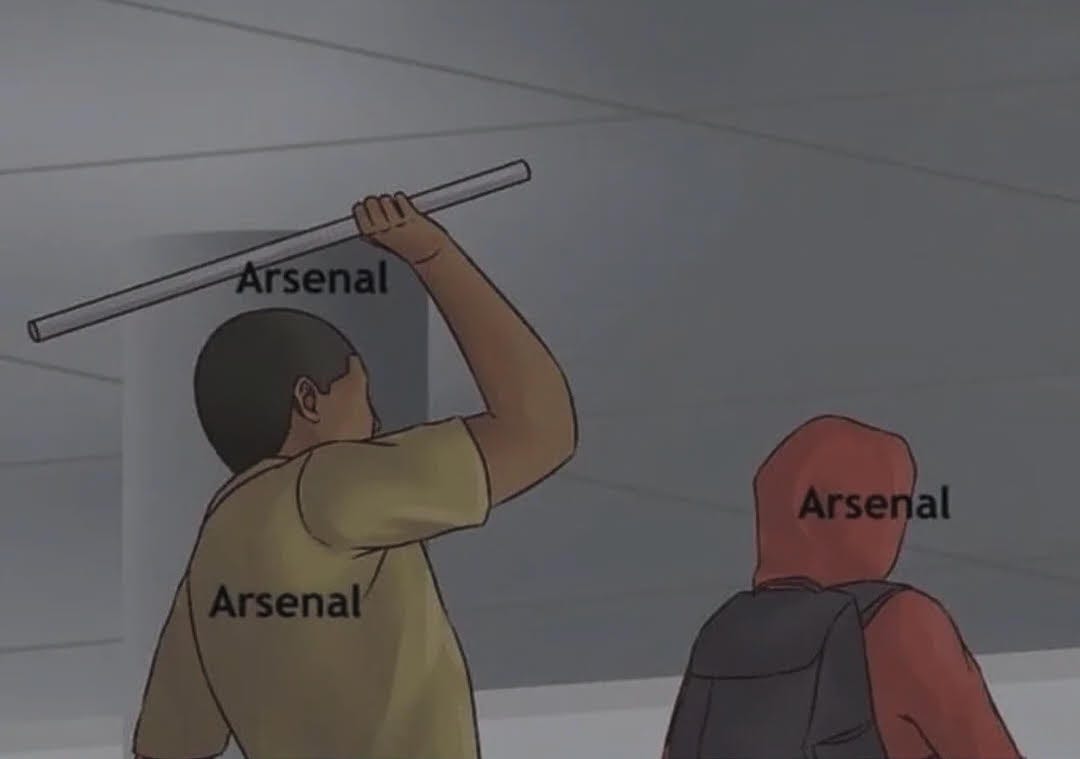
Around this time, next week, Arsenal will be preparing to face second-placed Manchester City in Manchester. Win the game and that’s the league title done. Lose it, and suddenly, City are breathing down your neck. The viper will open its jaws.
There is one guarantee—whatever happens, it will be a watch. If Arsenal win the league, they won’t reach the finish line cruising. They’ll get there fumbling, knees scraped, hands brown with mud. If they lose, if it all comes apart in one glorious explosion, it will make for the most spectacular wreckage you’d wish to watch.
Either way, hug your nearest Arsenal fan.
Their women’s team is phenomenal and I hate them from the bottom of my heart for stealing Alessia Russo.
See, I realise it doesn’t say good things about me that I found some of it hilarious, but have you ever heard someone curse their mother in Jamaican patois for making him support Arsenal as a child? One went, “Mum, I love you, but I don’t know what you been drinkin’, blud.”
I don't watch football but I kind of follow it because of an Arsenal fan and another Liverpool fan at home. Let me share this lovely article with them.
Great read, Sarthak! The pickpockets story is crazy!