

Barbados was just yesterday wasn’t it? That rainswept afternoon when the Indian men’s team finally touched gold. When Kohli rose and Rohit rallied, and both held each other in a long embrace on the stairs—two men in the evening of their careers, clinging to each other like survivors of something. When tears fell from Hardik’s eyes as he lined up to finish the formalities. When, for nearly an hour, another heartbreak stared India in the face, and India, for once, stared back.
That was just eighteen months ago. We’re back to the starting line of another World Cup.
The global population has increased by a mere hundred million since. The WhatsApp groups I was part of then are still thriving. This is the eighth men’s world event since June 2021. Somewhere in the blur there was a Champions Trophy. Somewhere a dropped catch ended a campaign, though which catch, which campaign, is harder now to say. The tournaments are coming so fast, our memories have lost their gravity.

Barbados, however, will stick. Not just because that ridiculously talented team finally got their confetti rain after a decade of drought, but because the game unfolded like a movie, pulling this way then the other, twisting and turning until the last moment. That tournament had been a mess—overpriced, poorly organised, and sparsely attended. But it got the final act it had hoped for. Two greats of the game retired from the format right there.
That afternoon was also a prelude. The blue machine had been burdened for years by expectation and fear, by the weight of a billion people who wanted it to win and couldn’t forgive it when it didn’t. Now it had tasted success. It knew how to fly. And it was time to unleash the next installment of the franchise.
Since Barbados, the Indian team has won 79% of its completed T20 games. That win-rate in the sport’s most volatile format is absurd on its own. Then you look at the ferocity of their batting, and absurd doesn’t feel like an adequate description.
Abhishek Sharma is scoring 14-ball half-centuries every other day; Ishan, Tilak, Surya, Hardik make up a tantalising core; the batting lineup stretches till number 8, sometimes 9; the bowling attack has Bumrah and Varun and about five other options. This team is so stacked there is no space for Yashasvi Jaiswal and Shubman Gill. Some months back, India scored 297 in a T20 game. Two hundred and ninety-seven cricket runs in a mere hour and a half. Last week, New Zealand set India a target of 156; India chased it down in 10 overs.
Like Jarrod Kimber said here, India are truly playing a different sport to everyone else. And yet, it fills one with an odd vertigo. How are we supposed to deal with this? As close followers of Indian men’s cricket, we’ve known good, we’ve known very good, we’ve even known great. But this is wild.
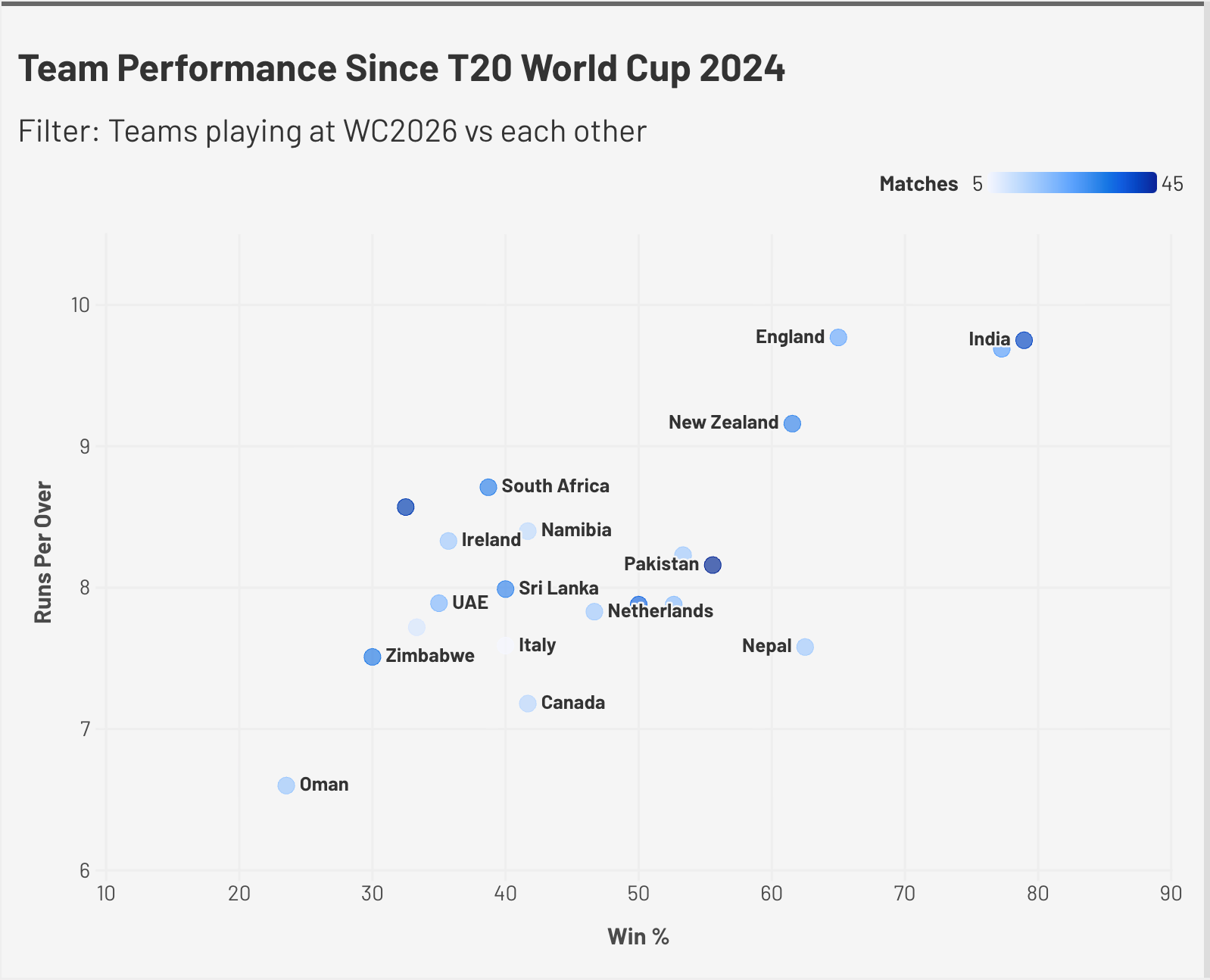
This isn’t to say that the celestial air around this team is impenetrable. The beauty of T20 cricket lies in the fragility of its margins. South Africa lost that Barbados final by two inches of Suryakumar’s right shoe. India, with its recent history of bitter near-misses, will know how thin the sheet of ice can be. But they start as overwhelming favourites, perhaps the most overwhelming any favourite has been in cricket for a while.
South Africa beat their own drought last year. Albeit in Test cricket, with different rhythms and way of being, their WTC triumph broke the mental shackles from two generations of lost knockout games. They will arrive at this tournament lighter than they’ve ever been. The young core—Stubbs, Rickleton, Markram himself—have now seen what winning looks like from the inside.
Australia, meanwhile, come to this World Cup as they come to every World Cup: as Australia. They won this tournament in 2021. They won the Test Championship and ODI World Cup in 2023. They lost the Test Championship last year at Lord’s, and within a week, they were ready for the Ashes. Like a conveyor belt of excellence, they just find a way to keep turning up. New Zealand, too, of course. They may be taking a whooping at the hands of India right now, but come the big event, they’ll push beyond their ceiling.
Watch out also for Sri Lanka, Afghanistan, and the West Indies. Sri Lanka play at home, in Colombo and Kandy, where Theekshana and Wellalage and Hasaranga will make the ball stop and skid. West Indies carry enough power to rearrange a game in ten minutes flat. These teams might dazzle or fizzle, but they’ll be fun anyway.
Afghanistan reached the semi-finals of the last T20 World Cup. They’re a serious threat now, not exotic outsiders anymore. They play the United Arab Emirates in Delhi on 16th February. If you’re around, get yourself a ticket to the Ferozeshah Kotla, sit amongst the Afghans in the crowd, and join them for a plate of post-match mutton tikka at Mazaar.
And keep your eyes locked on Italy—World Cup debutants, 230 years in the making.
In a sporting context, Italy makes you think of football. Packed stadiums with pyrotechnic flares blooming like fireflies in a forest, smoke drifting across the pitch, athletic men in tight jerseys, hairbands holding their polished, gelled manes. And the man you think of, most of the time, is Paolo Maldini.
Maldini’s club, AC Milan, probably Italy’s grandest sporting institution, was founded in 1899. It was then called the Milan Football and Cricket Club. Ditto, Genoa and Internazionale.
The man responsible for Italians turning away from cricket in the 20th century was Benito Mussolini. His regime’s ideological commitment to Italianità—Italianness—demanded the rejection of foreign things, especially those tinged with Anglo-Saxon influence. Football, with its mass appeal, was spared and nationalised. Cricket, the game of English elites, was jettisoned. After 1945, it survived only amongst the tragics and expatriates, many of whom came from the subcontinent.
And now, through gradual professionalisation of domestic cricket, withdrawal from tournaments that forced the ICC to revise their citizenship rules, and a qualifying knockout match that needed them to navigate the complex mathematics of Net Run Rate (NRR), Italy are here, a week ahead of their cricket World Cup bow.
Three of their matches are in Kolkata, a city with an eternal love for two extremely Italian things: football and cigarettes. They’ll be welcomed with open arms.
This is a twenty-team World Cup—the most expanded edition in all of cricket’s history. And it starts around the thirtieth anniversary of the World Cup that announced the subcontinent as the game’s financial beating heart.
The 1996 World Cup showed what cricket could look and sound like. And it was immediately intoxicating. The £8 million sponsorship deal with ITC—the tournament was called the Wills World Cup, after ITC’s flagship cigarette—was the most money ever paid for a sporting event in the subcontinent. As Suresh Menon put it, “It was the World Cup of the official sponsors and ambush marketing. There was a ‘chewing gum of the World Cup’ and a glimpse into the global cola wars.”
While T20 cricket has gone far beyond where ODI cricket was in January 1996, there is still a sensation that we might be at a similar tipping point of the sport.
ODI cricket is undoubtedly heading towards its dusk. With everything we’re surrounded with, you could make a legitimate case that spending nine hours at a stadium is probably not the best use of time either. It flourished when televisions could throw a blaze of colours and the internet was just figuring out its boundaries.
The format is currently operating in a vacuum. No result truly means much. The schedule is just a random assortment of games where some players play, audiences watch because cricket is popular, and then everyone forgets about it. India recently lost a home ODI series to New Zealand—the first time the Kiwis had ever won one there. Nobody blinked. All headlines, including one by this writer, were focussed on the shapes and sounds of Virat Kohli’s batting. This T20 World Cup has the potential to seal the conversation about ODI cricket’s long-term future.
It is incredibly tragic that the tournament kicks off in the shadow of Inderjit Singh Bindra’s passing. He was instrumental in bringing the 1996 World Cup to the subcontinent. Like Ehsan Mani says in this moving tribute, Bindra saw the subcontinent as many parts moving together, in a completely opposite tenor to the kind popular today.
The World Cup final is scheduled for March 8 in Ahmedabad (of course). Eighteen days later, the IPL will begin. It feels designed, almost deliberately, like a music festival. The headliner plays the first night—the match you bought the ticket for—and then the festival stretches on, act after act, until you forget the sound of your own breath. By the end of May, you’ll wonder if Test and ODI cricket are rusted relics from a different century.
Cricket these days comes like a series of beginnings without breaks, without time to breathe and reflect, celebrate the victors and mourn the almost-theres. There is a World Cup next year, then another the following year, a Champions Trophy the year after, another World Cup, and then another.
We’ll keep watching. Hypnotised, half-present, the blur washing over us like smoke in a hot box. We’ll keep writing too, because the cricket might be too much, but some of it will be good. That’s the hope, at least. That, every now and then, sunlight can break through the haze and give us an afternoon to hold onto.
BCCI has achieved the impossible feat of both killing as well as keeping alive Global Cricket. Not sure if I can watch any more....
20 teams. hmm. I feel sorry for the whatsapp groups you are a part of.