

In my room, behind my work desk, there is a poster from 1970. At its centre is the golden Jules Rimet Trophy, its winged figure of Nike—the Greek goddess of victory—coated in translucent red, yellow, and green. I had this picture saved in my drive for years, and last year, finally framed it for my wall.
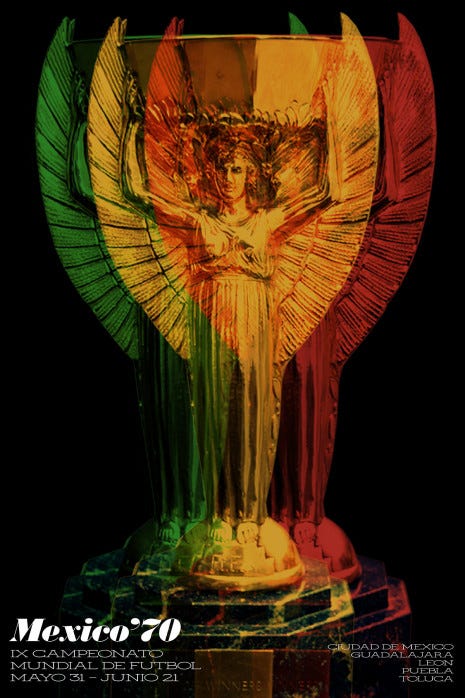
Mexico 1970, IX Campeonato Mundial de Futbol. The ninth men’s World Cup, the first broadcasted in colour.
The footage from Mexico 1970 is mesmerising. The pale, sun-bleached grass, the heat one can sense from the brightness of the pictures, the royal blue of Italy a cooling shade against the ground, the Brazilian yellow vivid, forming an association of colour with weight when worn by Pelé and Rivelino. Rivelino even rocked a proper ‘70s ‘stache! Pelé leaping over an English marker; Gordon Banks moving through air, birdlike almost, somehow getting enough palm and power to thwart the ball.
Then the final. I’ve watched that game in full, many times over. It’s an exhibition—no, a demonstration—of what it means to truly play football. Many consider it, rightly, the most artistic football ever produced. I think it was the most relaxed that sport ever got. Play the footage, open another tab with a street capoeira beat, and you’ll know what I mean.
And, of course, Carlos Alberto’s goal. The final goal of the tournament, possibly the greatest team goal ever scored, given context and beauty—a sequence of short, deliberate passes, a cheeky stepover, more unhurried passing, players moving around each other as if they were in a synchronised dance, Pelé’s pause, just for a breath, his right foot going over the ball and holding its arc, and, while walking, a casual pass rightwards, as Carlos Alberto roared in like a bullet train and took his shot without breaking stride.
Italy, at the time, had a reputation of being defensive gods— the two Milan clubs had won four of the last eight European Cups. And yet, Brazil made them chase ghosts for ninety minutes in the oppressive Mexico City noon.
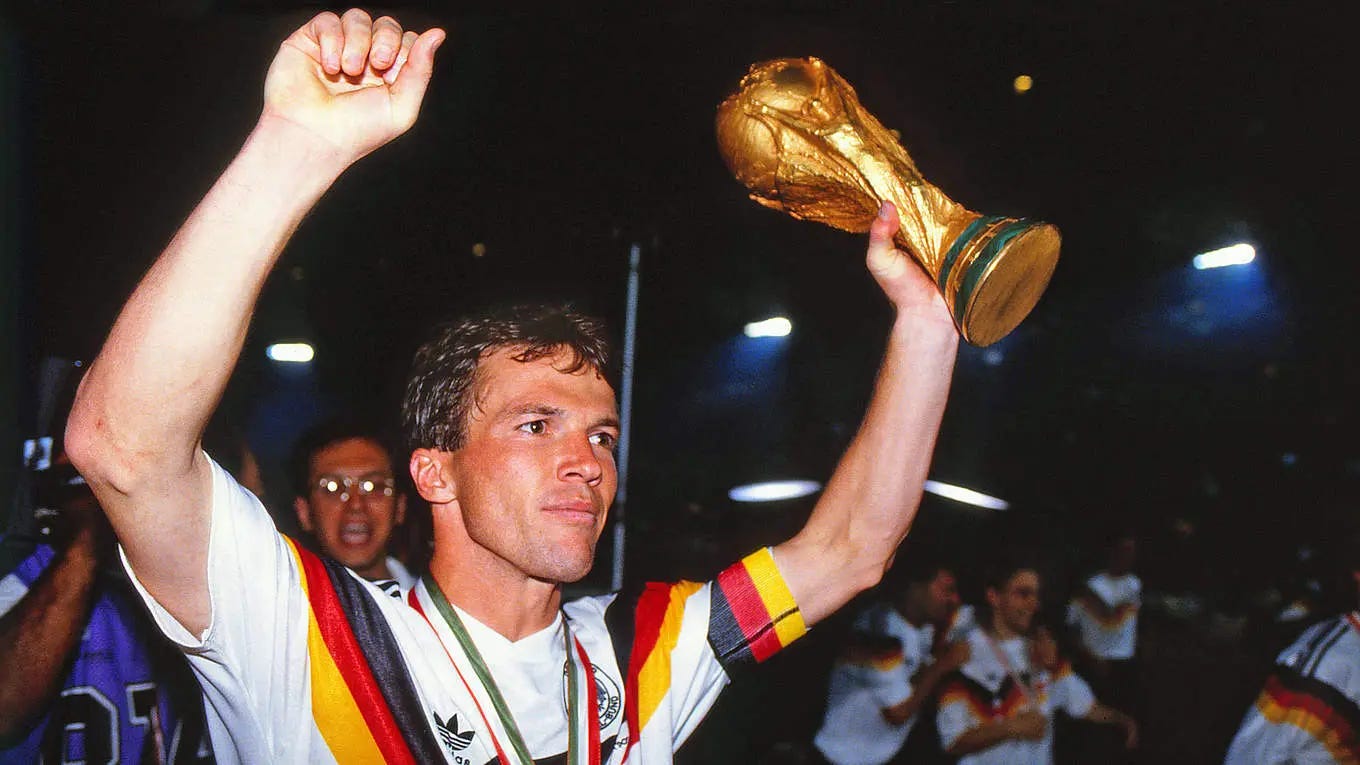
I was born in a World Cup year, about three months after Lothar Matthäus neutralised Diego Maradona in Milan, and West Germany—runners up at the previous two World Cups—finally got their gold. The first football tournament I properly watched was also a World Cup: France 1998. I remember that we had moved the television to the bedroom, because some matches would start at 9:30, and some after midnight. The World Cup, back then, was the most important and prestigious trophy in the sport. Club football was intense, deeply entrenched into local community and rivalry, but the World Cup was the big deal. Pele and Maradona’s legacies were cemented after their heroics in national colours; Ronaldo, and I, would have to endure heartbreak before catharsis four years later.
The World Cup announces itself some months before the actual tournament, as teams start qualifying and missing out. This time, Italy dominated the headlines after missing their third consecutive World Cup. Italy won the World Cup in 2006. Since that time, their men’s football team has won as many World Cup matches as their men’s cricket team: one. For me, who grew up on Maldini and Del Piero and Totti, there was an initial shock, but over the years, seeing how insular the Serie A has become, how distant it is to other major European Leagues, their absence isn’t a surprise anymore. Italian football has developed a knack for a nosedive.
It was good to see Norway qualify for the first time after ’98, when they beat Brazil in the group stages. I have faint memories of Tore Andre Flo bustling past the Brazil defenders for the equalising goal. My heart, though, was made up by Haiti and Curacao qualifying. This is a 48-team World Cup and three American countries co-hosting and qualifying by default meant more spots for the continent, but there’s something to be said about Haiti playing against Brazil, Curacao against Germany, that makes the tournament richer.
Aside from the qualification process, there is also the pre-gaming, which starts as the regular domestic season enters its final laps. Back in the day, ESPN would treat us to special documentaries on every World Cup in a chronological order. You didn’t want to miss Hungary in 1954 and Pele in ’58. By the lead-up weeks, you’d reach 1982 and Socrates—how Brazil messed that Italy game up, only they’d know. Maradona in ’86, Maradona in ’90. Baggio, good lord. These days, I use YouTube for that kind of footage.
And there’s, of course, the written word. Until 2018, Brian Glanville would publish an updated edition of The Story of the World Cup every four years. Somewhere back home, I have about five different editions. Glanville has since left us, and Simon Kuper and Jonathan Wilson have written wonderful books for this summer. Kuper and Wilson have decades of experience reporting and covering World Cups, and their new books are genuinely rich in detail, worthy of your desk or coffee table.
There’s also a new series, a three-parter on the history of World Cups, written by Jonathan O’Brien. Last month, I was very kindly given access to a review copy. An essay on World Cups, and the book, was published on Scroll today.
Some excerpts:
“The World Cup, by design, is simultaneously heavy and weightless. Weightless because name counts for nothing. You could be Cameroon, in just your second ever World Cup, facing defending champions Argentina, and you have an equal chance at victory. Heavy because its quadrennial cycle brings tension and anxiety. Four years is a generation in football; lives change in that time.
And the best way to experience a World Cup is to ditch the abstract and watch it through the 3D glasses of history and context, the past breathing under the surface, the stakes of the future. For example, apply just one layer of context to Cameroon’s victory against Argentina in 1990: Argentina were led by the world’s greatest player of the time, or perhaps ever, Diego Maradona; the World Cup was happening in Italy, where Maradona played his club football; and Cameroon, African champions but a motley crew to the global eye, beat them 1-0 on the opening day.”
Maradona’s Argentina would recover and reach the final, where they’d face the same opponents they’d beaten four years prior: West Germany. The man asked to mark Maradona in Mexico City was now West Germany’s captain, and perhaps the best midfielder in the world. By the end of the night, he’d lift the World Cup—the last for a team called West Germany.
Then, there’s the story of another number 10.
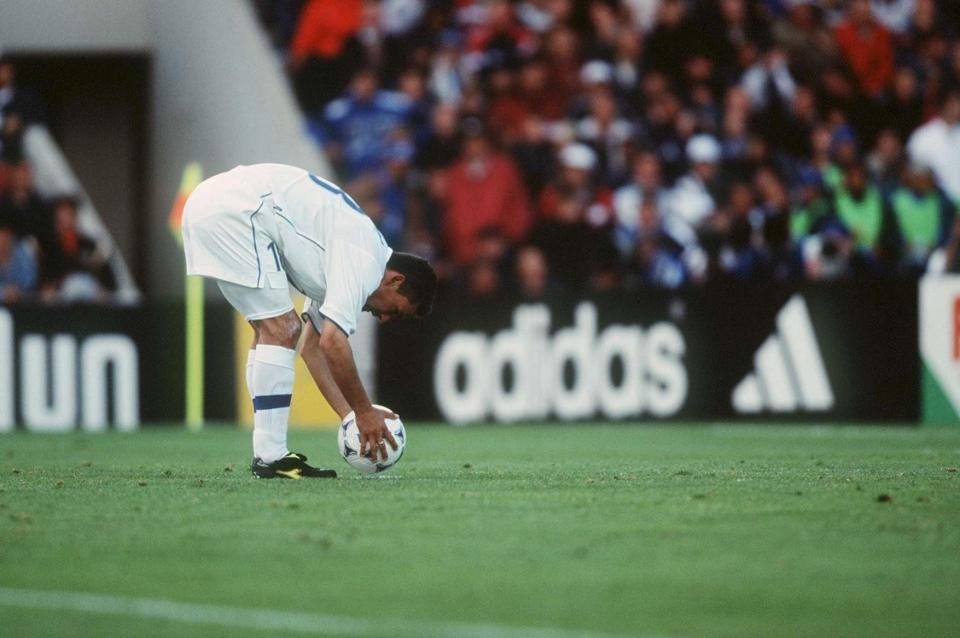
“It is day two of the 1998 World Cup, and Italy are losing to Chile. The Bordeaux sky is faint white, awaiting dusk. With seven minutes left in the game, the referee points to the penalty spot and gives Italy a lifeline. Baggio, 31 years old, wearing number 18, places the ball on the penalty spot and takes four steps back. Both sections of the crowd are on their feet, hooting at him. Behind his restrained face lies a raging storm.
The significance of this penalty has nothing to do with the score. Neither does it have much to do with Roberto Baggio potentially becoming the first Italian to score in three World Cups. All its weight comes from another penalty, four years prior.
Baggio then wore jersey number 10, the number reserved for artists and maestros. He was the best player in the world. He stood above the penalty spot in Pasadena, California, with the 1994 World Cup on the line. And then he hit his penalty over the bar, into the crowd behind the goal, sealing the fate of the game and his life. Many in Italy still consider Baggio one of the greatest to have ever worn their blue, but the defining image of his career was that ball sailing into the Californian sky. He would later say it was the one episode he would erase if he had a magic wand.
So when, four years on, in Italy’s first World Cup match since that wretched afternoon, the referee blew for a penalty, everyone looked at Baggio. Did he have the heart to go again?
He scored; Italy salvaged a draw.”
There’s much more in the essay—on Brazil’s heartbreak, Pele’s arrival, Maradona vs England, a World Cup in Qatar, and Donald Trump.
The 2026 Men’s World Cup starts in four days. The book is genuinely excellent. Pick it up!