

Another year, another album to look back on fondly. In 2025, sport slipped further into the soulless Netflix-show mould, but somehow, it found ways to move us all the same. Gut punches, tear-jerkers, edge-of-the-seat thrillers. We got a generous serving of the real thing. If one event killed your appetite, another restored it.
The Men’s Ashes has popped and fizzed and sparked, but in such small bursts that it has barely felt like Test cricket. If anything, it should’ve been a gripping year-ender, two imperfect teams running at each other for five Tests. It has instead felt like a series sponsored by TikTok (joke credits: not me).
But most of the year was great, filled with moments worth recalling and celebrating.
We should start where we’re ending: Australia. The men’s team lost the Test series 3-1. An ageing side losing in cricket’s most unforgiving place shouldn’t surprise anyone. But India looked confused, inept, perpetually half a gear behind. That’s not cool. They kept selecting the wrong people for the wrong battles. The seniors finally looked their age. Barring one Jasprit Bumrah, the score would’ve been 5-0.
Tours like this usually cost people their jobs; this one ended three careers.
Ravi Ashwin retired in the middle of a Test match. Rohit Sharma then, one week after he was speaking excitedly on a podcast about the summer tour to England. And Kohli, soon after, announcing his departure on Instagram with Frank Sinatra’s “My Way” as soundtrack—the choice of music saying everything the caption left unsaid.
Perhaps all three were on their last laps anyway. Perhaps a couple of them knew they couldn’t get back to the levels proud cricketers set as a baseline. But together with Cheteshwar Pujara’s departure, this exodus marked the definitive end of a dominant Indian Test side. Ashwin and Pujara were its spine; Kohli, its blade.
We’ll move on with time, but replacing them is another matter altogether.

Running in parallel, with substantially fewer cameras, was the Australian Open Women’s Singles final. 19th-seed, 30-year-old Madison Keys vs top-seed Aryna Sabalenka, who had won the previous Grand Slam and the last two Australian Opens. Keys beat Sabalenka in a thrilling three-setter. For perspective, imagine Sri Lanka beating Australia in a cricket World Cup final.
The next day, Jannik Sinner turned Alexander Zverev to jelly.
Coldplay played three nights in Mumbai and Ahmedabad, drawing dense crowds from across India. Those guys really know how to put on a show. Many went, many couldn’t, and we got to hear the sound of jealousy at nation-wide scale. Days later, India’s 21st century Beatle turned up for a domestic match at his home ground. No one watches domestic cricket in India. That day, people queued up from half past four in the morning. Only for him. It was endearing and revealing of the unique mechanics of fan loyalty.
The IPL arrived as it annually does—loud, bright, an assault on the senses, bearable mainly through jokes about Royal Challengers Bengaluru. But RCB felt different this time. Every match produced a new hero. For once, this wasn’t merely the Virat Kohli Cricket Club. Something had clicked.
Then the IPL stopped.
One afternoon, four gunmen walked into Kashmir’s Baisaran Valley and killed twenty-six tourists, filtering them first by religion. Twenty-six people who had come to feel the sun, hold someone’s hand, share a joke with a friend. Dead. India sent fighter jets across the border; the neighbours sent theirs. On television, news anchors—even the measured ones—frothed. Friends on Instagram called for final solutions to the “traitors at home.”
Cricket couldn’t possibly go on. Not with players hearing about blackouts and air raids. When the IPL resumed two weeks later, something had drained from it. The games went on because they had to, but it wasn’t with the same fizz. RCB held on anyway, and delivered. I watched the final at a pub in Central Bangalore and saw a cathartic explosion of joy.
By the next evening, joy had curdled into tragedy. Hundreds of thousands crammed into a one-mile radius without logistical, medical, or police support. Officials, politicians, the franchise—everyone had been warned. But they wanted their moment in the sun. Eleven people died as the Chief Minister and his deputy hoisted the golden trophy inside Chinnaswamy Stadium and “We Are The Champions” played through the loudspeakers.
This wasn’t just a story of an overeager franchise or politicians blinded by vanity, but another chapter in how Indian administrators, across every domain, treat crowds as cattle. In 2025 alone, eight confirmed stampedes claimed 127 lives across the country. That is when you consider the grossly conservative estimates on the Maha Kumbh death toll.
In Paris, the French Open opened with the name that usually closes it: Rafael Nadal. The French Tennis Federation unveiled a permanent plaque on Court Philippe Chatrier bearing his footprints. It was a bit sobering to see Nadal in a black suit instead of a pop-coloured vest, a bandana, and shorts that reveal every muscle in his quadricep. Alongside him stood Roger Federer, Novak Djokovic, and Andy Murray. Not long back, that was a semi-final lineup.
The final act belonged to the new kingdom. Carlos Alcaraz and Jannik Sinner played six hours of spellbinding, jawdropping tennis. At one point Sinner stood five minutes away from the title. Alcaraz then clawed it back, point by rigorous point. Every time you felt like the players possibly couldn’t have more left in the tank, they came back with a new burst of energy. It was a boxing match where both boxers went for every punch they saw. No defensive shuffling or wearing the other one out.
The level of tennis, for stakes this high, bordered on the surreal. At the end of the game, you couldn’t separate the both, not even for the number of points won. Sinner 191-192 Alcaraz.
Nadal offered the epitaph the game deserved: “One for the ages.”

Paris had more to celebrate. Paris Saint-Germain—a football club rebuilt as an advertisement hoarding for Qatari royalty—finally put together a side worth staying up for. They played a mesmeric, collaborative style of football and won the Champions League. Have you ever barfed while clapping?
The next few days and weeks were difficult for those of us who yearn for sport to maintain a semblance of purity. It’s never been more over.
South Africa finally climbed a cricketing Everest, after three decades of slipping from the precipice. Sweeter still, they beat the team that have a permanent base camp at the top. It was a day for the cricket fan, a surge of emotions even the tough-nosed Australians must’ve found hard to begrudge.
Then India and England played a Test series that will soon acquire mythical status. It will get its own shorthand—like “Ashes ‘05”—and produce books and documentaries. People will recite random bits from memory like dialogues from a movie. It was that good. Five Tests, each stretching deep into the final day, accumulating into something that will feel, years from now, like a slow-burn novel.

Sinner absorbed his Roland Garros disappointment and beat Alcaraz at Wimbledon. This was Sinner distilled: physicality fused with efficiency. He’d tell you he played brilliantly in Paris, and he did, but Wimbledon was his purest performance. Zero blemishes. That’s what makes this rivalry what it is. Both are elevating singles tennis to an athletic point rarely ever seen, in their own styles, without compromising on quality.
Back in India, we bid to host the 2036 Olympics while our premier football league lies indefinitely paused. Thankfully, the International Olympics Committee asked Indian sporting administration to clean and renovate their own house first. I have it on good authority that our pitch was something on the lines of: “We have UNESCO number 1 Prime Minister, UNICEF number 1 business tycoon, and an economy that grows with the same pace as Instagram reels on the latest trending song. Please say yes kthx.”
In the words of a great modern philosopher, “Kahaan milega itna content?”
Between all this, cricket descended into a street brawl. One team won and refused to acknowledge their opponents. The opponents responded with fighter-jet gestures. After the final, the chief administrator fled with the trophy because the winners wouldn’t accept it from his hands. The hypocrisy of building entire tournaments around this “rivalry,” and then indulging such churlish and performative gestures, was not lost on many.

Something was breached that evening in Dubai. Check out this video of a 15-year-old prodigy, certain to represent India within 18 months, showing precisely what he thinks of an opposing player. We’ll be seeing a lot more of this, because the most popular athletes in the land have now legitimised behaving like primary school kids.
In New York, the US Open final was delayed nearly an hour because a Nobel Peace Prize nominee could watch courtside. He was summarily booed, but the broadcasters were instructed not to air that footage. Then Alcaraz dismantled Sinner. Each finished the year with two Grand Slam titles. It’s scary to think where they’ve taken tennis before reaching the age of 25. What a decade we have in front of us.
And then, the Women’s ODI World Cup. Where do I even begin?
From the fog of doubt, from the wreckage of heartbreaking losses to England and South Africa, the Indian women’s team built themselves a monument. Brick by brick. They faced a world record chase and nailed it without panic. They batted first in a delayed final and smashed into South Africa. This team, man.
I can say it now: I had tickets to the final. Three days before my flight to Mumbai, a friend I was going to the final with caught Covid. Am I sad I missed it? Of course. Is my friend alive? That’s another question. Even if he is, he won’t be for long.
That said, I thoroughly enjoyed the game either way. I wanted to, just once, call this team the centre of Indian cricket. I got to write about them, and title a piece “World Champions.” It doesn’t get better. I’m still buzzing from that month and the final week, and I guess the giddiness will carry me well into the next year too.

Speaking of which, 2026 should be another great year of sport. Yes, we will get more examples of greed and morally dishonest administration, more athletes exhibiting the damaging effects of fame, but somewhere in the middle, there will be pockets when the good ones will make every late night worth the red eyes.
In the first two-thirds of the year alone, we’ll have the Commonwealth Games, two cricket World Cups, and a football World Cup. The men defend their T20 title at home; the women travel to England, hoping to add a T20 crown to the 50-over one; and forty-eight football teams will congregate in North America for the largest non-Olympic sporting event on the planet.
Sinner and Alcaraz will resume their rivalry. Hopefully with some stiff competition. Maybe Zverev, or Casper Ruud, or maybe Holger Rune. Who knows? Meanwhile, Djokovic will keep forcing players a generation younger to earn every point. We will talk about his retirement again, and he will make us all look very silly.
Aryna Sabalenka will win two Grand Slams, minimum. And watch out for Coco Gauff.
If you couldn’t tell, I’m excited. Mostly for the FIFA World Cup. Unlike cricket, FIFA have managed to keep its biggest tournament in a quadrennial cycle. That’s how it should be. The tension of a rare chance is very much part of the charm. It’s what makes Morocco defend with every sinew as Spain send wave after wave of attack. Make it more frequent, and both Spain and Morocco know another chance with the same team is just around the corner.
The Times of India kindly commissioned a short essay from me. We workshopped a couple of possible angles and settled on, “vibes.” You can find it here.
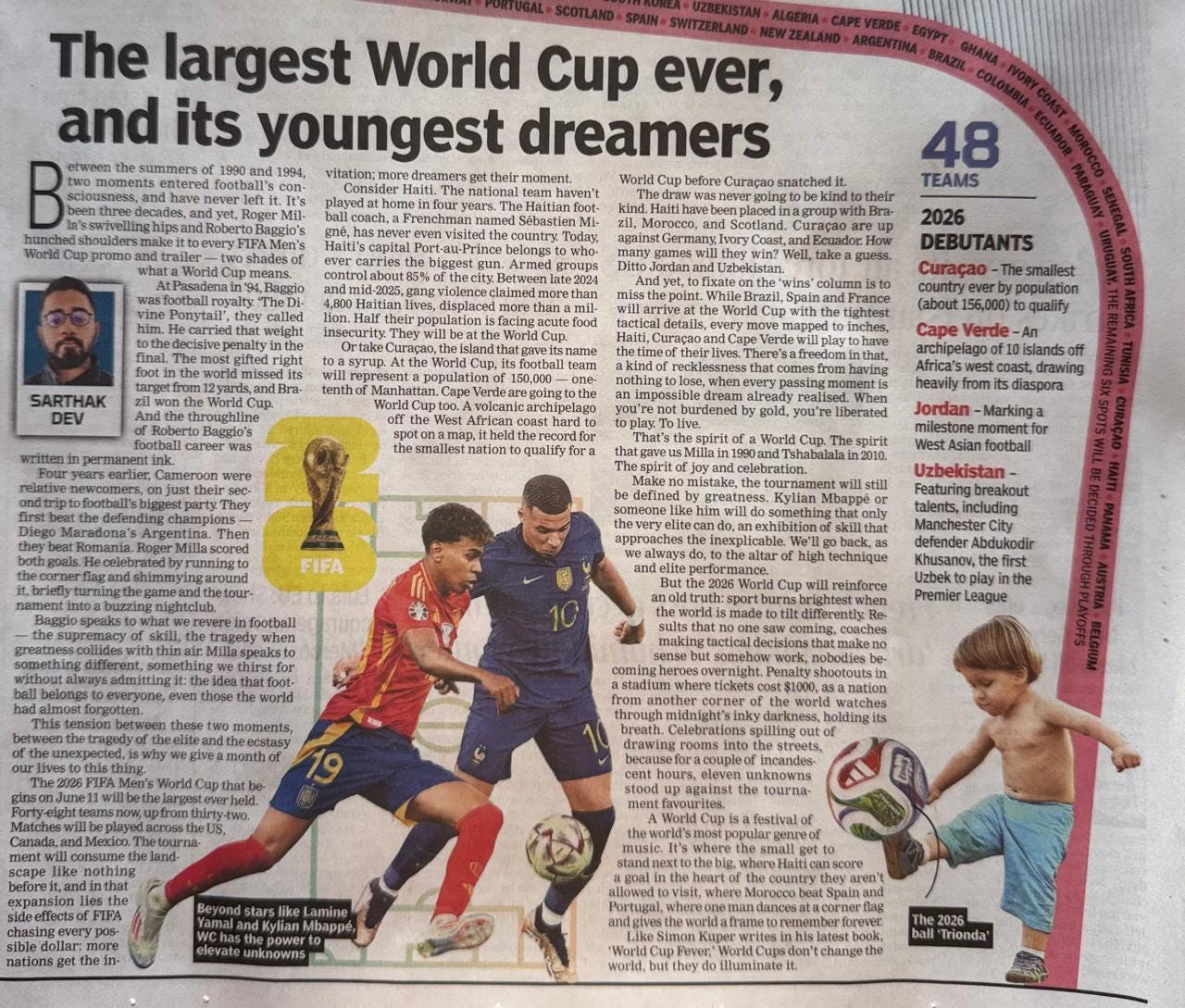
If you catch the print version, you’ll notice that my essay was placed next to Dubai Chocolates and sober cocktails. I hope my 2026 is filled with one of them. And yours too. Kunafa never fails. Make it kunafa with a dollop of biscoff ice-cream, and you have a 10/10 dessert.
I hope you had a cracking 2025, and 2026 is even better. Wishing you love, light, and music. See you in a fortnight’s time.
Bro this is brilliant
Thank you for the summary Sarthak. Loved it.
BTW, very sorry to hear about your friend. I hope he gets fit and fine soon. 🙏🏽